HEINER
Heiner is a surname of German origin. It is a patronymic derivative of the personal name Heinrich, which translates to “ruler of the home” or “home ruler.” The name is formed from two Old High German elements: hagan, meaning enclosure or homestead, and rihhi, meaning ruler. Consequently, individuals bearing the surname were historically associated with authority or leadership within their households or local communities.
Historical records show that the name, in a variety of spellings, has been documented across Europe for over eight centuries. In the 13th century the earliest known English record is that of Thomas Henery of Kent in 1275, during the reign of King Edward the First. Later medieval charters record John Fitz Henrie of London in 1346, Genetiv de Heinrich of Fritzlar, Germany, in 1335, and John Hendrie of Cornwall, England, in 1359. These documents illustrate the surname’s early use as a marker of lineage and its spread within German‑speaking regions and beyond.
Variation in spelling is extensive, reflecting regional pronunciation and orthographic practices. In German dialects the name appears as Hainer, Hoener, and Heintze, while in English‑speaking areas it has been rendered as Hendrick, Hendrik, Hendrickson, and Henric. French‑Provencal forms include Aimeric and Enric; Celtic variants such as Hendry and Henryson appear in Scotland; and Slavic derivatives like Jinda and Jindrick are found in Czech and other Slavic regions. The surname has also been anglicised in Ireland, most likely from the Gaelic O'Inneirghe, meaning “the descendant of the abandoned one.”
In addition to its Germanic roots, some instances of the surname may stem from Jewish communities, where it is thought to derive from the Hebrew name Chayim meaning life, with variants such as Hyman and Haim. The surname is therefore a pluralistic marker of cultural identity, and its bearers can be found in Germany, the United States, Canada, and other countries hosting sizeable German‑descendant populations.
Overall, the surname Heiner encapsulates a linguistic heritage rooted in rulership and domestic leadership, is evidenced by a substantial corpus of historical records, and has undergone numerous orthographic changes that reflect the diverse linguistic landscapes in which it has been used. Its continued use across continents underscores its enduring legacy within the German diaspora and beyond.
Similar and related surnames
Related and similar names are generated algorithmically based on the spelling, and may not necessarily share an etymology.
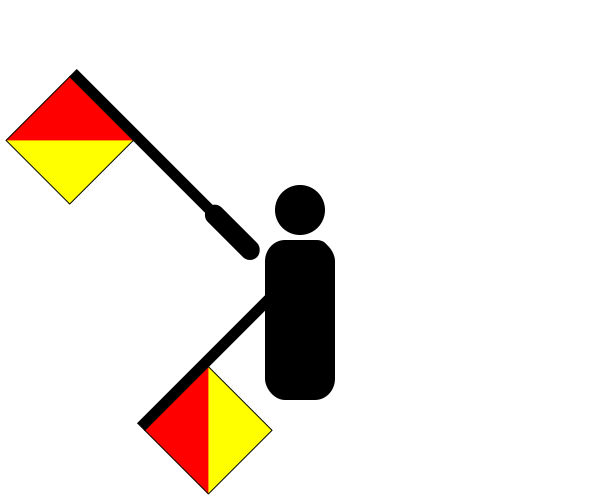
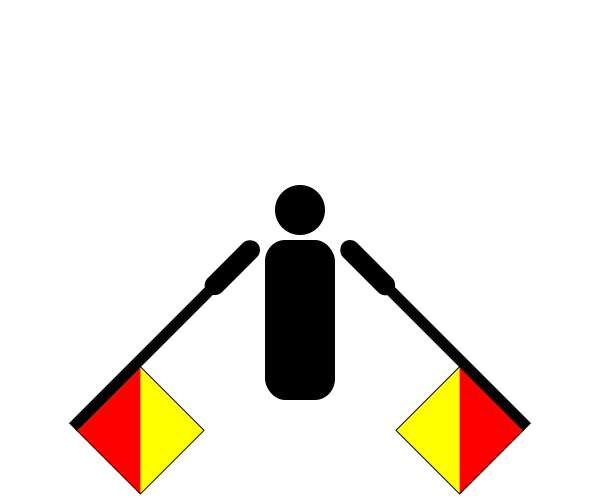
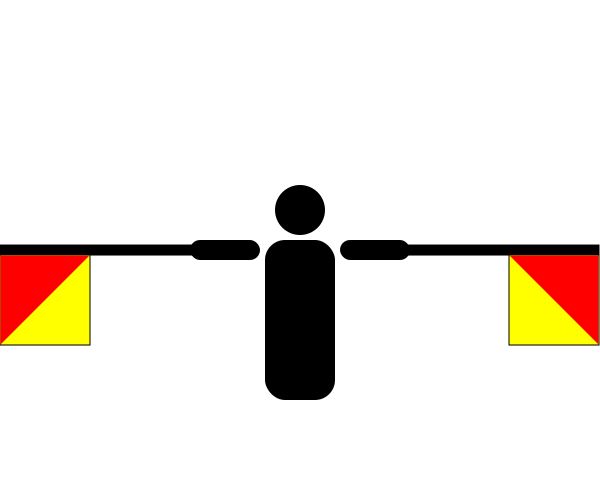
How to communicate the surname Heiner in...
Braille
⠓⠑⠊⠝⠑⠗
Morse
.......-...-.
Semaphore


Sorry, we don't have any statistics on this name. That's probably because it's very uncommon in Britain.
