HECK
Heck is a surname of Germanic origin that gained a presence in the British Isles during the Middle Ages. Its earliest attestations in England appear in the early fifteenth‑century Early Yorkshire Charters, where it is recorded as Hecca in 1157.
In the linguistic record, the name is most commonly linked to the Middle High German word hecke, meaning a hedge or fence. Consequently, it functions as a topographic surname for an individual who lived near such a feature, or as a habitational designation for someone from a place called Heck in Germany or, less commonly, from the place named Heck in Yorkshire, near Selby, or from Heckmondwike in the former West Riding of Yorkshire.
Other etymological interpretations regard Heck as deriving from the Old High German word hacco, meaning a hatchet or axe. In this sense the surname could denote an occupational identity, perhaps that of a woodcutter or someone skilled with an axe. A further possibility is a reference to the German word heck, meaning stubborn or obstinate, although this interpretation is not supported by documentary evidence in the English context.
The first recorded English spelling of the surname appears in the tax rolls known as the Feet of Fines in 1216, where it is simply written as Heck. A later reference is found in the Assize Court Rolls of Yorkshire in 1219 under the name of John del Hek, taken during the reign of King Henry of the first duke of England, 1216 to 1272.
Throughout the thirteenth and fourteenth centuries the name appears in a variety of forms, including Hecks, Heak, Heake, Heaker, Heeker, and Heakins. The name also shows a tendency for spelling variation when recorded in parish registers: for example, the marriage of Marie Heck and Edward Barkham at Tottenham on 18 January 1635, and the marriage of Martha Heake, daughter of Moses Heake, at St Giles‑Cripplegate in London on 2 September 1670.
In the nineteenth and early twentieth centuries, the surname migrated across the Atlantic, often through clerical immigration from German states. In the United States, Heck remains a common surname, particularly in former settlement areas of German immigrants such as the Midwest. It also appears in France, the Netherlands and Canada, reflecting wider patterns of Germanic migration.
Locally, in England the surname remains concentrated in the former West Riding of Yorkshire, particularly near the towns of Selby and Heckmondwike. The dispersal of families bearing the name during periods of urban migration and job‑seeking contributed to a wider geographic spread throughout the British Isles, as evidenced by the early medieval record of John de Hecke in the Book of Fees of Yorkshire in 1242.
Distinct variations of the surname, such as Hecke, Hecka, Hekk and Hecker, often developed into independent lineages and should not be assumed as direct descendants of a single family line. Furthermore, surnames that resemble Heck in spelling, for example Heckler or Heckman, typically have separate etymologies or have arisen in different regions.
In sum, the surname Heck demonstrates the complex interplay of linguistic shifts, geographic migration and occupational identifiers. Its documentary record, spanning from the thirteenth‑century English charters to contemporary global distribution, provides a tangible link between medieval Germanic roots and modern surname usage.
Typical given names associated with the Heck surname
Male
- Bruce
Female
Similar and related surnames
Related and similar names are generated algorithmically based on the spelling, and may not necessarily share an etymology.
How to communicate the surname Heck in...
Braille
⠓⠑⠉⠅
Morse
.....-.-.-.-
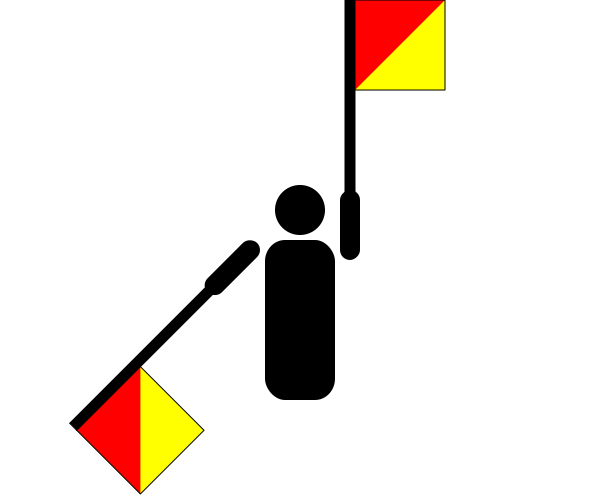
Semaphore


There are approximately 79 people named Heck in the UK. That makes it one of Britain's least common surnames. Only around one in a million people in Britain are named Heck.
Origin: English
Region of origin: British Isles
Country of origin: England
Religion of origin: Christian
Language of origin: English
