HEBRON
Hebron is a family name with a dual heritage, derived from a Hebrew word meaning “association” or “alliance” and from an Anglo‑Saxon locational surname based on places named Herbron and Heburn in Northumberland. The name is therefore connected both to the ancient biblical city of Hebron in the West Bank and to specific geographical features in northern England and Scotland.
In Hebrew, the element *haver* means “friend”, and the placename Hebron itself is traditionally interpreted as “association”, “alliance” or “union”. The town of Hebron is mentioned in biblical sources as the settlement of the tribe of Judah and has been a fixed landmark for at least three millennia. Those bearing the surname often trace ancestral links either to the city itself or to the region that surrounds it.
The Anglo‑Saxon toponymic form originated from a settlement called “Herbron” in Northumberland. In medieval records the name appears as Heburn in the Fees Court Rolls of 1242 and as Heborin in 1262. The meaning of the place name is “the high mound”: the Old English prefix leah, combined with *hish* and the suffix byrgen, denotes a mound or tumulus, in this case a hill of 424 feet. The first recorded use of the family name in England is the christening of John Hebron in Ripon, Yorkshire on 11 July 1604 during the reign of King James I of England and VI of Scotland.
Records from Scotland first mention the surname in 1376, when William de Hebron acted as a witness in a legal document. Historically, the name appears most frequently in Yorkshire and Northumberland, spreading to Scotland from the early seventeenth century. Two modern variants of the surname are Hebron and Hebbron.
The distribution of Hebron is broad. In Great Britain it is most common in England and Scotland, with a notable concentration in Ireland where it is the sixteenth most frequent surname. Outside the United Kingdom, the name is widely represented in the United States and Canada, especially in the Midwest, the South and western states, and in Canadian provinces such as Ontario and Alberta. Smaller numbers are found in continental Europe – Germany, France, the Netherlands, Spain and other nations – and in Australia, where the surname is relatively rare.
Numerous variant spellings exist, reflecting phonetic shifts and regional dialects. These include Hebarron, Heveron, Hebban, Hebburn, Heburn, Hepburn, Hebren and others, some of which have developed into distinct surnames in their own right.
Prominent individuals who have carried the name include the American Civil War Brigadier General Winfield Scott Hebron, the British conductor and pianist Robert Hebron, and the composer and harpist Morris Hebron. These figures illustrate the surname’s presence in military, cultural and artistic spheres across several centuries.
Typical given names associated with the Hebron surname
Male
- Andrew
- David
- Howard
- James
- John
- Mark
- Michael
- Niall
- Nigel
- Paul
- Peter
- Robert
- Stephen
Female
- Annette
- Caroline
- Christine
- Daphne
- Emma
- Jean
- Kerry
- Louise
- Margaret
- Mary
- Natalie
- Rebecca
- Sallie
- Sarah
- Susan
Similar and related surnames
Related and similar names are generated algorithmically based on the spelling, and may not necessarily share an etymology.
How to communicate the surname Hebron in...
Braille
⠓⠑⠃⠗⠕⠝
Morse
.....-....-.----.
Semaphore


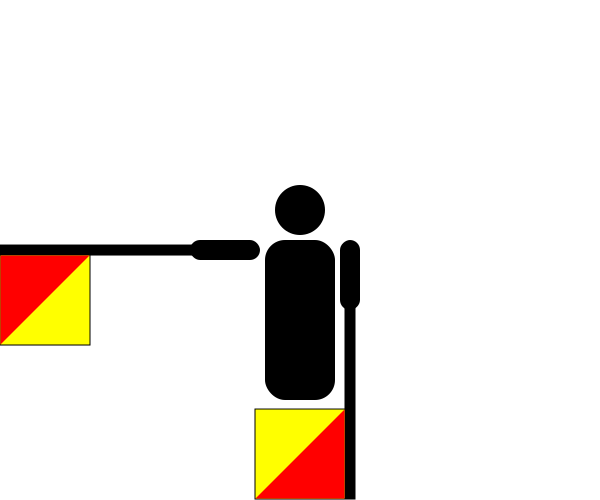
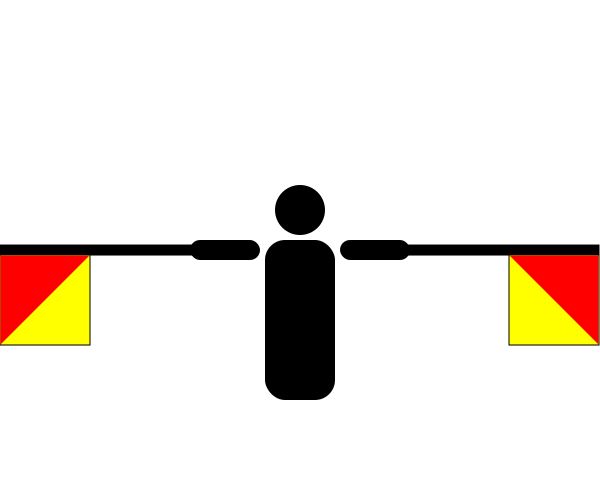
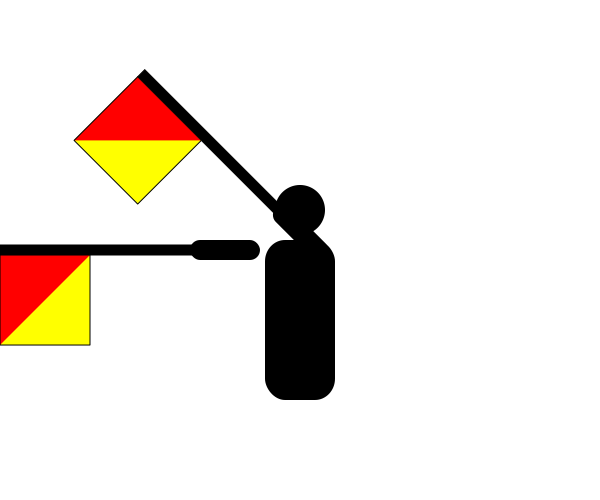
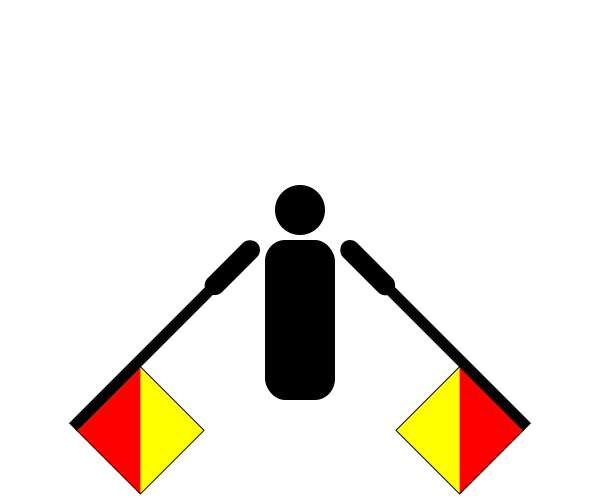
There are approximately 406 people named Hebron in the UK. That makes it one of Britain's least common surnames. Only around six in a million people in Britain are named Hebron.
Surname type: Location or geographical feature
Origin: English
Region of origin: British Isles
Country of origin: England
Religion of origin: Christian
Language of origin: English