HAYER
The surname Hayer possesses a history that is both diverse and deeply rooted in European linguistic traditions. It is widely recognised as being of English origin, yet it is also recorded in various continental forms, including Norman‑French, Germanic and Punjabi Sikh contexts. Each of these strands contributes to a rich tapestry of meaning and usage, which is explored in the following discussion.
In the earliest English references, the name derives from the Old English word hæg or hege, meaning a hedge or enclosure. The toponymic interpretation suggests that an original bearer of the name resided in proximity to a hedge or an enclosed field, while an occupational reading proposes that the name was borne by a hedger or a fence builder. These early applications are attested in medieval documents, such as the 1208 Feet of Fines of Essex, where the form Ralph le Eir is recorded, pointing to a possible evolution of the surname through the Middle English period.
A separate line of derivation connects the name to the Middle English eir and the Old French heir, which in turn is derived from the Latin heres and denotes a successor to a title or fortune. Early medieval records provide a series of examples, including Robertus Heres of Cambridgeshire in 1220, Richard le Heyer of Gloucestershire in 1274, and Adam le Hayre of Yorkshire in 1275. These occurrences illustrate the surname’s spread across southern and eastern England, and the subsequent Anglicisation into forms such as Hayer, Heyer and Hoyer.
Another occupational hypothesis, documented in contemporary scholarship, proposes that Hayer originates from the Middle English term heier, meaning a cutter of hay or a person who worked with hay. In agrarian societies, hay was essential for feeding livestock, and the role of a hay‑cutter was vital. This theory suggests that bearers of the name may have been identified by their profession rather than by their residence, thereby passing the surname along through hereditary occupation.
There is also a Germanic perspective that views Hayer as a derivative of the occupation heuer (or hauer), signifying a mower or reaper. This interpretation aligns the surname with the broader Germanic pattern of occupational names and indicates independent development within central and eastern Europe. The extended spelling variants found across German‑speaking regions, such as Heyer, Haier and Hoare, further demonstrate the surname’s linguistic diversity.
In addition to its European roots, Hayer is also identified as a Punjabi Sikh surname. In this context, it appears among communities in India, particularly within the Punjab region. The inclusion of the name in Sikh genealogical records is noted in contemporary Indian sources; however, the precise meaning of the surname in Punjabi is not comprehensively documented. Nevertheless, its presence among Sikh families underscores the name’s global diaspora.
The catalogue of spelling variants associated with Hayer is extensive. Common forms include Haye, Hay, Hayes, Hays, Hey, Heys, Heas, Heyes and Heyse, as well as German‑language variants such as Höer and Hoyer. These variations are largely attributed to regional dialects and the phonetic spelling practices of early record‑keepers, who often transcribed names as they heard them. Consequently, a single local tradition could produce dozens of distinct orthographic forms.
Throughout its history, the surname Hayer has migrated beyond its original English strongholds. Modern demographic data identify significant concentrations in the United Kingdom, the United States, Canada, Germany and India. The widespread distribution of the name is largely a result of migration and the settlement of families in areas with established Commonwealth, industrial and agricultural opportunities. As a result, the name remains a truly international surname, carrying with it a heritage that bridges toponymy, occupation and lineage across multiple cultures.
Typical given names associated with the Hayer surname
Male
- Gian
- Inderjit
- Jaswinder
- Jatinder
- Mohinder
- Parminder
- Rajinder
- Ranjit
- Ravinder
- Sandeep
- Satnam
- Sukhvinder
- Surinder
- Surjit
Female
- Amandeep
- Baljinder
- Daljit
- Gurpreet
- Harpreet
- Jasvinder
- Jaswinder
- Kamaljit
- Kirandip
- Mandeep
- Mohinder
- Narinder
- Sukhpal
- Surinder
Similar and related surnames
Related and similar names are generated algorithmically based on the spelling, and may not necessarily share an etymology.
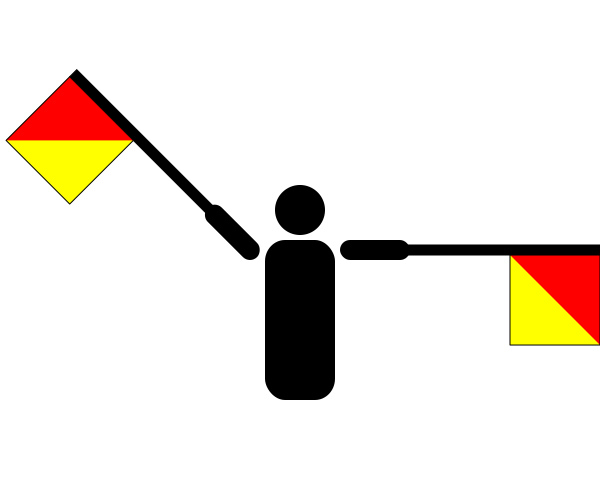
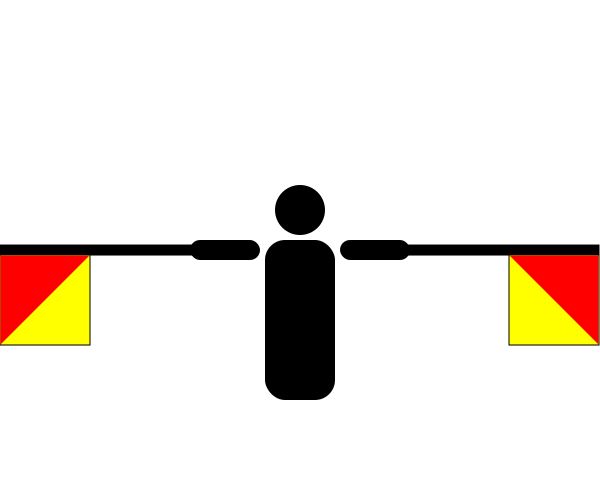
How to communicate the surname Hayer in...
Braille
⠓⠁⠽⠑⠗
Morse
.....--.--..-.
Semaphore



There are approximately 1,082 people named Hayer in the UK. That makes it roughly the 6,942nd most common surname in Britain. Around 17 in a million people in Britain are named Hayer.
Region of origin: Asia
Country of origin: India
Religion of origin: Sikh
Language of origin: Punjabi
