HAWKING
Hawking is a surname of English origin, deriving from the Old English word hafoc which means “hawk.” The name entered the English lexicon during the Middle Ages as a nickname or an occupational surname for someone who worked with hawks or displayed qualities associated with the bird of prey.
The Middle English forms of the word—hauk and hawke—confer the meaning of “hawk” and indicate that the surname may have originally identified a falconer or a person whose behaviour or temperament was perceived as hawk-like. Falconry was an elite pursuit, restricted to nobility or wealthy gentry, which required the ownership of a trained falcon and the commitment of considerable resources. Consequently, the name Hawking was historically associated with status, technical skill, and affluence.
The earliest recorded appearance of a name derived from hafoc occurs in the Domesday Book of 1086, where a person named Havok is listed. In later medieval records, the surname appears in several forms: in 1176 Roger Havech is noted in the Pipe Rolls of Dover; in 1298 Roger Havekin is recorded in the Essex Rolls; and in 1327 Margery Haukyns appears in the Subsidy Pipe Rolls of Worcestershire during the reign of King Edward III. By the fourteenth and fifteenth centuries a range of variations—such as Hawkin, Hawkyns, and Hawkyns—had become established.
Variants of the surname are extensive. They include Hawkin, Hawkyns, Hawkings, Hawkings, Hawkyen, Hawkens, Hawken, Hawken, Hawkinson, Hawkins, Hawkinso, Hawkinson, Hoakin, Howkin, Howkins, Howkison, and Hokin, among others. The form Hawkings is a double diminutive that can be interpreted as “the sons of the kin of the hawk.” Preference for particular spellings often varied by region and by era, with the spelling Hawkins becoming especially common in England and later adopted widely in the United States.
Within the United Kingdom the surname is most concentrated in the south‑west. Historically, Devon is noted as the county with the greatest density of individuals bearing the name, with evidence of families tracing their roots back to the seventeenth century. Other notable concentrations can be found in Dorset, Devon, Herefordshire, Gloucestershire, and Wiltshire. Significant populations also reside in London and the Midlands, where historical migration and urbanisation brought many bearers of the name to larger cities.
The surname has been brought to other parts of the world primarily through emigration from England. In the United States, the name is most prevalent in California, Pennsylvania, Texas, Virginia, North Carolina, and Florida. The earliest documented American arrival bearing the name is recorded in 1635 when John Hawking migrated from London to Virginia. In Canada, the name is particularly common in Ontario, Manitoba, and Alberta. Presence is also noted in Australia, New Zealand, and Ireland, illustrating an international dispersion that reflects broader patterns of British colonial settlement.
Statistical records confirm the relative rarity of the surname compared with more common English names. The 1881 census of England and Wales recorded approximately 2,300 individuals with the surname Hawking, whereas the 1981 census reported 25,681 individuals with the surname Hawkins, indicating a significant increase in the latter over the twentieth century. The persistent, though modest, number of Hawking bearers illustrates continued use of the name within the English-speaking world.
In contemporary times, the surname is most widely recognised because of the life and work of Sir Stephen Hawking, the theoretical physicist and cosmologist. Born in 1942, he conducted pioneering research on black holes and authored several popular science books, including A Brief History of Time. His diagnosis of a motor neuron disease in his early twenties did not deter him from producing influential scientific work and achieving global renown. His accolades include the Presidential Medal of Freedom, awarded in 2009, which recognises his extraordinary contributions to science and humanity.
While no modern individual known by the surname has the same level of public prominence, the name remains a marker of historical significance. It encapsulates a lineage that stretches back to medieval England, reflects the specialised craft of falconry, and today connects to the legacy of one of the most celebrated scientific minds of the twentieth and twenty‑first centuries. The surname therefore retains its cultural and historical importance across both Britain and the wider world.
Typical given names associated with the Hawking surname
Male
- David
- John
- Leon
- Mark
- Peter
- Richard
- Robert
- Roger
- Stephen
- Steven
- Thomas
- Timothy
- William
Female
- Alison
- Amy
- Beryl
- Catherine
- Dawn
- Jacqueline
- Julia
- Mary
- Sara
- Sarah
- Sonia
- Susan
- Wendy
Similar and related surnames
Related and similar names are generated algorithmically based on the spelling, and may not necessarily share an etymology.
How to communicate the surname Hawking in...
Braille
⠓⠁⠺⠅⠊⠝⠛
Morse
.....-.---.-..-.--.
Semaphore


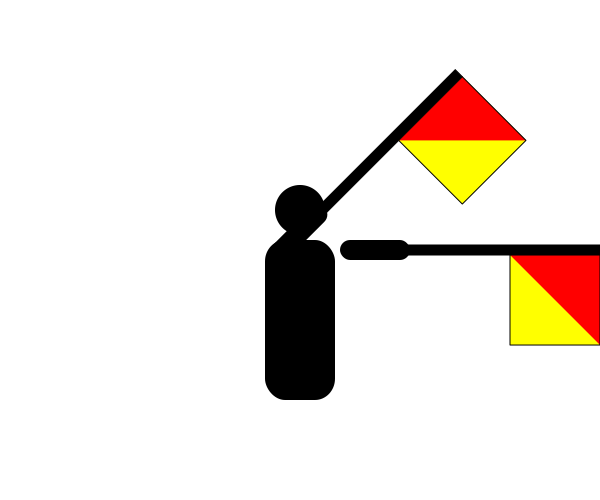
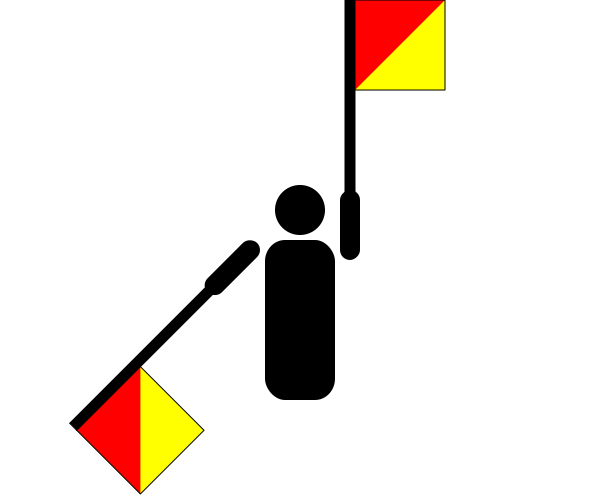
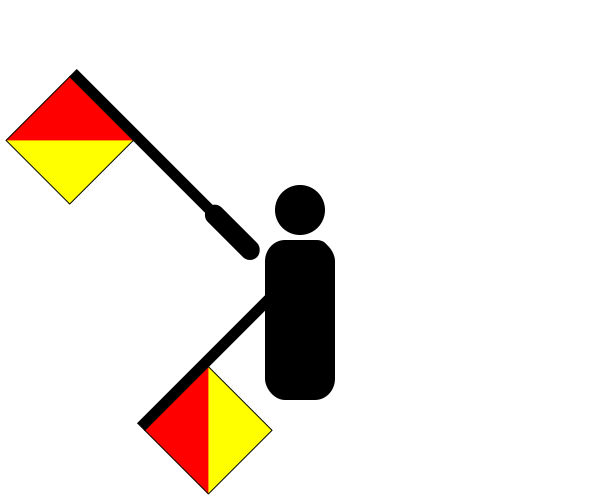
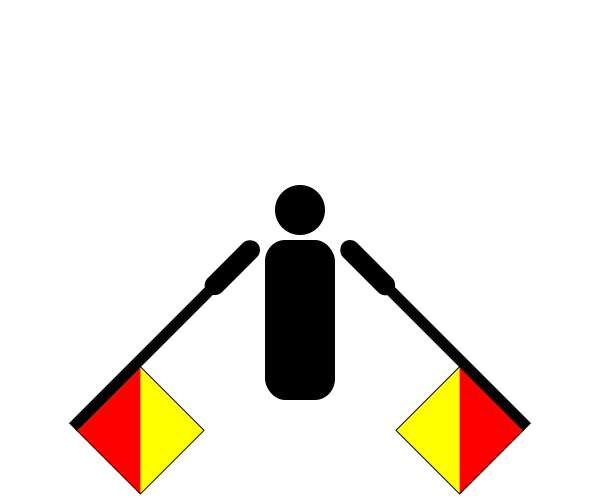

There are approximately 265 people named Hawking in the UK. That makes it one of Britain's least common surnames. Only around four in a million people in Britain are named Hawking.
Surname type: Location or geographical feature
Origin: English
Region of origin: British Isles
Country of origin: England
Religion of origin: Christian
Language of origin: English

Famous people named Hawking
- Stephen Hawking - Theoretical physicist, cosmologist, and author (1942 to 2018)
- Lucy Hawking - Journalist and novelist
Names and descriptions courtesy of Wikipedia, and may contain errors. This is not intended to be an exhaustive list of every famous person with this name.