HAVERTY
However, other scholarly sources identify alternative Gaelic cognates that have produced the same anglicised rendering. One such form is Ó hAirtéidigh, the anglicisation of Ó hAirtghir—the latter meaning “noble” or “lord.” In this construction, the surname conveys the sense of a descendant of a nobleman or lord. A further possibility cited in the literature is the derivation from Ó hIomhair, whose personal name *Iomhar* means “lordly,” “warlike,” or “noble.” These divergent etymologies demonstrate that the composite surname Haverty encapsulates a range of attributes associated with status and prosperity within the Gaelic cultural milieu.
The earliest documented reference to the name appears in the annals of *Inisfallen* dated 1095, under the entry “O hAbartaig, Abbot of Mayo.” This record confirms that the name was in use in the early medieval period and establishes a historical line of descent that continues to the present. Subsequent documentation includes a 1584 list of Co. Galway pardons mentioning a William O'Havorta, as well as a 1635 appearance in the Strafford Inquisition of Mayo attributed to an O'Havarta. These entries highlight the name’s presence in key counties of Connacht, especially Galway, where the surname remains well represented in the parishes of Kilmordaly and Craughwell.
In the late eighteenth and early nineteenth centuries, the Haverty surname entered the realms of the arts, history, and publishing through several distinguished individuals. Joseph Patrick Haverty (1794‑1864) was a celebrated portrait painter whose legacy survives through the eponymous Haverty Trust, which funds the acquisition of works by Irish artists. His half‑brother, Martin Haverty (1809‑1887), distinguished himself as a historian. A further noteworthy bearer was Patrick Martin Haverty (1824‑1901), a Galway‑born American publisher of Irish historical and musical works. He was active in the Young Ireland movement domestically and participated in the American civil war, earning the description of being the “best known Irishman in America.” These figures underscore the surname’s cultural impact beyond its geographic origins.
The seventeenth and eighteenth centuries saw a gradual expansion of the family name beyond its native Irish strongholds. The surname came to be found in other Irish provinces, including Sligo, Mayo, Donegal, Cavan, Kerry, and Cork. By the early nineteenth century, a wave of emigration from Ireland carried the name to the United Kingdom, France, Spain, Australia, and the United States. In Britain, records indicate a presence in various parts of the country, whereas in continental Europe the name appears notably in France and Spain. Within the United States, the surname amassed a substantial population, particularly in the southeastern states. States with particularly high concentrations include Pennsylvania, Virginia, North Carolina, Georgia, Texas, South Carolina, and West Virginia. Within Ireland, the name remains prevalent in counties such as Clare, Cork, Limerick, and Longford, affirming its enduring domestic footprint.
Variant spellings and mutated forms of the surname have arisen over the centuries, reflecting both phonetic interpretation and the anglicisation process. Recorded variations include O'Haverty, Havertys, O'Harvie, O'Gerty, Harvie, Harvies, Hearty, Iverty, Iferty, and Ivie, among others. These iterations all stem from the same core Gaelic origin but differ in orthographic rendering due to regional accents, clerical transcription, and the anglicisation of pastoral records.
In contemporary terms, the Haverty surname signifies more than mere lineage; it embodies a sense of tradition, heritage, and the legacy of ancestors who conjured notions of wealth, nobility, and perseverance. Its distribution across multiple continents, coupled with its historical prominence in the fields of art, literature, and public service, affords it a place of respect within genealogical, cultural, and scholarly circles. The surname records a narrative that traverses time and geography while preserving its intrinsic Gaelic identity.
Similar and related surnames
Related and similar names are generated algorithmically based on the spelling, and may not necessarily share an etymology.
How to communicate the surname Haverty in...
Braille
⠓⠁⠧⠑⠗⠞⠽
Morse
.....-...-..-.--.--
Semaphore


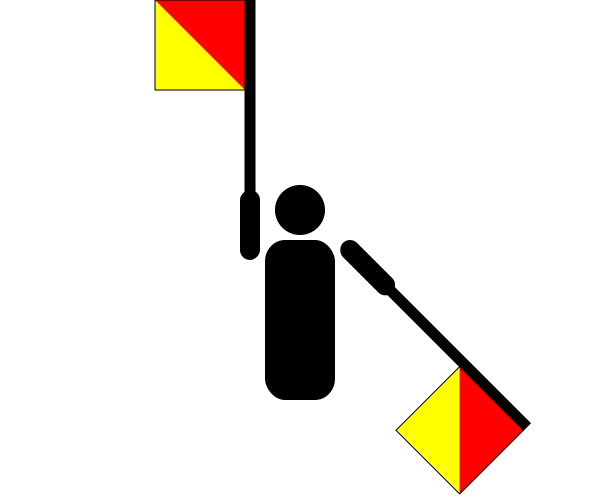

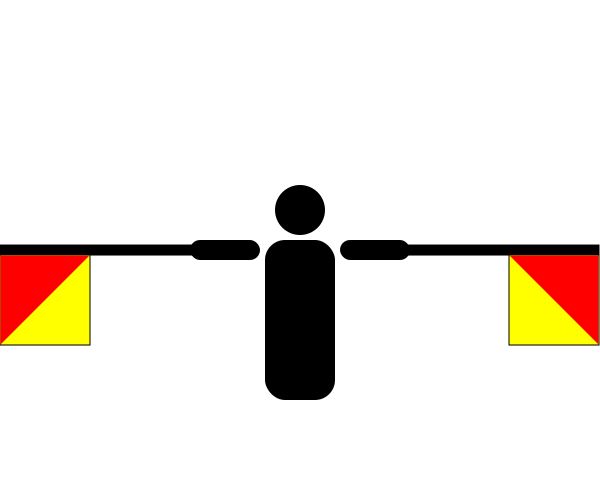
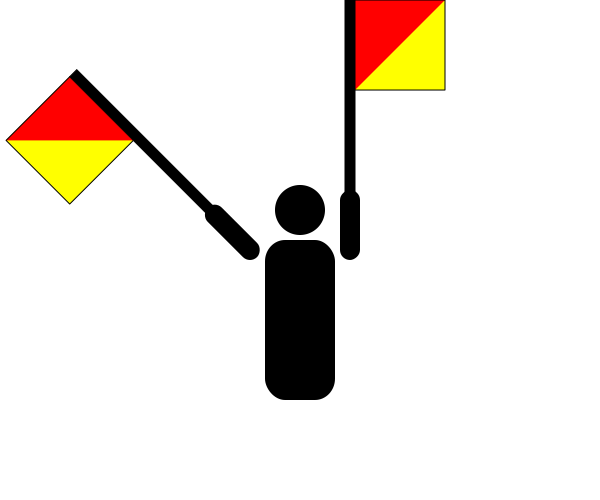
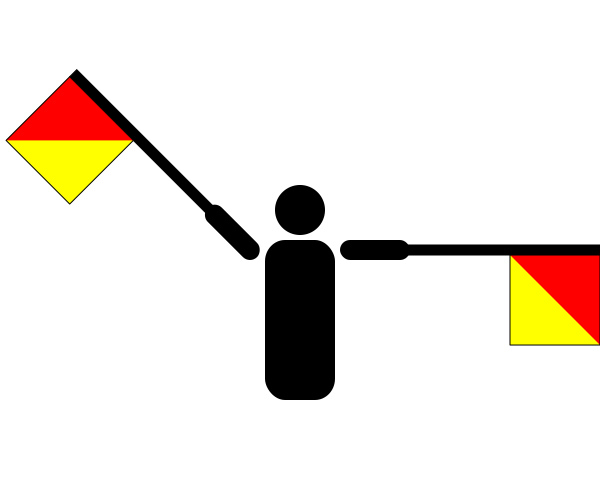
There are approximately 142 people named Haverty in the UK. That makes it one of Britain's least common surnames. Only around two in a million people in Britain are named Haverty.
