HARWELL
Harwell is a locational surname of English origin, first recorded as a place name in the United Kingdom. The earliest elements of the name are derived from the Old English word hara, meaning “hare,” and well(a), meaning “spring” or “stream.” In this sense the surname originally referred to a person who lived near a spring that was frequented by hares, or, alternatively, to someone who displayed the speed or agility associated with the animal.
Over time the name has appeared in several forms, including Hardwell and Horwell. It is most closely associated with two locations in Berkshire: the village of Hardwell and the town of Harwell. The Old English pre‑7th‑century term horde waella for the former is best understood as “treasure spring,” referring to an ancient place of worship where coins were deposited for good luck and later retrieved. The latter, recorded as Haranwhylle in a document dated 936 AD, is interpreted as a “grey hill spring,” possibly alluding to the chalky hills that dominate the local landscape. This locative origin was typical of surnames that denoted people who had moved away from their village, adopting the name of their place of origin.
Another well‑documented derivation is from the Old English words hoar, meaning “grey” or “old,” and wella, again meaning “spring” or “stream.” Under this interpretation Harwell would have meant “grey spring” or “old spring,” perhaps signifying a notable watercourse in an aged settlement or a place associated with a man of grey hair. Both the hare‑spring and grey‑spring explanations are consonant with the Anglo‑Saxon habit of forming place names from descriptive features of the landscape.
The surname is historically recorded in Lincolnshire, where evidence suggests that a Harwell family held a seat before the Norman conquest of 1066. Subsequent centuries saw the name spread throughout England, and it has remained relatively common in the United Kingdom. Migration patterns have carried the name to former British colonies, where it is now found in the United States (particularly in southern states), Canada, Australia, and New Zealand.
Numerous variants circulated over time, including Harwill, Harville, Hurwell, Hartwell, Horwell, Herwell, Harvelle and, in some contexts, Harewell. The presence of a Celtic element, such as the word Arwela meaning “on the slope,” has led some scholars to trace a partial influence from Celtic language, particularly in Scottish and Irish contexts. In Ireland similar surnames such as O’Hare, O’Harra, and O’Harrow appear, which may share a linguistic ancestry with the English Harwell through the common animal motif of the hare.
In modern times, the Harwell surname continues to be recognised as a marker of Anglo‑Saxon heritage and the historical practice of adopting locational identifiers. While the name has evolved into a variety of spellings, its core meaning remains tied to a spring or stream that is significant either for its natural features or its symbolic associations with hares and white or grey tones in the surrounding environment.
Typical given names associated with the Harwell surname
Male
- Gregor
- John
- Norman
- Richard
Female
- Angela
- Sheelagh
Similar and related surnames
Related and similar names are generated algorithmically based on the spelling, and may not necessarily share an etymology.
How to communicate the surname Harwell in...
Braille
⠓⠁⠗⠺⠑⠇⠇
Morse
.....-.-..--..-...-..
Semaphore


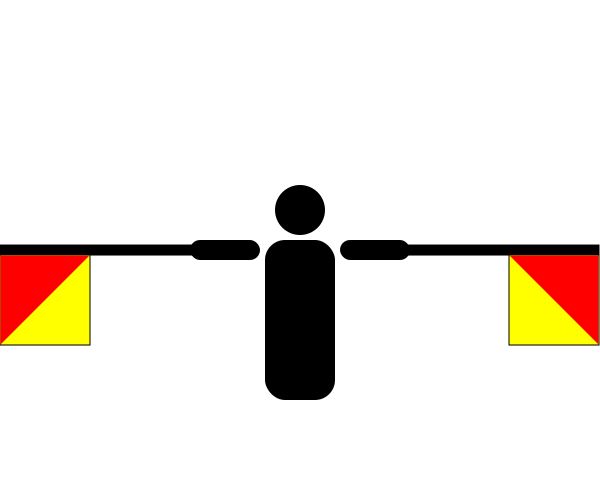
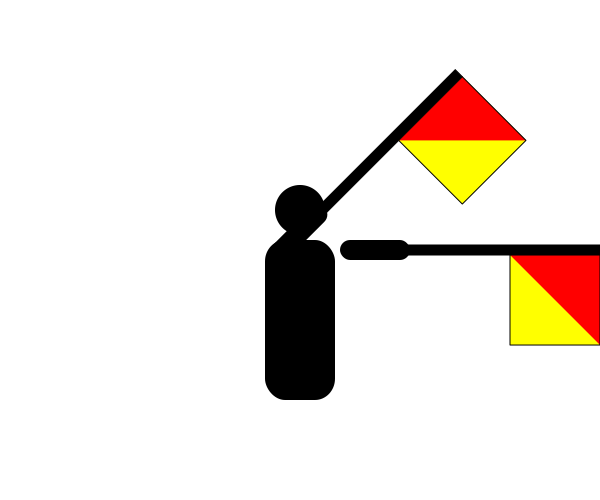


There are approximately 41 people named Harwell in the UK. That makes it one of Britain's least common surnames. Only around one in a million people in Britain are named Harwell.
Origin: Celtic
Region of origin: British Isles
Country of origin: Scotland
Religion of origin: Christian
Language of origin: Gaelic
