HARDER
The surname Harder is documented in both English and German contexts, with a presence in the British Isles and across northern Europe, particularly in Germany, the Netherlands and Denmark. Its earliest attestations appear in medieval English records, such as the Curia Regis rolls of Dorset in 1220, where an individual named John Harder is recorded. The name was also found in the Hundred Rolls of Lincolnshire in 1275 and in the Subsidy Rolls of Sussex in 1327 under the spelling Walter Hardiman.
In England the name is interpreted as an occupational designation. It derives from the Middle English word hard, meaning “hard” or “strong”, and was applied to craftsmen who worked with resilient materials. The primary trades associated with the name are stonemasonry and blacksmithing, professions that required the manipulation of hard stone or metal. In medieval culinary practice, hardening was used to describe the process by which bakers formed a fine crust on dough, a technique mentioned by Chaucer; this connection may explain another occupational link for the surname in the English milieu.
In German, the surname originates from the Middle High German word hart or from the Old High German heard, both connoting hardness or firmness. It was frequently used as a nickname for a person perceived to be strong, brave or steadfast, or in some locales as a reference to those who lived near a forest, the term for a woodland derived from the verb hart meaning “to make a forest”. The name has been recorded in the German surname registers as well as in the Dutch and Danish records, where it commonly appears in variants such as Harter, Hart and Harde.
Variants of the surname have arisen from linguistic shifts and regional pronunciations. These include, but are not limited to, Hardes, Harding, Hardeman, Hardiman, Hardes and Harte. The suffix -man, as seen in Hardeman or Hardiman, is archetypal of Anglo‑Saxon personal names and usually denotes “man of” or “descendant of”, while the form Harderson would signify “son of a Harder” in Scandinavian naming traditions.
During the post‑medieval period, numerous individuals bearing the surname are found in church registers. Examples include John Hardyman, a prebendary in Chester in 1563, and John Hardes who was christened in 1652 at St. Olaves in London. Further evidence of the name’s persistence is seen in the christening of Mary Hards in 1705 at St. Olave's, Southwark.
In contemporary times the surname Harder persists in its regions of origin, especially in Northern Germany and the Netherlands, and has spread to English‑speaking countries through immigration. In the United States it is found in areas with significant German or Dutch heritage, such as Pennsylvania, the Midwest and the Canadian provinces where German and Dutch settlers established communities.
Overall, the surname Harder encapsulates a dual heritage: it signifies either a person of personal strength or a craftsman skilled in working with hard materials, and its evolution reflects the linguistic and occupational practices of medieval England and northern Europe.
Typical given names associated with the Harder surname
Male
- Andrew
- Brian
- Colin
- David
- James
- Markus
- Martin
- Michael
- Paul
- Robert
- Steven
Female
- Barbara
- Claire
- Edith
- Jessica
- Kirsten
- Louise
- Patricia
- Philippa
- Rachel
- Ruth
- Sandra
- Susan
- Yvonne
Similar and related surnames
Related and similar names are generated algorithmically based on the spelling, and may not necessarily share an etymology.
How to communicate the surname Harder in...
Braille
⠓⠁⠗⠙⠑⠗
Morse
.....-.-.-....-.
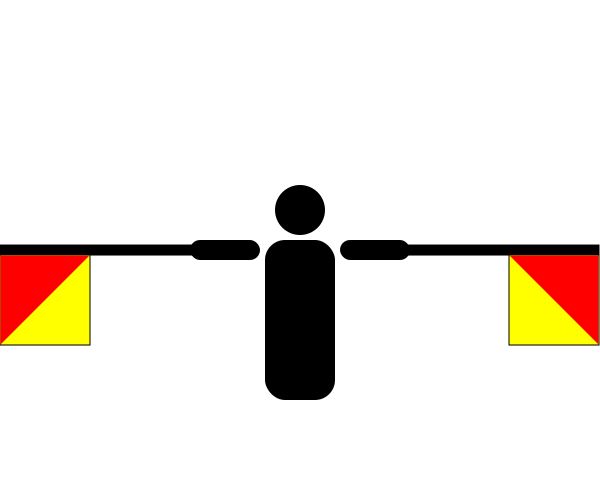
Semaphore




There are approximately 269 people named Harder in the UK. That makes it one of Britain's least common surnames. Only around four in a million people in Britain are named Harder.
Surname type: Occupational name
Origin: English
Region of origin: British Isles
Country of origin: England
Religion of origin: Christian
Language of origin: English