HANE
Origin and etymology of the surname Hane are rooted primarily in Germanic and Hebrew linguistic traditions. In Middle High German, the word han – meaning “rooster” – served as a nickname for individuals who displayed rooster‑like qualities such as pride or a willingness to defend. The name may also have arisen as an occupational surname for those who bred or tended poultry. In the Germanic tradition, Hane can be interpreted as a patronymic derivative of the personal name Hans, itself a short form of Johannes (equivalent to John). The suffix -e in this context indicates “son of”, so the name essentially means “son of Hans”.
Alternatively, Hane is a variant of the Jewish surname Hahn, which derives from the Hebrew word hagana meaning “protection” or “defence”. The surname is also related to the medieval English given name Han (or Han(n)), a diminutive of Johan, itself from the Hebrew Yochanan, translated as “Jehovah has favoured”. Historical records in the London Church Registers note marriages and christenings of individuals bearing the surname between the early seventeenth and early nineteenth centuries, and the earliest documented spelling appears as Richard Hannesone in 1379 within the “Records of the Borough of Nottingham”.
Throughout the centuries, the surname Hane has developed a range of variants reflecting regional pronunciations and orthographic changes. These include Hanes, Han, Haner, Hene, Hain, Hainey, Hany, Hone, Haine, and Haney; as well as related surnames such as the German Hahn, the Dutch Haan, the French Haine, and the Norwegian Hanevik. Longer forms such as Haneline, Hanebuth, and Hanewald may also be interconnected through immigration‑driven phonetic alterations.
In contemporary distribution, Hane is most frequently encountered in the United States, while it appears to a lesser extent in Germany, Australia, Canada and South Africa. Its global prevalence remains sparse, with fewer families bearing the name than many of its variants. Nonetheless, the surname’s multifaceted origins – ranging from German occupational and patronymic roots to Jewish Hebrew semantics and medieval English usage – underscore its enduring historical significance across European and American contexts.
Regional records indicate that the surname is present in European countries, notably Poland where the language of origin is Polish. The plural footprints of Hane across diverse linguistic and cultural landscapes reflect the broader patterns of migration, anglicisation and local adaptation that have shaped surname histories over the past millennium.
Typical given names associated with the Hane surname
Male
Female
Similar and related surnames
- Haen
- Ahne
- Han
- Hana
- Haan
- Haeney
- Hagn
- Hagne
- Hagnes
- Hagney
- Hahn
- Hahne
- Hain
- Haine
- Haines
- Hainey
- Hainie
- Hainnes
- Hains
- Hainz
- Hanes
- Haney
- Hanh
- Hani
- Hanie
- Hann
- Hanna
- Hanne
- Hannes
- Hanney
- Hanni
- Hannie
- Hanno
- Hannoe
- Hanns
- Hano
- Hans
- Hanu
- Hany
- Hanz
- Hayn
- Hayne
- Haynes
- Hayney
- Haynie
- Hayns
- Hean
- Heane
- Heanes
- Heaney
- Heanne
- Heanue
- Heene
- Hehn
- Hein
- Heine
- Hene
- Henes
- Henne
- Heyn
- Heyne
- Hance
- Hand
- Hanek
- Hanel
- Haner
- Hant
- Hine
- Hone
- Hunn
Related and similar names are generated algorithmically based on the spelling, and may not necessarily share an etymology.
How to communicate the surname Hane in...
Braille
⠓⠁⠝⠑
Morse
.....--..
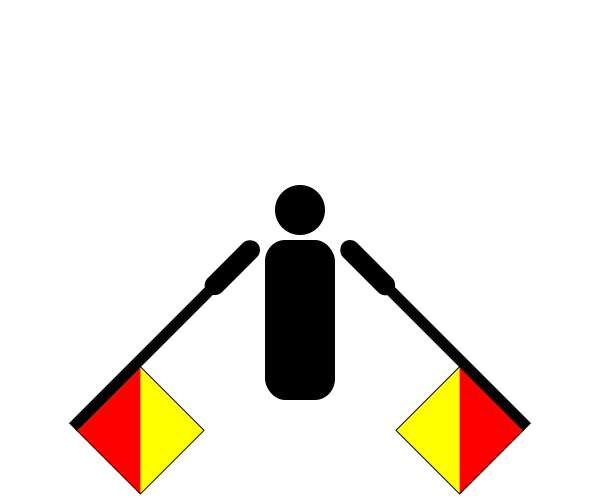
Semaphore



There are approximately 17 people named Hane in the UK. That makes it one of Britain's least common surnames. Fewer than one in a million people in Britain are named Hane.
Region of origin: Europe
Country of origin: Poland
Language of origin: Polish