HAMLET
Hamlet is a surname of English origin, first documented in the late fifteenth century. The name is a locational surname derived from the Middle English word hamel, meaning “little village” or “homestead”. It would have been applied to an individual who lived in or near such a small settlement, indicating a tangible connection to a particular rural community.
The surname also appears as a double diminutive of the Norman personal name Hamo(n), introduced into England following the conquest of 1066. The Norman name originates from the Germanic *Haimo*, itself a short form of compound names beginning with haim – a word meaning “home”. Records in the Domesday Book of 1086 list three variants of the personal name: Hamo, Haimo and Hamon. The modern surnames Hamlet, Hamlett and Hamblett are derived from the truncated root Ham combined with the diminutive suffixes el and ot. The personal name persisted until at least the mid-sixteenth century, as documented in the will of one Hamlet Milot of Carrigton, Chester, in 1587.
Early baptismal records provide the first confirmed spelling of the family name. Judith Hamlet was christened on 4 December 1553 at St. Peter Cornhill, London, during the reign of Queen Mary I. The name also appears in parish registers in 1647, when Elizabeth Hamlet married William Tirrat at St. Bartholomew the Less, London.
In addition, the etymology of Hamlet is linked to the Old German word hammelet, which translates as a small settlement. The suffix ‑let indicates a diminutive form, while the prefix ham denotes the surrounding area. Earlier Germanic settlers in Britain adopted the name from the communities in which they settled, following a common medieval European practice of deriving surnames from place names.
Geographical distribution records show that the surname is most common in England, particularly within the West Midlands region and the East Coast counties of Lincolnshire, Suffolk and Norfolk. In Ireland the name is found mainly in Dublin, Kilkenny and Carlow, as well as across Northern Ireland. A significant concentration also exists in the United States, notably in Illinois, Missouri, Maryland and Texas, a pattern that reflects migration during the colonial period from English and Germanic origins. Canadian and other international databases indicate the name is present in Australia, New Zealand, South Africa, India and many other countries, owing to ongoing migration.
Variant spellings of the surname include Hamlett, Hamletts, Hamlette, Hamelett, Hamelette, Hamelot, Hamelet and, as distinct families but related by linguistic origin, Hamlin, Hamlen and Hamelin. Other surnames sharing a root meaning “home” or “homestead” are Hainault, Heimlich, Heyman, Heman and Hammack. The French version of the name is spelled Hamel, while the Scandinavian adaptation is Haimel.
Historical records associate the name with several prominent families, including the Hainaulter lineage in France. These families had a widespread presence across Europe and may have contributed to the evolution and anglicisation of the surname. In contemporary discussion, the name is occasionally mentioned in relation to Shakespeare’s play Hamlet; however, linguistic evidence suggests that the literary character’s name was not a primary source of the surname’s modern form.
Typical given names associated with the Hamlet surname
Male
- Brian
- Christopher
- David
- Hayden
- John
- Jonathan
- Mark
- Michael
- Paul
- Peter
- Robert
- Roger
- Stephen
Female
- Jane
- Jennifer
- Julie
- Kathryn
- Louise
- Mandy
- Margaret
- Marilyn
- Michelle
- Nicola
- Pauline
- Sarah
- Susan
- Victoria
Similar and related surnames
Related and similar names are generated algorithmically based on the spelling, and may not necessarily share an etymology.
How to communicate the surname Hamlet in...
Braille
⠓⠁⠍⠇⠑⠞
Morse
.....---.-...-
Semaphore


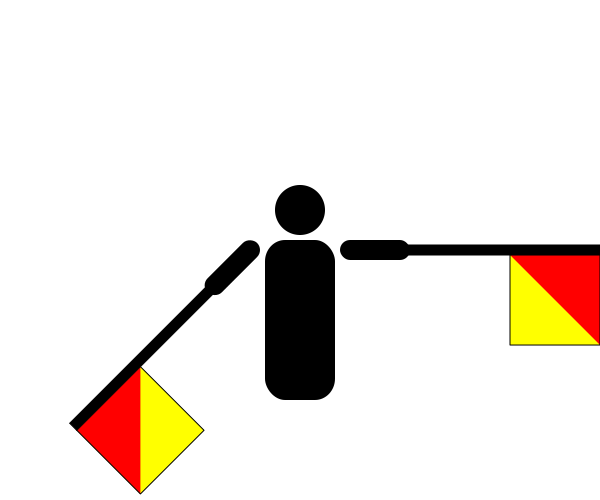


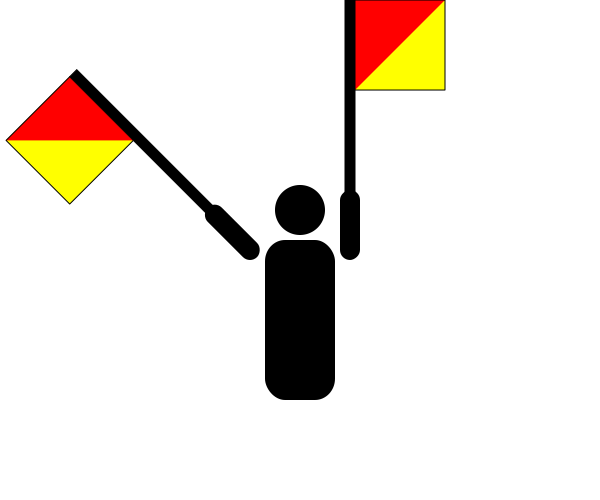
There are approximately 834 people named Hamlet in the UK. That makes it roughly the 8,510th most common surname in Britain. Around 13 in a million people in Britain are named Hamlet.
Surname type: Diminutive
Origin: English
Region of origin: British Isles
Country of origin: England
Religion of origin: Christian
Language of origin: English
