HALLOWAY
Halloway is an English surname that traditionally arises from a geographical context, typifying a locational or topographic identity. The name is usually recognised as being derived from the landscape surrounding the first bearers, a custom common across surnames of the British Isles.
J. Spin respectively over the linguistic evidence points to an Old English etymology. The composite elements halh – meaning a nook or recess – and weg, meaning a path or way, combine to form Halloway as “a way to a secluded recess”. An alternative derivation, also grounded in Old English, draws from the pair halig “holy” and weg “way”, giving the sense of a “holy path”. Both readings reflect the likely practice of assigning surnames based on significant local features that marked the locale of residence or work.
Although the dominant origin is English, some scholars recognise a Scottish dimension in certain spellings. Places named Alloway, Alloa or Alva in the former county of Ayrshire, for instance, stem from the Gaelic allmhagh, “rocky plain”. In such contexts, the surname could have been adopted by inhabitants of those settlements, producing spelling variations such as Allaway, Aloway, Alway and others. The long list of variant spellings – Allaway, Alway, Alaway, Allawy, Alleway, Elloway, and Halloway – illustrates both the linguistic fluidity of the period and the influence of regional accents on spelling.
Documentary evidence for the surname dates back to the early thirteenth century. The earliest recorded spelling appears in the Pipe Rolls of Middlesex for Roger Alewy in the year 1200, during the reign of King John. Subsequent entries in the Eynsham Cartulary record a Richard Aawy in 1260. In London, church registers provide additional examples: a marriage between John Allowaye and Margaret Langshawe on 20 June 1587 at St. Michael's, Bassishaw, and a christening of David Allaway on 12 November 1637 at St. Margaret's, Westminster. These documents confirm that both the English and Scottish forms circulated throughout England from the medieval period onward.
Heraldic records associated with the Allaway family further underscore the surname’s historical significance. A grant of arms depicts a shield divided by a blue and black bend, framed by three boars' heads couped and two silver six‑pointed stars. The crest bears two black anchors crossed, topped by a dove holding an olive branch in its beak. The motto, “Dei Dono sum quod sum”, translates as “By the bounty of God I am what I am”. Such heraldic symbols suggest that bearers of the name were recognised as a distinct family unit in the medieval period, with a lineage worthy of registration in the College of Arms.
In contemporary times the surname remains relatively uncommon, with its highest concentration in the United States and especially in Texas, California and Florida. Within England, the name persists but is still considered uncommon. Migration patterns of the eighteenth and nineteenth centuries explain the broader North American distribution, while the surname’s retention in England reflects the continuity of local habitational identities. Statistical data indicate that the name clusters around historic locational references, notably in Derbyshire and Lancashire – regions where old “holy paths” or secluded ways may have informed the original designation.
Variation in spelling has historically been common due to non‑standardised orthography and regional pronunciation. In addition to the spellings already mentioned, references occasionally surface for Holloway, Hollaway and a less common Holoway. These all share a common etymological root reflecting a path leading to a sacred site or a secretive lane. While modern spelling is largely fixed, the persistence of these variants in archival material illustrates how the surname evolved in tandem with linguistic practices of the time.
In sum, the surname Halloway embodies a clear topographic legacy, born of the English landscape and fortified by historic records, heraldic documentation and migratory traces. Its enduring presence in both Britain and the United States marks it as a distinct lineage that continues to reflect the geographical and cultural identities of its bearers.
Typical given names associated with the Halloway surname
Male
- Andrew
- David
- Hassan
- Jamal
- John
- Malcolm
- Mark
- Martin
- Peter
- Richard
- Robert
- Roger
- Sheriff
Female
- Amanda
- Christine
- Deborah
- Elain
- Florence
- Joyce
- Kayleigh
- May
- Nicola
- Patricia
- Rebecca
- Susan
Similar and related surnames
Related and similar names are generated algorithmically based on the spelling, and may not necessarily share an etymology.
How to communicate the surname Halloway in...
Braille
⠓⠁⠇⠇⠕⠺⠁⠽
Morse
.....-.-...-..---.--.--.--
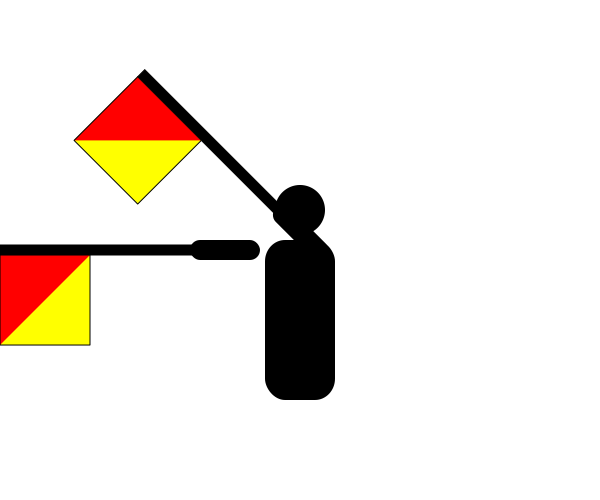
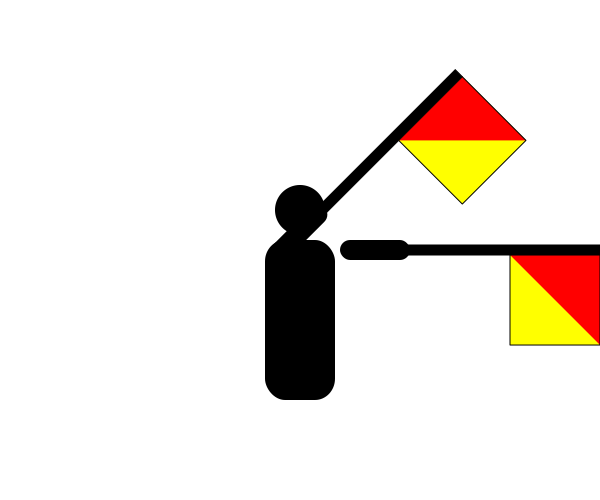
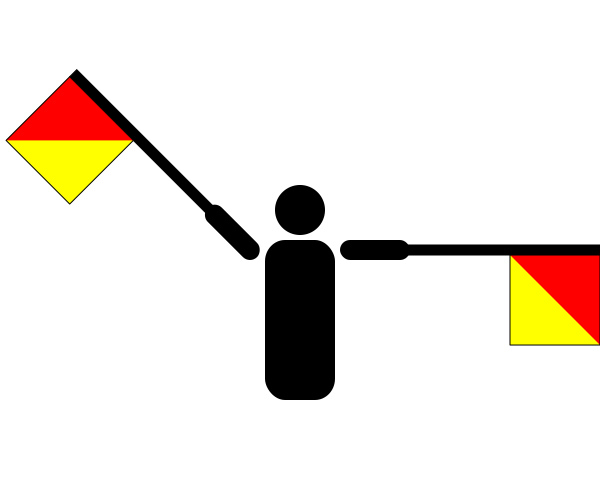
Semaphore


There are approximately 148 people named Halloway in the UK. That makes it one of Britain's least common surnames. Only around two in a million people in Britain are named Halloway.
Surname type: Location or geographical feature
Origin: English
Region of origin: British Isles
Country of origin: England
Religion of origin: Christian
Language of origin: English