HALIBURTON
The Haliburton surname is a locational name of English and Scottish provenance, recorded in numerous early spellings such as Alleburton, Alliberton, Halberton, Holburton, Halliburton, and the rare Hallyburton. It originally denoted persons who hailed from the village of Haliburton in East Lothian, Scotland, or from Halberton in Devonshire, England, depending on the variant adopted.
The etymology of the name varies according to the source of the settlement. In Scotland the toponym is traditionally believed to be formed from the Old English hale – “healthy” or “whole” – and burh – “fortress” or “town,” giving the literal sense “healthy town” or “fortress of health.” In England the Devonshire place name is recorded as Halsbretone in the Domesday Book of 1086 and appears in the 1188 Pipe Rolls as Hauberton. Modern scholarship analyses that it is derived from the elements haesel (“hazel”), bearu (“grove”), and tun (“homestead” or “village”), which together signify “homestead by a hazel grove.”
Some interpretations of the etymology draw upon the Old English words Halig (meaning “holy” or “blessed”) and beorht (meaning “bright”). Consequently one rendering of the name is “blessed bright one.” These linguistic elements have led to a perception of the Haliburton family as holding a status of distinction or religious influence, a view that persists in contemporary social consciousness. Consequently the surname is often associated with aristocracy, wealth and high‑ranking professional positions in business, finance and academia.
Early documentation of the Haliburton surname appears in London church registers of the seventeenth century. A marriage record dated 10 September 1631 notes the union of George Halliburton and Elizabeth Rosse at St. Bride’s, Fleet Street. Another record dated 22 September 1651 documents the marriage of James Alleburton and Hanah Bayler at St. Margaret Pattens. The earliest preserved spelling is that of Thomas Holberton, who married Thomasina Fox on 21 May 1599 at Ugborough, Devonshire, during the reign of Queen Elizabeth I.
The surname possesses a wide range of orthographic variants, such as Halbert, Halbertston, Halburton, Helburt, Halbertson, Halbretton, Hewburton, Halbertstoun and Halberston. Scottish usage has produced alternative forms such as Halbert‑ston and Halber‑ston, owing to regional dialectal pronunciation. Similar sounding surnames of Scandinavian origin – for example Hallberg, Hallbom, Helberg, Helfer, Helfers, Halberg, Hallbäck, Halberstad and Halfers – are sometimes confused with the English‑Scottish Haliburton lineage, although they are etymologically distinct.
In contemporary times the surname remains distributed across the British Isles, with concentration in the United Kingdom and Ireland, as well as smaller populations in Germany, France and Scandinavia. In the United States the name appears most frequently in California, Michigan and New York, while in Australia it is predominantly found in New South Wales and other parts of south‑eastern Australia. The surname has also been recorded in Jamaica, where descendants of the British Haliburton family are believed to have emigrated in the late eighteenth century. A prominent modern association of the name is with a major Canadian oil‑field services company founded in the nineteenth century by Henry Haliburton; the firm now operates in more than 80 countries and employs over 80 000 people.
Similar and related surnames
Related and similar names are generated algorithmically based on the spelling, and may not necessarily share an etymology.
How to communicate the surname Haliburton in...
Braille
⠓⠁⠇⠊⠃⠥⠗⠞⠕⠝
Morse
.....-.-....-.....-.-.-----.
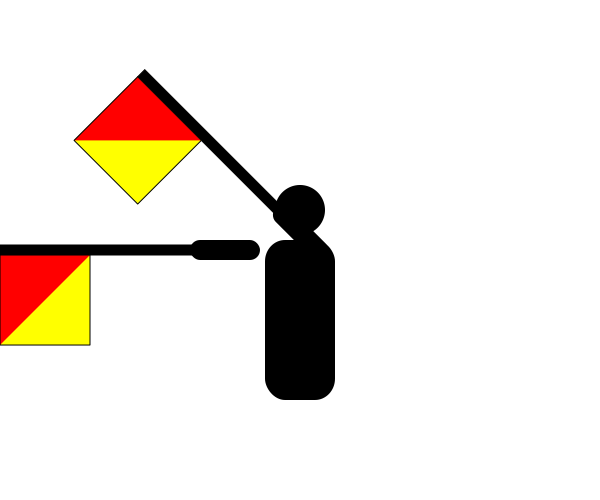
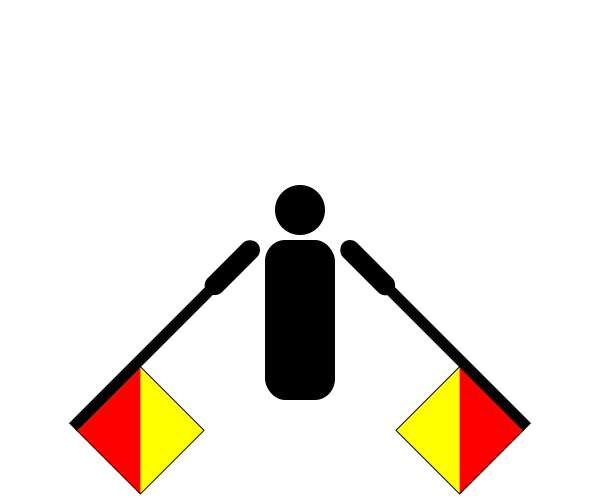
Semaphore


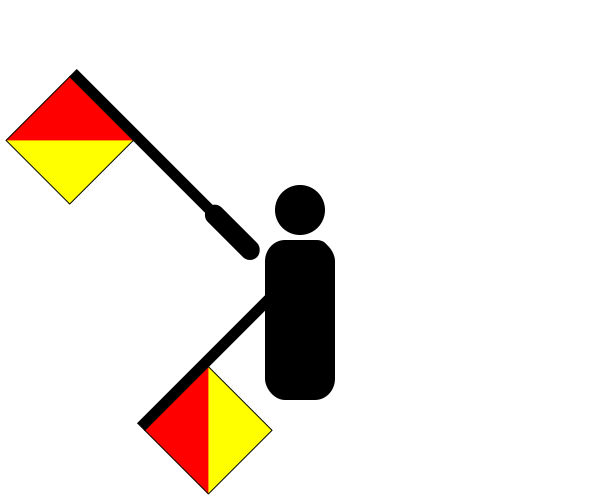
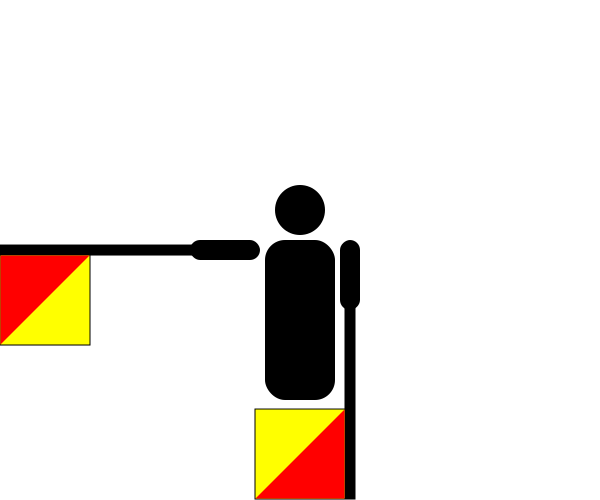

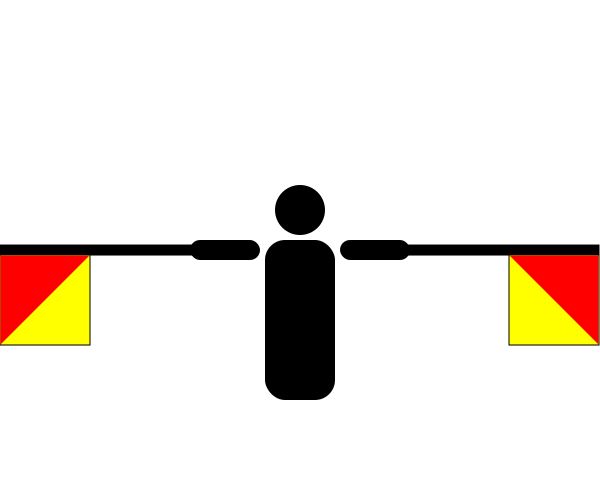
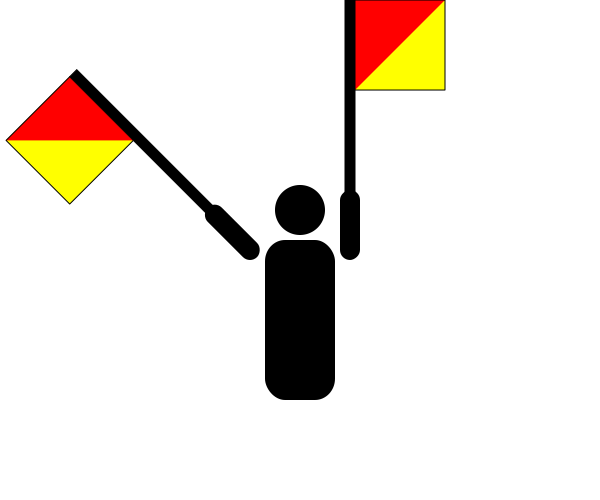
Sorry, we don't have any statistics on this name. That's probably because it's very uncommon in Britain.
