HAITH
Haith is an English locational surname with origins in Old English terminology. The word haeth, from which the name derives, denotes a heath or heather, indicating that the initial bearers of the surname resided near a heathland or a heath‑covered area.
The earliest recorded spelling of the name is that of John de la Heth, dated to 1248 in the Fine Court Rolls of Essex. This appears during the reign of King Henry the First, who reigned from 1216 to 1272. The name subsequently evolved in spelling, with early variants including Haith, Hayth, and Haet, all arising from the Middle English dialectal word heth or hath – a developed form of the Old English heath. The evolution of these spellings was influenced by regional pronunciation and clerical variations that were common in the medieval period.
In addition to the heath‑based derivation, the surname has a secondary topographic interpretation. The Old English components hægþ (meaning “enclosure”) and þorp (meaning “outlying farmstead” or “hamlet”) give rise to a habitation name that would have been applied to a person living near an enclosure or a hay‑producing farmstead. The Middle English word haythe – meaning “enclosure” or “fenced area” – conveys a similar geographical sense, suggesting that some bearers of the name may have been associated with a hedged area or forest clearing.
Variations of the surname Haith are found throughout English history. Common forms include Haight, Haithe, Haighte, Haythe, Hayth, and the place‑name related Haighton. Surnames sharing a potential common origin with Haith are Heath and Hath – both linked to Old English terms for moorland or heathland. The surname Hyde, derived from the Old English hid (an older land measurement), is also considered a possible variant, reflecting the fluidity of medieval name formation.
Geographically, Haith was primarily concentrated in Yorkshire, England, as evidenced by contemporary records. As a result of British colonisation and emigration, the name spread to other parts of the world, including the United States, Canada, and Australia. In the current era, the surname remains relatively uncommon on a global scale, although retrospective research indicates that there may be more individuals bearing the name in the United States than in any other country.
In sum, the surname Haith exemplifies the way in which medieval English naming practices combined geographical descriptors, topographic features, and occupational associations into hereditary family names. Its multiple recognised variants and its modest frequency today attest to both the stability and the adaptability inherent in the evolution of surname traditions.
Typical given names associated with the Haith surname
Male
- Andrew
- Benjamin
- Christopher
- David
- Ian
- James
- Lee
- Mark
- Michael
- Philip
- Stephen
Female
- Andrea
- Debra
- Evelyn
- Helen
- Karen
- Leanne
- Lisa
- Madge
- Marie
- Patricia
- Rachael
- Rebecca
- Sandra
- Sharon
- Tina
Similar and related surnames
Related and similar names are generated algorithmically based on the spelling, and may not necessarily share an etymology.
How to communicate the surname Haith in...
Braille
⠓⠁⠊⠞⠓
Morse
.....-..-....
Semaphore


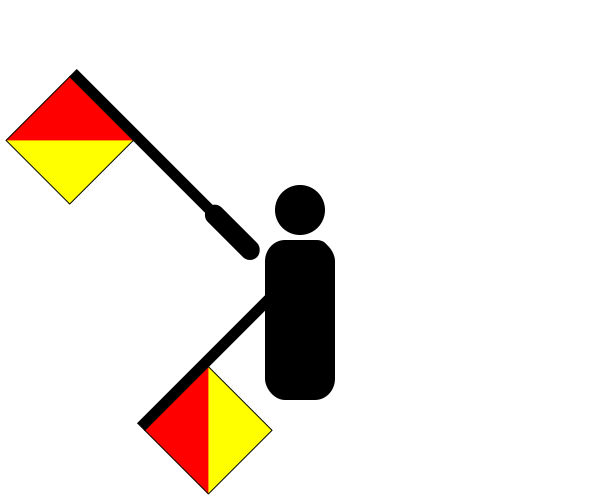
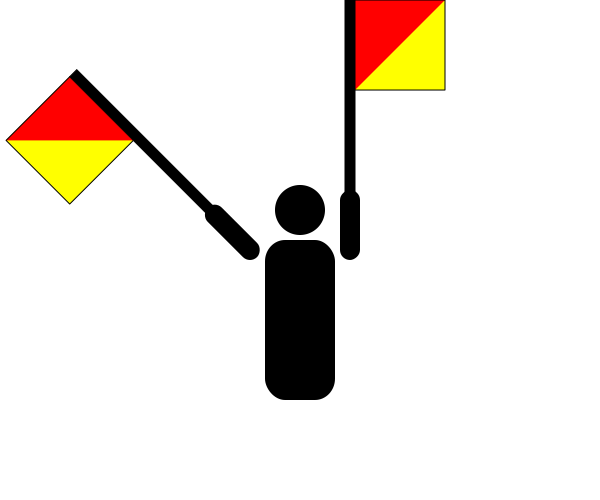
There are approximately 283 people named Haith in the UK. That makes it one of Britain's least common surnames. Only around four in a million people in Britain are named Haith.
Origin: English
Region of origin: British Isles
Country of origin: England
Religion of origin: Christian
Language of origin: English
