HADAWAY
Hadaway is a surname of English origin, its earliest traceable usage in the 12th century. The name derives from the Old English phrase hæð weg, meaning “heath road,” and was originally applied as a locational surname to individuals who lived near or were associated with a road that crossed a heath or heathland.
The linguistic construction of the name is a combination of the Middle English word hath (a later development of the pre‑7th‑century Old English haeth meaning heath) and the Middle English way (from Old English weg meaning way). As a result, the surname signifies a person dwelling by a pathway across a heath.
An alternate etymological view proposes that Hadaway may have been derived from the rare Old English personal name Heaethuwig, composed of the elements heaethu meaning “strife, contention” and wig meaning “war.” This hypothesis draws a parallel with the Germanic personal name Hedwig, itself a compound of Old High German Haduwig.
Archival evidence confirms the existence of the name in the late 12th century. The first recorded spelling appears in the Pipe Rolls of Herefordshire, dated 1178, where an entry for William Hadewi is recorded during the reign of King Henry XI (1154–1189). Subsequent documents include church records from London, such as the christening of Thomas, son of John Haddyway, at St. Margaret's, Westminster, on 22 March 1616, and the birth of Katherine Hadaway at Allhallows London Wall on 7 April 1681.
The surname has produced a notable heraldic achievement. A coat of arms, granted to the family, is described as a black escutcheon bearing a silver bugle‑horn. The crest is a red demi‑lion rampant holding a fleur‑de‑lis in its dexter paw. This heraldic description is recorded in the public register of arms, reflecting the family's established status in English society.
Over the centuries, the name has given rise to several spellings, including Hadway, Hedaway, Hathway, Hathaway, Haddaway, and Hadoay. These variants are attributable to regional accents, variations in scribal spelling, and the natural linguistic evolution of the English language.
Geographically, the surname is associated with the northern counties of Northumberland and Durham, where the Middle English term haed (heath) was common. The early bearers of the name were often residents near heath roads in these regions, and the name consequently carried the suggestion of a rural, pastoral environment.
In modern times, the surname remains a relatively uncommon surname in England but has disseminated to other English‑speaking countries through historical migration. It can be found in the United States, Canada, Australia, and New Zealand, with concentrations often reflecting past settlement patterns.
Typical given names associated with the Hadaway surname
Male
- Anthony
- Christopher
- David
- John
- Lee
- Mark
- Michael
- Paul
- Robert
- Roger
- Ronald
- Steven
- William
Female
- Anne
- Elizabeth
- Jill
- Karen
- Linda
- Lisa
- Melanie
- Nicola
- Pauline
- Samantha
- Sarah
- Susan
- Victoria
- Wendy
Similar and related surnames
Related and similar names are generated algorithmically based on the spelling, and may not necessarily share an etymology.
How to communicate the surname Hadaway in...
Braille
⠓⠁⠙⠁⠺⠁⠽
Morse
.....--...-.--.--.--
Semaphore


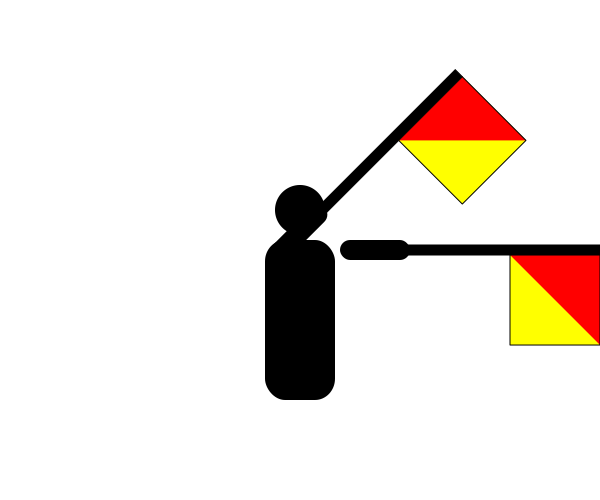
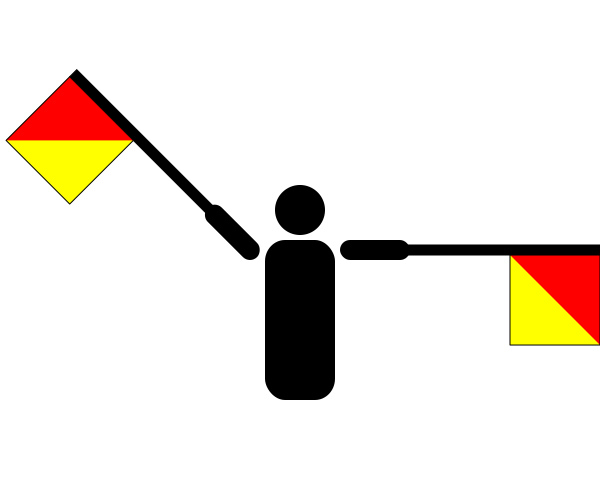
There are approximately 756 people named Hadaway in the UK. That makes it roughly the 9,154th most common surname in Britain. Around 12 in a million people in Britain are named Hadaway.
Surname type: Location or geographical feature
Origin: English
Region of origin: British Isles
Country of origin: England
Religion of origin: Christian
Language of origin: English
