GWINN
Gwinn is a surname of Welsh provenance that has been in use in the British Isles for many centuries. Its earliest documented appearance is in the early fifteenth century, in the Feet of Fines for the county of Surrey, dated 1481–1482, during the reign of King Henry V.
The name is derived from the Welsh personal name Gwyn, meaning “white” or “fair”. As a patronymic surname it originally served to identify the descendants of a man called Gwyn. In medieval Welsh usage, it was commonly employed as a by‑name for a person with fair hair or a noticeably pale complexion.
Over time the surname has taken several orthographic forms. In South Wales the forms Gwyn, Gwynn and Gwynne are most common, whereas in North Wales you will often find Wynn, Wynne and Winn. The appearance of an ending -e in the spelling was an English influence, as Welsh orthography is largely phonetic and the added letter would misleadingly alter the pronunciation.
Historical records bear witness to the spread of the name. The first known mention of a person bearing the surname in Wales is the christening of John, son of Marmaduke Gwynne and Mary Gwillym, registered on 3 May 1669 at Typn, in Brecon. In England, the earliest surviving reference to a family named Gwinn occurs in the “Placita Coronae” of 1282, where a John Gwinn is listed as a party to a legal proceeding, a record dating to the reign of King Henry III.
In addition to its Welsh roots, a minority of sources associate the name with the medieval kingdom of Gwynedd, suggesting that a small family of notable Welsh warriors may have borne the surname in the twelfth and thirteenth centuries. Nevertheless, the primary etymology remains that of a personal descriptor based on the Latin cognate for “white”.
By the eighteenth and nineteenth centuries, Welsh emigrants carried the surname across the Atlantic. William Gwinn, an ancestor of many modern bearers of the name in the United States, arrived in North Carolina in 1744. Today, the surname is most prevalent in the eastern United States, particularly in Virginia, North Carolina, South Carolina, Texas, Georgia and Alabama, with significant concentrations also in New Jersey, Pennsylvania, Mississippi and Arkansas.
In Britain the name remains relatively rare, but pockets of families can still be found in England, Scotland and Ireland. Outside the British Isles, the surname occurs in smaller numbers in Canada, Australia and New Zealand, and occasional records exist in continental Europe, including Italy, Spain and Austria.
Across the world, those who bear the surname Gwinn do so with a sense of connection to an ancient Welsh linguistic tradition that celebrated the aesthetic qualities of light and fairness. The persistence of the name across five centuries and across multiple continents is a testament to enduring cultural heritage and the migration patterns of Welsh communities.
Typical given names associated with the Gwinn surname
Male
- Christian
- Christopher
- Dylan
- Julian
- Roy
Female
- Helen
- Janet
- Jennifer
- Roslyn
- Sheila
Similar and related surnames
Related and similar names are generated algorithmically based on the spelling, and may not necessarily share an etymology.
How to communicate the surname Gwinn in...
Braille
⠛⠺⠊⠝⠝
Morse
--..--..-.-.
Semaphore

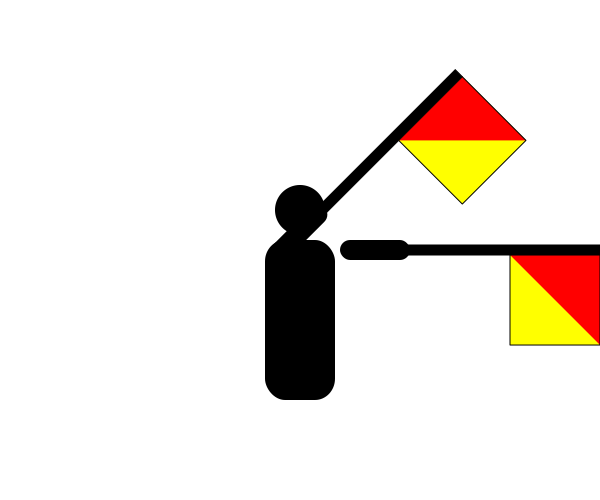
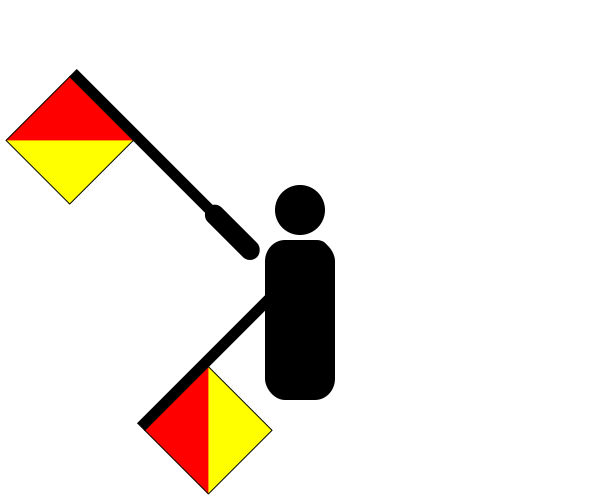
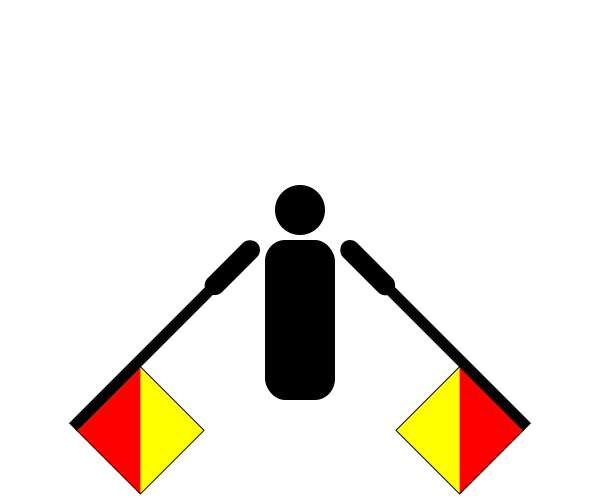
There are approximately 55 people named Gwinn in the UK. That makes it one of Britain's least common surnames. Only around one in a million people in Britain are named Gwinn.
Origin: English
Region of origin: British Isles
Country of origin: England
Religion of origin: Christian
Language of origin: English
