GROSVENOR
The surname Grosvenor is historically rooted in the British Isles, specifically England, and is of English origin derived from medieval French. It originates from the Old French words gros meaning “large” and veneur meaning “hunter”; the literal translation is therefore “great hunter” or, more precisely, “chief huntsman”. The name was originally a nickname for an individual of exceptional skill or prominence in hunting, an occupation of high esteem during the Middle Ages. Early records show the surname in several spellings, including Grosvenor, Gravener, Gravenor and Gravinor, reflecting variations in regional pronunciation and orthography.
Evidence of the name appears at the turn of the twelfth century. The earliest documented use is recorded in the chartulary of Whalley Abbey in Lancashire, dated 1201, where the individual referred to is Robert le Gros Venour. This entry, situated in the reign of King John (1199‑1216), demonstrates the long-standing nature of the surname within English society.
During the thirteenth and fourteenth centuries, the Grosvenor name became associated with a lineage of military and administrative service. A prominent figure was Sir Robert Grosvenor, who died in 1396. He fought in the great battles of the Hundred Years’ War, including Poitiers in 1356 and Limoges in 1370, and was awarded a coat of arms featuring a blue field with a single gold garb. The heraldic crest that followed, a gold talbot—an emblem of the hunting dog—further emphasised the family’s lasting connection to the sport of hunting.
The rise of the Grosvenors into the hereditary peerage began in the early seventeenth century. King James I created the first baronets of the family in 1611, granting the estates of Grosvenor Square in London and Eaton Hall in Chester hereditary honours. Richard Grosvenor (1731‑1802), the seventh baronet, was elevated to the peerage as the first Earl of Westminster. The Dukedom, however, was not bestowed until 1874 when Hugh Grosvenor, Master of the Queen’s Horse and aide‑de‑camp to Queen Victoria, was created Duke of Westminster. Today the Duke remains the head of the aristocratic family and the Grosvenor Estate stands as one of the largest private landholdings in the United Kingdom.
Despite its aristocratic prestige, the surname is not particularly common. In England and Scotland, individuals bearing the name are traditionally seen as associated with wealth, influence and, historically, hunting expertise. Its presence in other parts of the world—United States, Australia, Ireland, Canada, India and South Africa—stems largely from colonial migration. In North America, for example, many bearers trace their ancestry to Thomas Grosvenor, who settled in the Maryland colony in 1662. In Ireland, descendants of the Grosvenors of Athlone in County Westmeath can also claim a Norman lineage linking back to the same noble line.
Contemporary Grosvenors continue to exert a significant impact across various fields. The family’s extensive property portfolio, especially within the United Kingdom, establishes them as leading figures in finance and real estate. In addition, the Grosvenor Foundation operates to provide charitable support for disadvantaged communities, underscoring the family’s ongoing commitment to philanthropy.
While the surname has evolved from its original occupational roots, its historical associations with hunting, nobility and landownership endure. Consequently, the name Grosvenor maintains a distinctive place within British onomastics, symbolising both the country’s medieval heritage and its modern socio‑economic landscape.
Typical given names associated with the Grosvenor surname
Male
- Anthony
- Christopher
- Daniel
- David
- John
- Mark
- Michael
- Paul
- Richard
- Stephen
Female
- Alison
- Amanda
- Barbara
- Deborah
- Elizabeth
- Emma
- Jean
- Julie
- Kate
- Margaret
- Natalie
- Patricia
- Sarah
- Susan
Similar and related surnames
Related and similar names are generated algorithmically based on the spelling, and may not necessarily share an etymology.
How to communicate the surname Grosvenor in...
Braille
⠛⠗⠕⠎⠧⠑⠝⠕⠗
Morse
--..-.---......-.-.---.-.
Semaphore

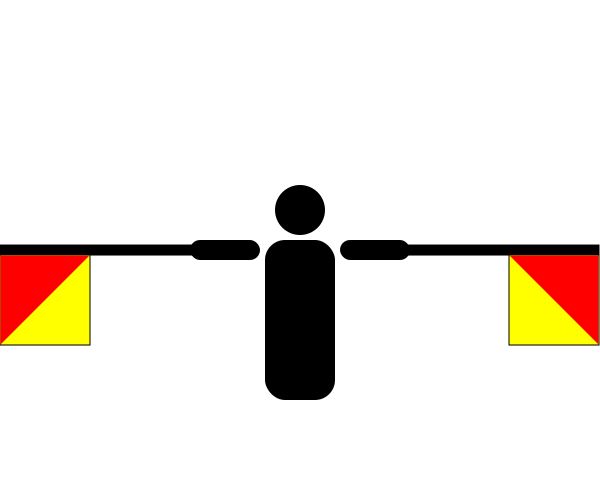
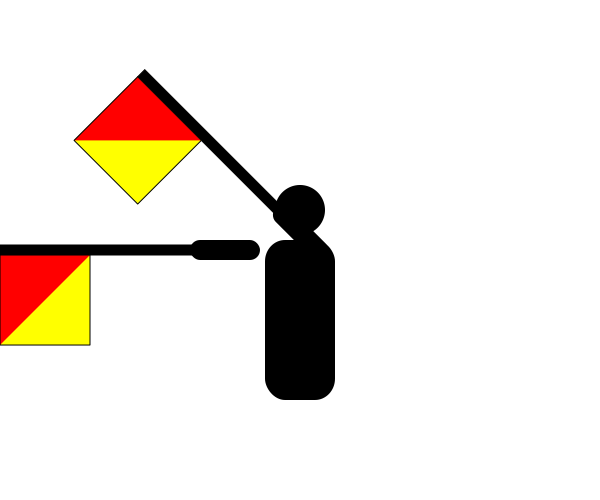

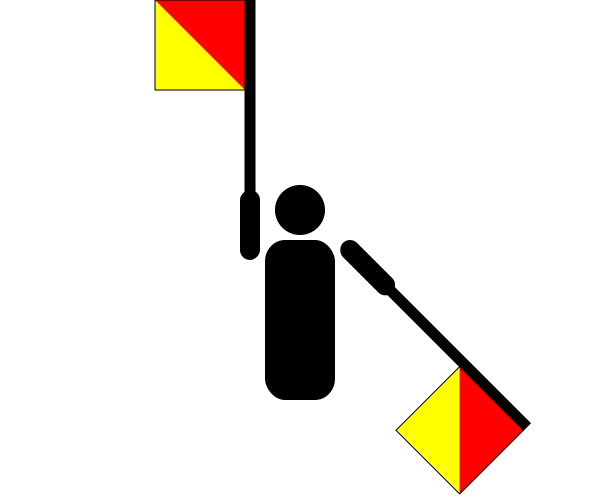

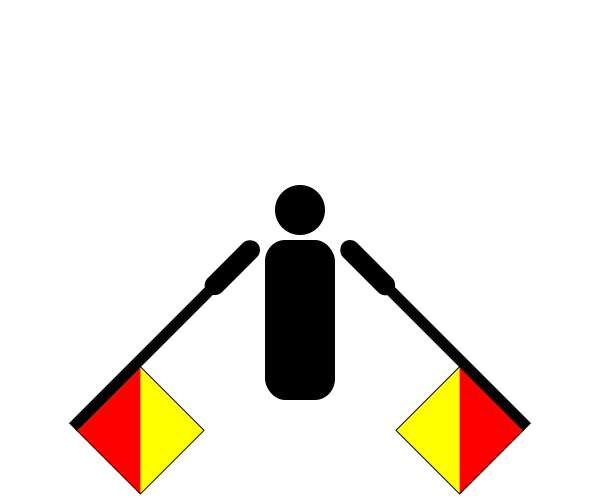
There are approximately 2,133 people named Grosvenor in the UK. That makes it roughly the 3,974th most common surname in Britain. Around 33 in a million people in Britain are named Grosvenor.
Origin: English
Region of origin: British Isles
Country of origin: England
Religion of origin: Christian
Language of origin: English

Famous people named Grosvenor
- Hugh Grosvenor, 7th Duke of Westminster - Aristocrat, billionaire, businessman and landowner
- Gerald Grosvenor, 6th Duke of Westminster - Billionaire landowner, businessman and Territorial Army officer (1951 to 2016)
- Hugh Grosvenor, 2nd Duke of Westminster - Duke of Westminster (1879 to 1953)
- Natalia Grosvenor, Duchess of Westminster - Duchess of Westminster
- Bendor Grosvenor - Art dealer and art historian
- Luther Grosvenor - Rock musician
- Robert Grosvenor, 5th Duke of Westminster - Duke of Westminster (1910 to 1979)
- Hugh Grosvenor, 1st Duke of Westminster - Duke of Westminster (1825 to 1899)
- Viola Grosvenor, Duchess of Westminster - Widow of 5th Duke of Westminster (1912 to 1987)
- Benjamin Grosvenor - Pianist from the United Kingdom
- William Grosvenor, 3rd Duke of Westminster - Duke of Westminster (1894 to 1963)
- Gerald Grosvenor, 4th Duke of Westminster - Duke of Westminster (1907 to 1967)
- Lady Edwina Grosvenor -
- Robert Grosvenor, 5th Baron Ebury - Politician (1914 to 1957)
- Sir Thomas Grosvenor, 3rd Baronet - Politician (1655 to 1700)
- Richard Grosvenor, 1st Earl Grosvenor - Racehorse owner (1731 to 1802)
- Sir Richard Grosvenor, 1st Baronet - Politician (1585 to 1645)
- Rebecca Jane Grosvenor-Taylor - Singer
- Caroline Grosvenor - Artist (1858 to 1940)
- Tom Grosvenor - England international football player (1908 to 1972)
Names and descriptions courtesy of Wikipedia, and may contain errors. This is not intended to be an exhaustive list of every famous person with this name.