GROGAN
The surname Grogan is of Irish origin and is an anglicised form of the Gaelic patronymic Ó Gruagáin or variants such as Ó Grógáin and Ó Grugáin. It is traditionally interpreted as meaning “descendant of Gruagán,” “descendant of Grógán” or “descendant of Grugán,” depending on the particular Gaelic root recognised by a family or local tradition.
The personal names Gruagán and Grógán are understood to be diminutives. In the more widely reported derivation, gruag is a Gaelic word meaning “long hair” or “long locks,” suggesting the name originally served as a nickname for someone with notable hair. In a separate line of scholarship, gróg is taken to mean “noble” or “illustrious,” so that the surname could be decoded as “descendant of the noble one.” A third possibility, reported in some middle‑eastern district sources, identifies grug as “heather” or “heart,” though no single meaning dominates the scholarly record.
The earliest documented instance of the name is a reference to Maelbrighde O' Grugain of Elphin dated to 1265 in the “Annals of the Four Masters.” The mention identifies a self‑styled King of Ireland during the reign of De Brugo, a Norman conqueror, and establishes the surname in the fourteenth‑century chronicles.
During the fifteenth and sixteenth centuries the name appears in several variations in the Tudor Fiants, most commonly as O' Grogan but also as O'Grogane, O'Growgane and O'Gruogan. Over the same period the sept may have relocated from their medieval homeland in Connacht to counties such as Limerick, Kildare, Offaly and Tipperary, signalling a dispersal that foretold later diaspora migrations.
In modern Ireland the surname remains concentrated in the west, especially within County Roscommon and County Westmeath, and to a lesser extent in Cork and Donegal where earlier branches of the family were noted. In the wider world, the surname spread most markedly during the great famine of the mid‑nineteenth century to the United States, Canada, Australia and Britain, and it continues to be observed in those countries today.
A notable figure bearing the name was Nathaniel Grogan (1740–1807), a painter from Cork whose work was widely circulated in the eighteenth‑century periodicals of the time. His presence illustrates that bearers of the name had already achieved prominence in cultural circles by the late eighteenth century.
In sum, the surname Grogan is a historically grounded Irish patronymic whose roots trace to Gaelic personal names associated with hair, nobility or nature. Its documented history from the thirteenth century to contemporary global diaspora underscores both its resilience and its capacity to adapt across societies while retaining its linguistic heritage.
Typical given names associated with the Grogan surname
Male
- Anthony
- Christopher
- David
- James
- John
- Mark
- Michael
- Paul
- Peter
- Thomas
Female
- Elizabeth
- Emma
- Helen
- Jane
- Margaret
- Mary
- Michelle
- Nicola
- Patricia
- Sarah
- Susan
Similar and related surnames
Related and similar names are generated algorithmically based on the spelling, and may not necessarily share an etymology.
How to communicate the surname Grogan in...
Braille
⠛⠗⠕⠛⠁⠝
Morse
--..-.-----..--.
Semaphore

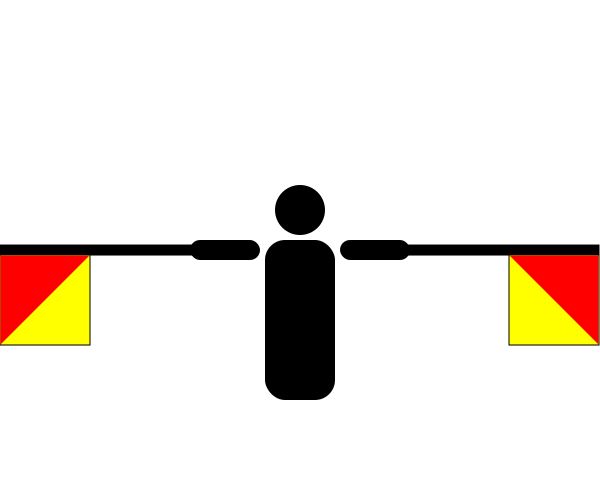
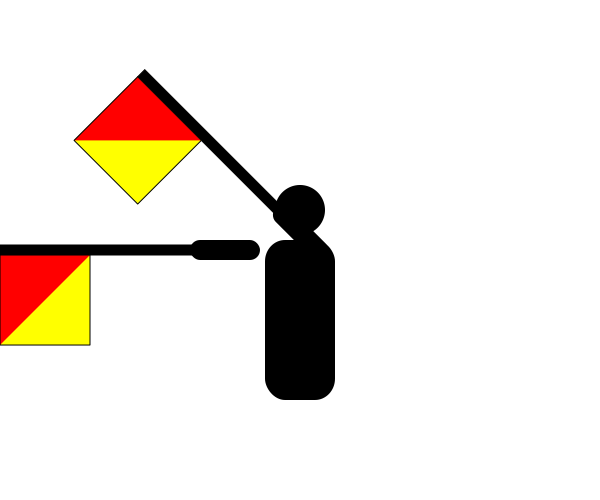

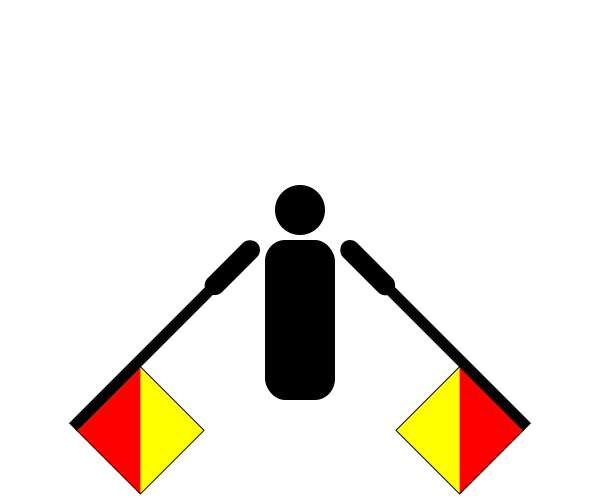
There are approximately 3,753 people named Grogan in the UK. That makes it roughly the 2,479th most common surname in Britain. Around 58 in a million people in Britain are named Grogan.
Origin: Celtic
Region of origin: British Isles
Country of origin: Ireland
Religion of origin: Christian
Language of origin: Gaelic

Famous people named Grogan
- Clare Grogan - Scottish singer and actress
- John Grogan - Politician
- Ewart Grogan - Explorer and politician (1874 to 1967)
- George Grogan - Recipient of the Victoria Cross (1875 to 1962)
- David Grogan - Water polo player (1914 to 1993)
Names and descriptions courtesy of Wikipedia, and may contain errors. This is not intended to be an exhaustive list of every famous person with this name.