GRIGORIAN
Grigorian is a surname of dual origin, deriving both from Armenian and Greek linguistic roots. It is formed from the Armenian given name Grigor, the local equivalent of Gregory, which in turn comes from the Greek Gregorios meaning “watchful” or “vigilant.” The surname therefore traditionally signalled descent from a person named Grigor and, by extension, a family that valued watchfulness or vigilance.
The earliest documented use of a variant of the name appears in the Assize Rolls of Somerset, England, where a John Grigory is recorded in 1280. Even earlier is the mention of Willelmus Gregorii in the Danelaw charters for Lincoln, dated 1143. These entries demonstrate that the surname entered the English roll of hereditary names during the high medieval period, long before the widespread adoption of fixed surnames elsewhere in Europe.
During the ante‑Christian era the name was common among Greeks, and after the rise of Christianity it was adopted by the Christianised populations of the eastern Mediterranean. The popularity of the surname was notably boosted by the veneration of two early church fathers named Gregory – St. Gregory of Nazianzene (c. 325–390) and St. Gregory of Nyssa (c. 331–395). The later and most influential force behind the widespread use of the name was St. Gregory the Great, Papacy 590–604, whose name spread throughout Christendom. The crusading wars of the 11th and 12th centuries further popularised the name, as returning crusaders christened their children with biblical or saintly names associated with the early church.
The name appears in a remarkably large range of spellings across Europe. From the simple forms Gregory and Grigor to more idiosyncratic variants such as Gligori, Regorz, Grunger, Greschke, Grzegorzecki and Hrinchenko, it has been recorded in Italy, Poland, Germany, France, Russia and many other linguistically diverse regions. Such diversity indicates both the adaptability of the name and its deep penetration into local naming traditions.
In Armenia, where the surname is most common, it is listed as the twenty‑third most frequent last name in the country according to the Historical Dictionary of Armenian Last Names. The prevalence is attributed to the popularity of the Armenian patron saint St. Gregory of Narek as a personal name. In diaspora communities, particularly in Russia, the United States, France, Syria, Turkey and Iran, the surname remains a marker of Armenian heritage and often carries a strong sense of cultural identity.
In addition to its Armenian form, the surname is also found among Assyrian communities. In Assyrian Aramaic, Grigorian means “biscuit maker,” derived from griq (baking) or Grigoor (a greeting). This alternative etymology shows that the same orthographic form can hold distinct meanings in different ethnic and linguistic contexts.
There are many orthographic variants of the name, all tracing back to the same root. Common spellings include Grigoryan (the most widespread form), Grigoriou (found mainly in Greece), Gregoryan (used in former Soviet states), Grigoroff, Grigoriev, Grigorjev, Grigorius, Grigoryevich, Grigorchik, Grigorcenko, Grigorin, Grigorov. Regardless of spelling, each variant shares the same essential lineage and religious connotations.
Similar and related surnames
Related and similar names are generated algorithmically based on the spelling, and may not necessarily share an etymology.
How to communicate the surname Grigorian in...
Braille
⠛⠗⠊⠛⠕⠗⠊⠁⠝
Morse
--..-...--.---.-....--.
Semaphore

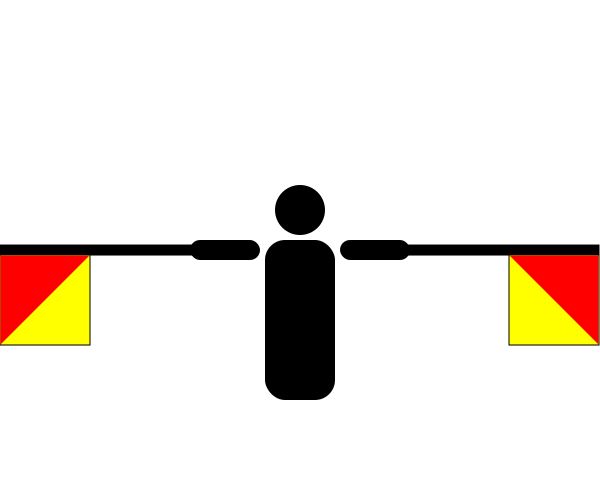
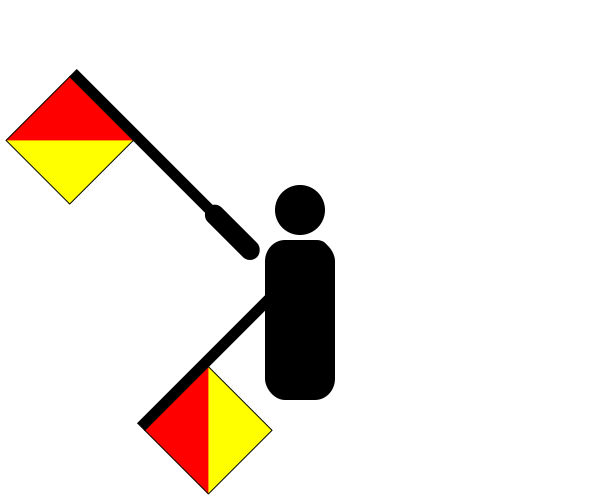
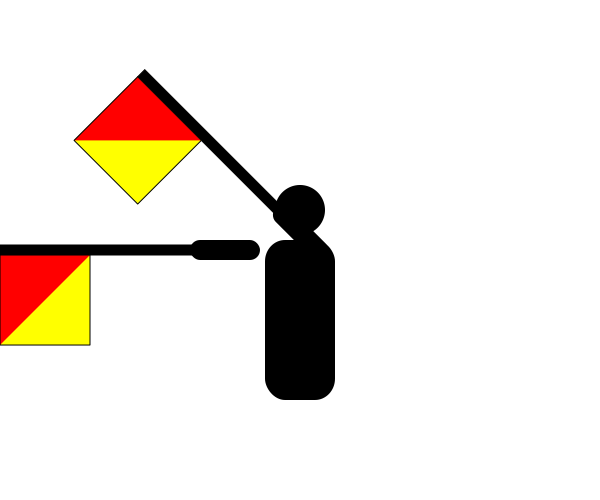

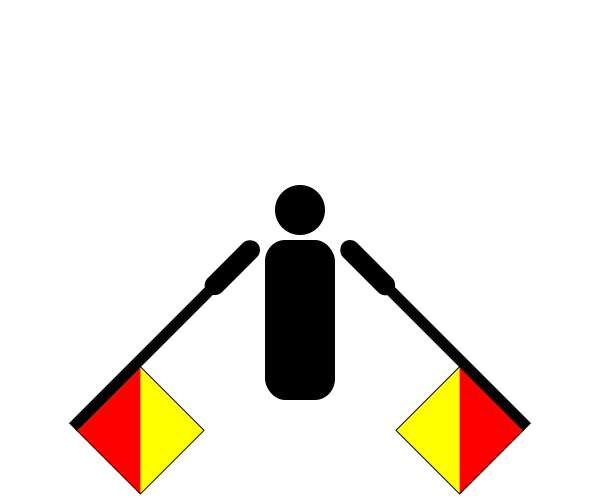
There are approximately 60 people named Grigorian in the UK. That makes it one of Britain's least common surnames. Only around one in a million people in Britain are named Grigorian.