GRIFFEN
Griffen is a surname that finds its earliest roots in the Welsh language, deriving from the personal name Gruffudd, which translates literally as “strong lord” or “powerful chief.” It is a patronymic surname, originally employed to identify the descendants of a man named Gruffudd and was subsequently passed down through successive generations as a family name.
While the primary origin is Welsh, linguistic scholarship recognises that the surname may also possess additional sources. In Old German, the word grifan meaning “to snatch or grasp” evolved into Middle English griffin, and the surname could have served as a nickname for a fierce or formidable person. An Irish variant, the Anglicised form of the Gaelic O'Griobhtha—where the prefix O denotes “descendant of” and Grioghtha stems from griobh, meaning griffin—also contributes to the name’s complex heritage.
The documented history of Griffen extends back to the mid‑12th century. The earliest recorded spelling is that of Robert Grifin in the Winton Rolls of Hampshire (1148), during the reign of King Stephen (1135‑1154). Subsequent entries include Robert Griffin in the 1197 Pipe Rolls of Warwickshire, John Grifen in the 1230 Chartulary of the Priory of St. Thomas the Martyr near Stafford, and the christening of John, son of Jane and George Griffin, dated 4 September 1558 at St. Andrew by the Wardrobe, London.
The Griffen family was granted a heraldic device that has become associated with the name. The coat of arms is described as a black field bearing a silver griffin in a position of segreant, with a gold beak and fore‑legs. This emblem reflects the symbolic ferocity and guardianship that the mythical griffin traditionally embodies.
In the British Isles, the surname is predominantly found in England and Wales, where the population has maintained a strong Christian tradition. Its prevalence in other English‑speaking nations—such as the United States, Australia, Canada, and Ireland—attests to historical migration patterns that saw bearers of the name relocate in search of new opportunities while preserving their ancestral identity.
Variations of the surname reflect both linguistic evolution and geographic dissemination. Common forms include Griffin, Griffith, Gryffin, Griffon, Griffyn, and Gryphon, each recognised within specific regions of Wales, Ireland, and England. The suffix -s and -son are frequently added in Welsh and Scottish contexts, producing patronymics such as Griffiths and Griffithson, whereas the Irish prefixes Mc and O yield McGriffin and O'Griffin.
Historically, the name has been associated with status, leadership, and a sense of noble heritage, mirroring the qualities suggested by its Welsh etymology and the mythic symbolism of the griffin. The enduring presence of Griffen across centuries and continents underscores a lineage that honours its ancestral roots while adapting to new cultural contexts.
Typical given names associated with the Griffen surname
Male
- Alexander
- Brian
- Christopher
- David
- James
- John
- Mark
- Nigel
- Paul
- Peter
- Richard
- Robert
Female
- Angela
- Catherine
- Debra
- Diane
- Elizabeth
- Emma
- Helen
- Julie
- Karen
- Kerry
- Laura
- Margaret
- Mary
- Sharon
- Tina
Similar and related surnames
- Griffan
- Griff
- Griffens
- Griffe
- Caravan
- Caravona
- Carofano
- Carphin
- Carvan
- Carvana
- Carven
- Carvin
- Corfan
- Corvan
- Corven
- Corvin
- Corvino
- Cravan
- Craven
- Cravin
- Cravon
- Creavan
- Creaven
- Creavin
- Crevan
- Crivan
- Criven
- Crivon
- Croven
- Crovin
- Curivan
- Currivan
- Curvan
- Curven
- Curvin
- Garafin
- Garavan
- Garaven
- Garavini
- Garfen
- Garfin
- Garofano
- Garofeanu
- Garrafin
- Garrifin
- Garvan
- Garvani
- Garven
- Garvin
- Garvine
- Garvon
- Gorevan
- Gorevin
- Gorfin
- Gorvan
- Gorven
- Gorvin
- Grafen
- Graffen
- Graffin
- Graffini
- Gravagna
- Gravani
- Gravano
- Graven
- Gravin
- Gravina
- Gravino
- Greeven
- Greffin
- Greven
- Grevin
- Grffin
- Grieffin
- Grifan
- Griffem
- Griffes
- Grifffin
- Griffin
- Griffine
- Griffins
- Griffioen
- Griffn
- Griffo
- Griffon
- Grifin
- Grifoni
- Grivon
- Groffin
- Grovan
- Groven
- Grovin
- Gurvan
- Karavan
- Karvani
- Karvouni
- Keirven
- Kerevan
- Kerivan
- Kerivin
- Kervan
- Kervein
- Kerven
- Kervin
- Kirvan
- Kirven
- Kirvin
- Korvin
- Kraven
- Krivan
- Krivine
- Krovina
Related and similar names are generated algorithmically based on the spelling, and may not necessarily share an etymology.
How to communicate the surname Griffen in...
Braille
⠛⠗⠊⠋⠋⠑⠝
Morse
--..-.....-...-..-.
Semaphore

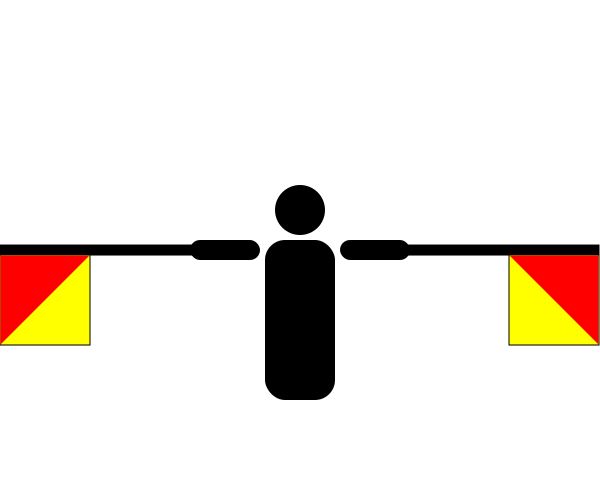
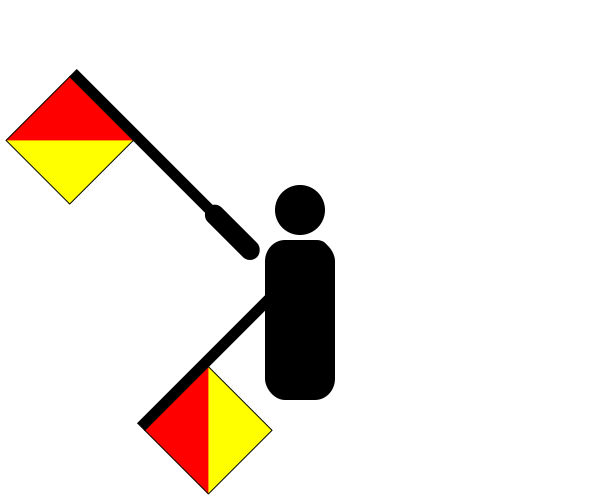
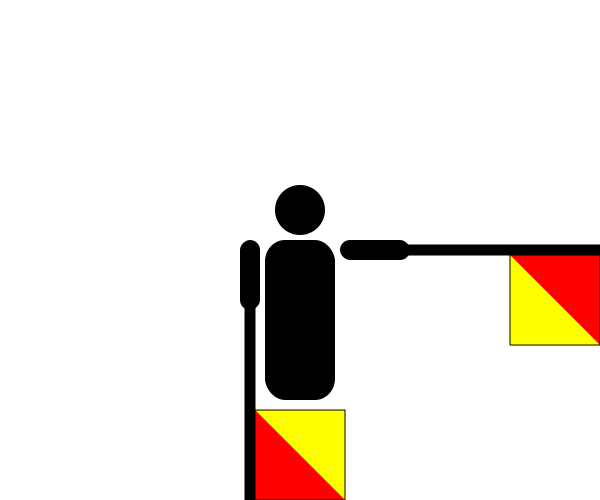

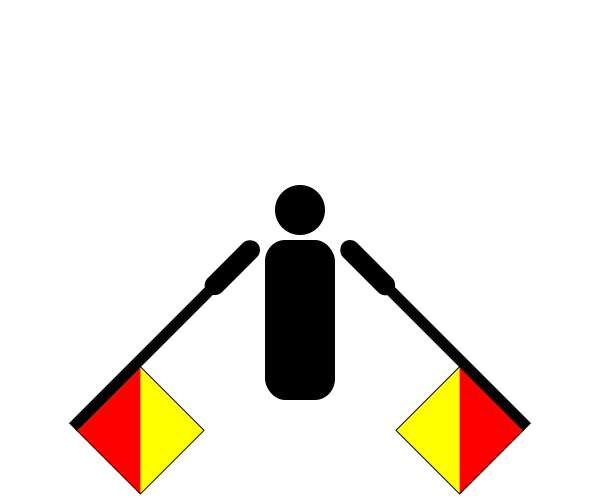
There are approximately 460 people named Griffen in the UK. That makes it one of Britain's least common surnames. Only around seven in a million people in Britain are named Griffen.
Origin: English
Region of origin: British Isles
Country of origin: England
Religion of origin: Christian
Language of origin: English
