GRICE
Genetically and socially the name Grice is recognisable as a surname of English provenance. It emerged within the British Isles and has retained a predominantly English linguistic heritage, though it has been recorded in other countries as a result of migration and anglicisation.
The earliest recorded meaning of the word derives from the Middle English noun grice, signifying a young pig or piglet. In the occupational naming system that prevailed in early medieval England, a person who raised pigs or worked closely with them may have been identified by this descriptor. An alternative derivation comes from the Old English root gris, meaning pig or hog, which could have been employed as a nickname for someone whose reputed traits evoked a pig, or as an indicator of one who lived near a pigsty.
There is also a tradition that recognises a French influence. In Old French the adjective gris means grey; hence the surname may have originally described a grey‑haired individual or someone who habitually wore grey garments, possibly a member of a monastic order. Conversely, the Old French noun grice also means pig or hog, furnishing a parallel occupational origin to the English one. This dual French possibility is reflected in surviving medieval documents.
Documentary attestations of the name date back to the twelfth and thirteenth centuries. The Feet of Fines of Norfolk record a Robert le Gris in 1185, while the Assize Rolls of Kent contain an entry for Leticia Grise in 1317, and the York Freemen document cites a Richard Grice in 1413. The earliest known inclusion in the official English record is in the Pipe Rolls of Northumberland in 1176, where a person named Richard Gris is listed; this is the initial contemporary spelling of the family name.
In 1262 the Gloucestershire document shows Ricardi filij Grici, the first extant citation of Grice as a surname in the shape that recognises a gender‑neutral patronymic. Subsequent medieval accounts describe the surname’s presence in Dorset, Devon, Kent, Somerset, Gloucestershire, Lancashire, Yorkshire, Derbyshire and Oxfordshire, indicating a widespread geographical distribution across southern and northern England.
Across the centuries the name has evolved into a wide array of orthographic variants, including Grice, Grise, Griss, Le Grice, Legrice, Le Grys, as well as further derivatives such as Greaves, Grece, Gryce, Gricey, and others. On the other hand, related surnames in Ireland and Scotland, such as Greig, Gregg, Grieve and Greigson, may share a common Germanic root heerein whereas the English Grice is primarily tied to the pig‑derived origin.
A coat of arms that has been granted to families bearing the name shows a gold field with a red chevron positioned between three boar’s heads; the crest consists of a black‑amoured head flanked by two gold wings. These heraldic emblems reflect the occupational association with swineherdry and the symbolic use of the boar in medieval iconography.
During the early modern period the Grice surname appears in the records of both the United Kingdom and the United States. An early colonial settler, James Grice, arrived in Virginia in 1616, followed by John Grice in 1665 and Nathaniel Grice in Pennsylvania in 1712. Today the name remains most common in the United Kingdom, especially in Lancashire, Yorkshire and Oxfordshire, but it also enjoys substantial frequencies in the United States, with occurrences in California, Texas, Florida and New York, and in Canada.
The surname’s continued prominence is recognised in contemporary genealogical databases, where it is listed among the more prevalent surnames in the UK. Its long documented history and broad geographical reach reflect the enduring nature of English naming traditions and their transmission across the Atlantic to English‑speaking colonies and beyond. Those who now carry the name are part of a lineage that has survived for over eight centuries, rooted in a simple animal reference yet enriched by its historical, linguistic and cultural dimensions.
Typical given names associated with the Grice surname
Male
- Andrew
- Anthony
- Christopher
- David
- John
- Michael
- Paul
- Peter
- Richard
- Stephen
Female
- Elizabeth
- Helen
- Jane
- Jean
- Julie
- Margaret
- Mary
- Nicola
- Patricia
- Rebecca
- Sarah
- Susan
Similar and related surnames
Related and similar names are generated algorithmically based on the spelling, and may not necessarily share an etymology.
How to communicate the surname Grice in...
Braille
⠛⠗⠊⠉⠑
Morse
--..-...-.-..
Semaphore

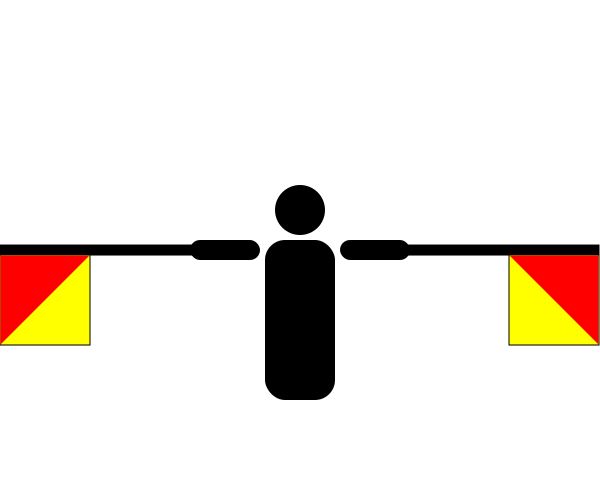
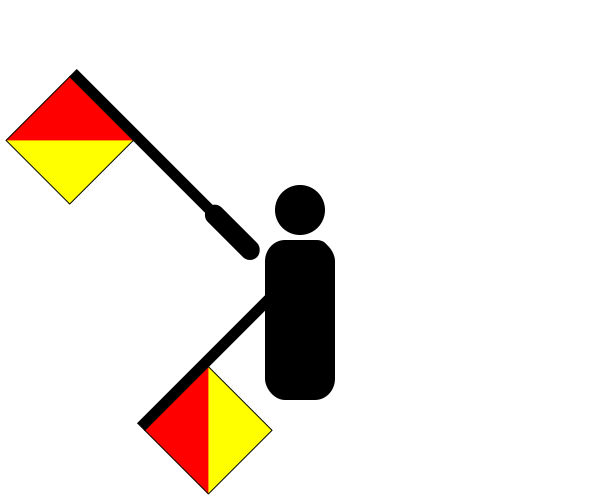


There are approximately 6,630 people named Grice in the UK. That makes it roughly the 1,419th most common surname in Britain. Around 102 in a million people in Britain are named Grice.
Origin: English
Region of origin: British Isles
Country of origin: England
Religion of origin: Christian
Language of origin: English

Famous people named Grice
- Paul Grice - Philosopher (1913 to 1988)
- Charlie Grice - Athletics competitor
- Mike Grice - Football player (1931 to 2002)
- Marjorie Grice-Hutchinson - Economist (1909 to 2003)
- Neve Grice - Football player (1881 to 1950)
Names and descriptions courtesy of Wikipedia, and may contain errors. This is not intended to be an exhaustive list of every famous person with this name.