GRACEY
Gracey is a surname that can be found in the British Isles, with particularly strong historical associations in Scotland and Ireland. The name is of Latin origin, derived from the word gratia meaning “favor” or “kindness”. This etymology suggests that early bearers of the name were regarded as holders of goodwill or benefactors within their communities.
In Scotland, the surname is commonly linked to the personal name Grace, itself a Latinised form that entered the English language during the medieval period. The transition from gratia to Grace was often accompanied by the diminutive suffix -ey, a process seen in other surnames of French influence. Consequently, Gracey can be understood as “little Grace”, a nod to either the personal virtue or the characteristic of the individual who bore the name first.
The name also appears to have locational roots. In Old English, the word groes meant “pasture” or “grazing land”, and a person living near or on such a meadow might have been identified by this descriptor. This locational sense aligns with the Germanic gras and reinforces the pastoral connotations that are sometimes associated with the name.
Early documentary evidence of the surname dates back to the late thirteenth century. The first recorded spelling, that of Gilbert Gracye, appears in the Subsidy Rolls of Sussex of 1296, during the reign of King Edward I. This early appearance places the name firmly within the legal and tax records of medieval England and indicates a settled presence in that region.
Further evidence of the surname’s presence in England is found in the will of Stephen Gracey, who married Jane Allcock at St. James, Dukes Place, London on 23 September 1680. The record of this civil ceremony shows that the name continued to be used and recognised across several centuries within the English population.
In Ireland, the surname is recorded as part of the Gaelic tradition. Although the name is Latin in origin, it appears within the Irish cultural milieu and is listed among surnames of Christian influence in the British Isles. Linguistic studies note that certain Welsh and Irish filiation patterns may have contributed to the adaptation of the name within these regions.
Overall, the surname Gracey demonstrates a blend of personal virtue—rooted in the Latin word for favour—and geographical signifiers, reflecting the complex patterns of surname development in the medieval British Isles. The use of the diminutive suffix -ey and its documented appearance in the thirteenth and eighteenth centuries illustrate the enduring nature of this family name across the English and Scottish literatures and records.
Typical given names associated with the Gracey surname
Male
- Andrew
- David
- Ian
- James
- John
- Mark
- Patrick
- Paul
- Robert
- Thomas
- William
Female
- Ailsa
- Anita
- Anna
- Elizabeth
- Emma
- Helen
- Jacqueline
- Jane
- Julie
- Margaret
- Mary
- Sarah
Similar and related surnames
Related and similar names are generated algorithmically based on the spelling, and may not necessarily share an etymology.
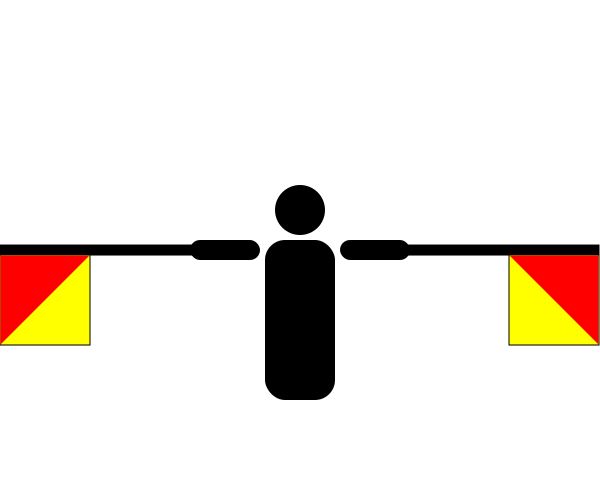
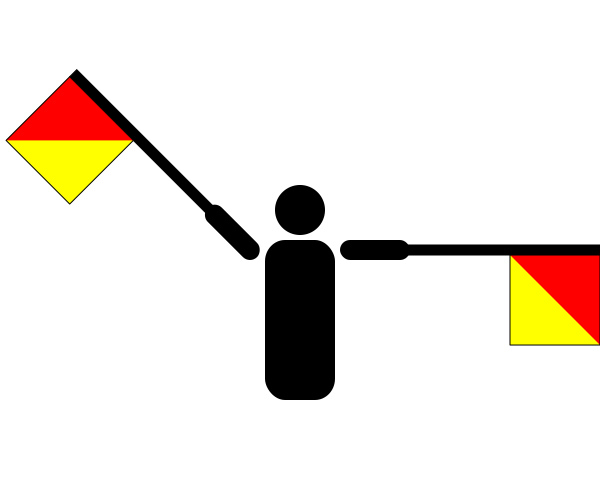
How to communicate the surname Gracey in...
Braille
⠛⠗⠁⠉⠑⠽
Morse
--..-..--.-..-.--
Semaphore



Did you know?
According to a survey carried out by Democracy Club, politicians and candidates with the surname Gracey are most likely to say that their favourite biscuit is a Chocolate Digestive.
There are approximately 781 people named Gracey in the UK. That makes it roughly the 8,945th most common surname in Britain. Around 12 in a million people in Britain are named Gracey.
Origin: Celtic
Region of origin: British Isles
Country of origin: Ireland
Religion of origin: Christian
Language of origin: Gaelic
