GOVE
Gove is a surname of English origin that has been recorded in the British Isles since the early medieval period. The name is first associated with Scotland, where it emerged as an occupational surname for a worker in metal, deriving from the Old Gaelic word gobha, meaning smith. Meticulously skilled metal‑workers such as smiths were essential to feudal societies, forging weapons, armour and agricultural implements. In this context, the surname Gove was a term of respect, indicating a person of notable craftsmanship and social standing within the clan structure, though it was not linked to any particular clan.
In addition to its occupational origin, the surname also contains a patronymic element rooted in Old English. The word gofa, meaning godfather or godparent, gave rise to a nickname for individuals who performed baptismal duties. Over time, this nickname became hereditary, expanding the surname’s usage beyond the metal‑working trade. Thus, Gove should be understood as possessing dual etymological pathways: one of craft and one of religious function.
Historical records demonstrate the surname’s longevity. The earliest documented spelling appears in the Charters of the Priory of Beauly, dated 1278, where Colin Gove is listed as constable of Taruid. This record places the family firmly within the Scottish context during the reign of King Alexander I, who ruled from 1249 to 1286. Subsequent parish registers from the early eighteenth century record several christenings of individuals bearing the surname, including John Gove in 1705 and William Gove in 1706, both in the parishes of Cromdale, Inverallan and Advie within the Inverness area.
Regarding heraldry, the Gove family was granted a distinctive coat of arms featuring a silver shield with a cross lozengy and four black eagles displayed. The crest includes a black demi‑monkey emerging from a gold mural coronet, a unique design that visually distinguishes the family within English and Scottish heraldic traditions.
Among the more prominent bearers of the surname is Richard Gove, M.A., of Oxford, who lived in the early sixteenth century. An orthodox clergyman, he was known for authoring numerous pious works that contributed to religious scholarship of the period. His inclusion in the “National Biography” underscores the intellectual and spiritual influence that members of the Gove family have exerted on English society.
Throughout its history, the surname has been anglicised in various forms. The most common are Gow and Gowan, the latter derived from the genitive Gaelic gobhainn. These variations reflect the natural linguistic adaptation that occurred as the family integrated into broader English-speaking communities.
Overall, the surname Gove embodies a rich tapestry of cultural, occupational and religious heritage within the British Isles, with documented roots stretching back to the medieval era and continuing into the modern age.
Typical given names associated with the Gove surname
Male
- Alan
- Andrew
- Christopher
- David
- Gary
- Grant
- James
- John
- Michael
- Peter
- Stuart
- William
Female
- Alison
- Angela
- Deborah
- Fiona
- Helen
- Jennifer
- Julie
- Linda
- Lindsay
- Margaret
- Mary
- Sandra
- Sarah
Similar and related surnames
Related and similar names are generated algorithmically based on the spelling, and may not necessarily share an etymology.
How to communicate the surname Gove in...
Braille
⠛⠕⠧⠑
Morse
--.---...-.
Semaphore

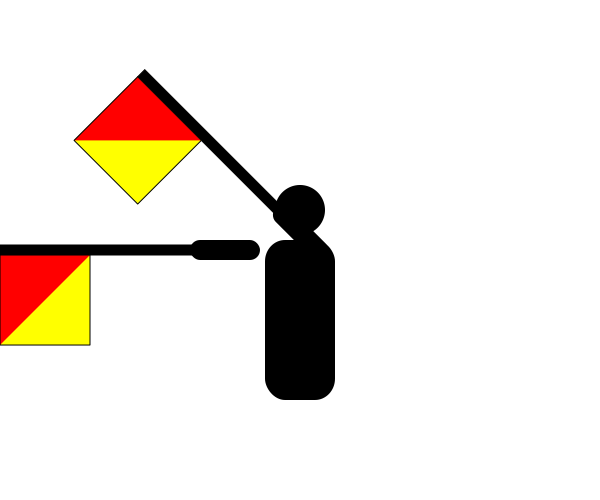
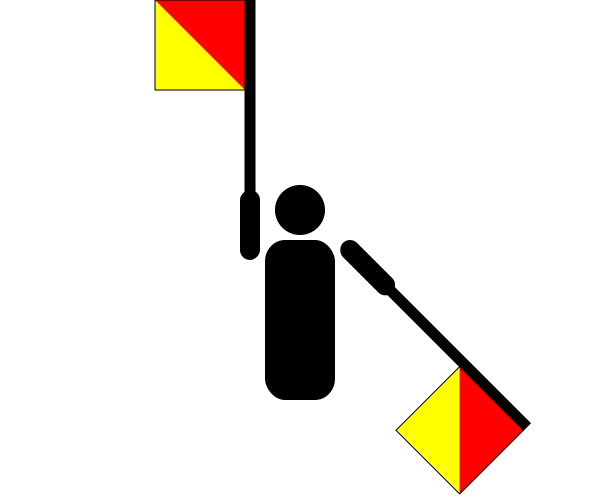

There are approximately 792 people named Gove in the UK. That makes it roughly the 8,846th most common surname in Britain. Around 12 in a million people in Britain are named Gove.
Origin: Celtic
Region of origin: British Isles
Country of origin: Scotland
Religion of origin: Christian
Language of origin: Gaelic

Famous people named Gove
- Michael Gove - Politician
Names and descriptions courtesy of Wikipedia, and may contain errors. This is not intended to be an exhaustive list of every famous person with this name.