GORST
Origin
The surname Gorst is of English origin. It is derived from the Old English word *gorst*, which denotes a type of shrub or bush. As a topographic surname it was normally applied to a person who resided in an area where these bushes were plentiful, thereby identifying the individual by the natural landscape surrounding them。
Etymology
In linguistic terms, the root *gorst* is related to the Old English word *gors*, meaning gorse. The name is therefore habitational, indicating a dwelling place characterised by the presence of gorse bushes. Some scholars note that the combination of elements that produced surnames in the Victorian era resembled Anglo‑Saxon compound names of the eighth century, each part conveying a distinct meaning, though the combined form itself no longer retained a literal sense. In the case of Gorst, the focus remains on the geographical feature rather than a polysemic abbreviation.
Historical Record
The earliest documented instance of the name is found in the Pipe Rolls of the City of Worcestershire, where a record dated 1275 names Roger de la Gorst. These documents were produced during the reign of King Edward I, who reigned from 1272 to 1307. Subsequent references appear in parish registers and deed rolls throughout the late thirteenth and early fourteenth centuries, indicating that the name was in use in several English localities, particularly where gorse vegetation was common.
Variations and Related Surnames
The name has occasionally been recorded with the spelling Gors or Gorseth, yet the most prevalent form remains Gorst. Related locational surnames, such as Unsworth, share a similar pattern of dual origin – the first component being derived from a natural feature (e.g. gorse) and the second from a settlement descriptor (e.g. “–worth” meaning enclosure). Although these pairs of surnames illustrate a broader naming convention, no direct genealogical linkage exists between individuals bearing the distinct names of Gorst and Unsworth without an examination of specific family pedigrees.
Conclusion
The surname Gorst exemplifies a class of English surnames that were created to describe the physical environment surrounding an ancestor’s place of residence. Its continued presence in historical records confirms its authenticity and provides a tangible link to the medieval landscape of England, where gorse bushes were a familiar sight. No speculative extensions of its meaning or origin are warranted beyond the established linguistic and documentary evidence.
Typical given names associated with the Gorst surname
Male
- Adrian
- Alan
- Anthony
- David
- James
- John
- Marcus
- Michael
- Philip
- Richard
- Robert
- Stephen
- Thomas
- William
Female
- Amanda
- Catherine
- Elizabeth
- Jane
- Julie
- Margaret
- Michelle
- Ruth
- Sarah
- Susan
Similar and related surnames
Related and similar names are generated algorithmically based on the spelling, and may not necessarily share an etymology.
How to communicate the surname Gorst in...
Braille
⠛⠕⠗⠎⠞
Morse
--.---.-....-
Semaphore

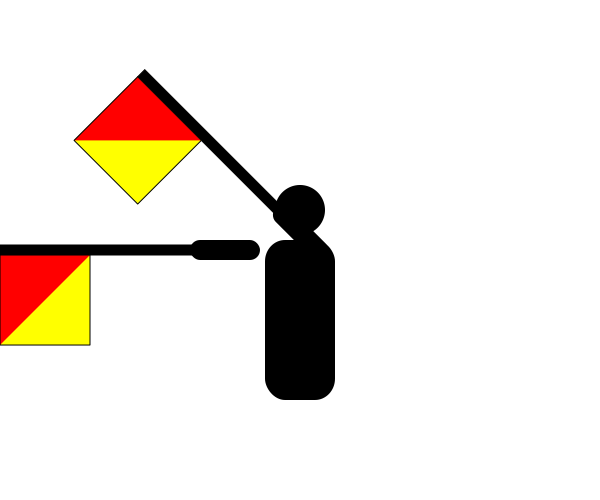
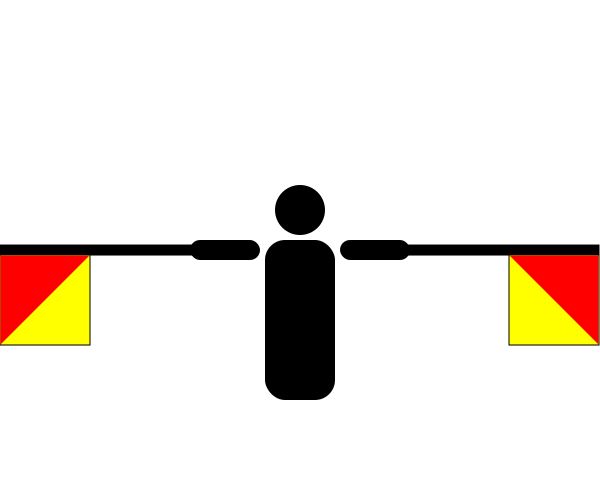

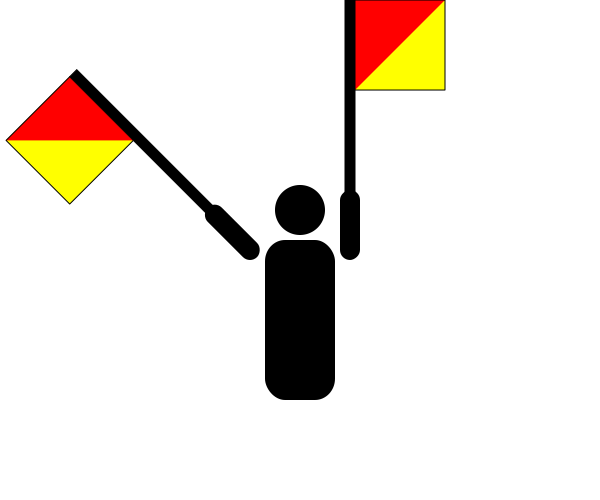
There are approximately 1,029 people named Gorst in the UK. That makes it roughly the 7,207th most common surname in Britain. Around 16 in a million people in Britain are named Gorst.

Famous people named Gorst
- Ian Gorst - Jersey politician, chief minister of Jersey, and an accountant
- John Gorst - Conservative party Member of Parliament (1928 to 2010)
Names and descriptions courtesy of Wikipedia, and may contain errors. This is not intended to be an exhaustive list of every famous person with this name.