GOODRUM
Goodrum is an English surname that originates from the British Isles and is traditionally linked to the Christian heritage of England. Historically it is believed to be derived from the Old English words god, meaning “good”, and rum, meaning “fame” or “renown”. Consequently, the surname can be interpreted as “one who is famous for being good” or “renowned for their goodness”, suggesting that it was originally bestowed upon individuals noted for virtuous or honourable qualities.
Another scholarly view proposes that variations of the name – such as Goodram, Gooderham and Guthrum – derive from the Old Norse personal name Gathormr, a compound of guth (“battle”) and ormr (“snake” or “serpent”). This etymology would render the name as “battle snake”, a metaphor possibly used for a warrior or a person of a fierce reputation. The name is recorded in the York street-name Goodragate and was historically associated with the first Danish King of East Anglia.
The earliest surviving record of the surname is that of Hugh Godrum, which appears in the Assize Rolls of Lincolnshire in 1260, during the reign of King Henry I, the Frenchman. This places the surname firmly in the mid thirteenth century.
Subsequent mentions in parish and civic documents add further evidence of its antiquity: a Thomas Guderam appears in the Subsidy Rolls for Suffolk dated 1283; in 1601, Alice White married John Goodrome at St. Gregory by St. Paul’s, London; and in 1706, Hester Goodram was christened on 22 July at St. Giles’, Cripplegate, London.
Additional records illustrate the spread and adaptation of the name across the country. For instance, on 28 May 1720, Godfrey Goodram married Elizabeth Alred in Great Yarmouth, Norfolk; and on 12 November 1749, George, son of Thomas and Mary Goodrum, was christened at St. Andrew’s, Holborn, London.
Geographically, the surname is most frequently found recorded in Norfolk, with a notable concentration of variants in that region. The place-name Goodragate in York further indicates the historical presence of the name in northern England.
Today, the surname Goodrum remains in use within England and, by extension, in other English-speaking countries. It is recognised as a modestly uncommon surname that carries with it a heritage of both Christian virtue and, in some interpretations, Norse warrior ethos. Its etymological roots remind bearers of the diverse linguistic and cultural strands that have woven together in English history.
Typical given names associated with the Goodrum surname
Male
- Daniel
- David
- Ian
- John
- Mark
- Matthew
- Michael
- Paul
- Peter
- Robert
- Stephen
Female
- Alison
- Christine
- Elizabeth
- Helen
- Irene
- Karen
- Margaret
- Rebecca
- Sarah
- Susan
- Tracey
Similar and related surnames
Related and similar names are generated algorithmically based on the spelling, and may not necessarily share an etymology.
How to communicate the surname Goodrum in...
Braille
⠛⠕⠕⠙⠗⠥⠍
Morse
--.-------...-...---
Semaphore

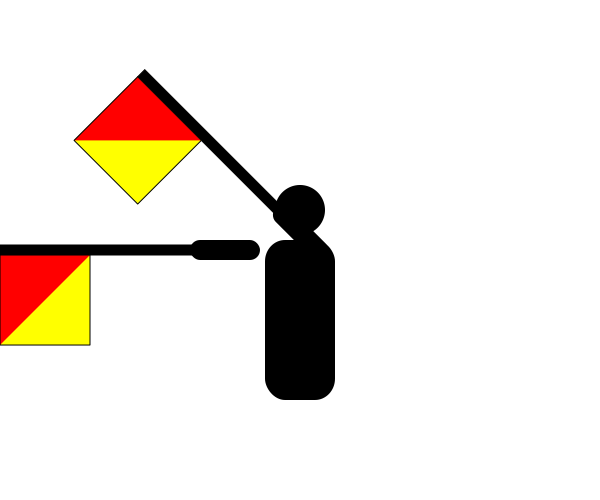

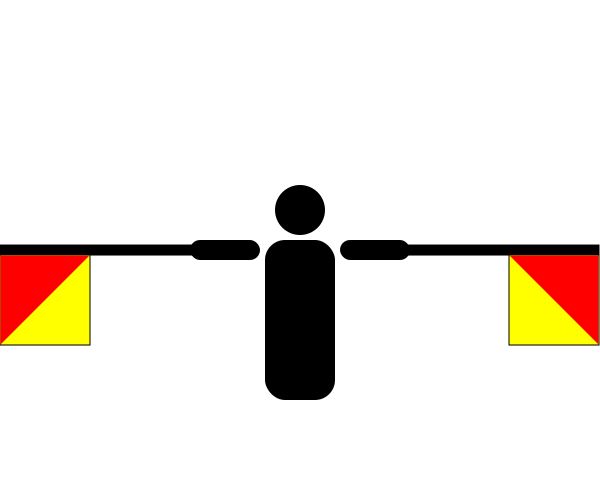

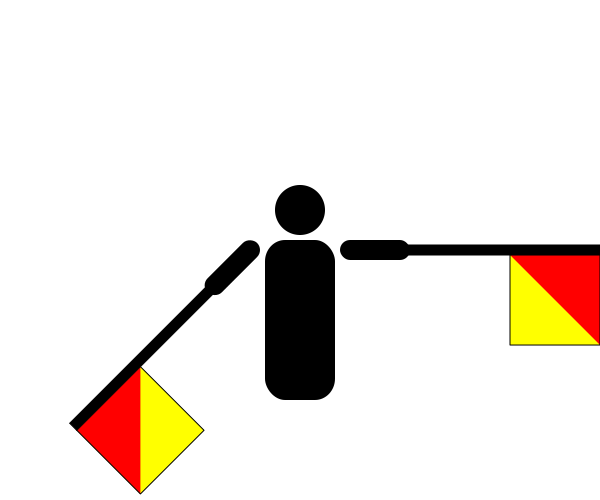
There are approximately 1,238 people named Goodrum in the UK. That makes it roughly the 6,268th most common surname in Britain. Around 19 in a million people in Britain are named Goodrum.
Origin: English
Region of origin: British Isles
Country of origin: England
Religion of origin: Christian
Language of origin: English
