GOING
Going is a surname of English origin, first recorded in documents relating to the British Isles, particularly England. It is traditionally associated with the Christian community and with the English language.
The earliest linguistic form of the name is linked to the Old English word gang, which means “to go” or “to walk”. Thus the surname could have arisen as a nickname for a person who was perpetually on the move or who displayed a restless nature. The derivation from a verb in this manner is a recognised pattern in English surname formation.
Another plausible explanation for the surname is locational. In Old English a gong referred to a road or passage. Consequently, a surname such as Going could have been adopted by someone dwelling near a main road or a notable passageway. Such locational surnames were common in medieval England.
There is also evidence that the name may originate from a pre‑10th‑century Gaelic form signifying “a smith”, derived from Gabha. The earliest surviving references to the surname in Essex date to the sixteenth century, including the marriage of Marie Gowen to Thomas Turner in 1585 and the baptism of Ann Going in 1735. Variants such as Gowens, Gowing, and Gowen appear in earlier records, for example Thomas Gowing in 1639 and John Gowens in 1693.
In Anglo‑Saxon tradition the suffix -ing was employed to form a patronymic, meaning “son of”. The personal name Gohn, which was associated with the meanings “good” or “god”, could have given rise to the surname through the construction Gohn-ing, subsequently evolving into Going. Some scholars also suggest a link with the Middle English term Gowen, traced back to the Gaelic Eòghan, and the anglicised forms Gowing, Gowen and Goin.
Throughout the Middle Ages the surname spread across regions of England and Ireland, and it later appeared in Scotland as an adaptation of the Gaelic “Gobha” meaning smith, which was anglicised to Gow and eventually altered to Going. Over the centuries of British colonisation and emigration, individuals bearing the name settled in the United States, Australia and Canada, with a noticeable presence in the southern United States in more recent census data. Today the surname remains uncommon but can still be found in English‑speaking countries.
Presently recorded variations of the surname include Goyne, Goynes, Goen, Goins, Gowing, Gowinges, Goings, Goin, Goan, Gowon and Goyn. Surnames such as Gawen, Gwyn, and Gones are occasionally considered related. The distribution of the surname continues to mirror historical migration patterns and the particular lineage of each family.
Typical given names associated with the Going surname
Male
- Anthony
- Carl
- Christopher
- Jason
- John
- Michael
- Patrick
- Peter
- Richard
- Robert
- Vaughan
- William
Female
- Amanda
- Ann
- Eileen
- Emma
- Hannah
- Janet
- Joanne
- Lauren
- Linda
- Rebecca
- Sarah
- Susan
- Tracy
- Valerie
Similar and related surnames
Related and similar names are generated algorithmically based on the spelling, and may not necessarily share an etymology.
How to communicate the surname Going in...
Braille
⠛⠕⠊⠝⠛
Morse
--.---..-.--.
Semaphore

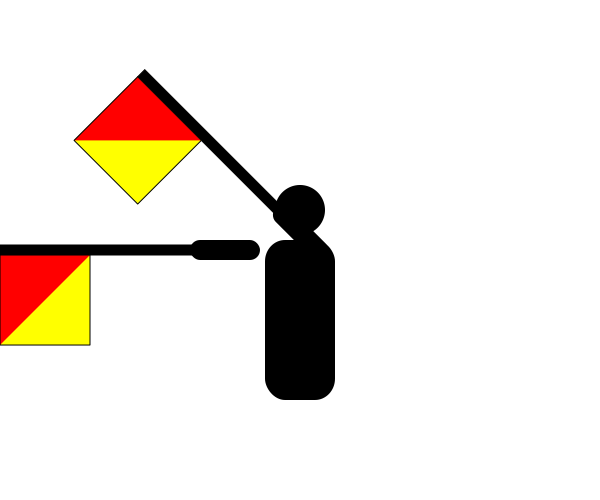
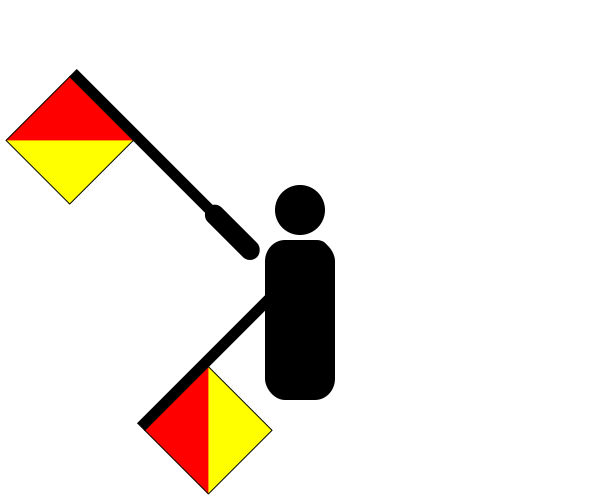
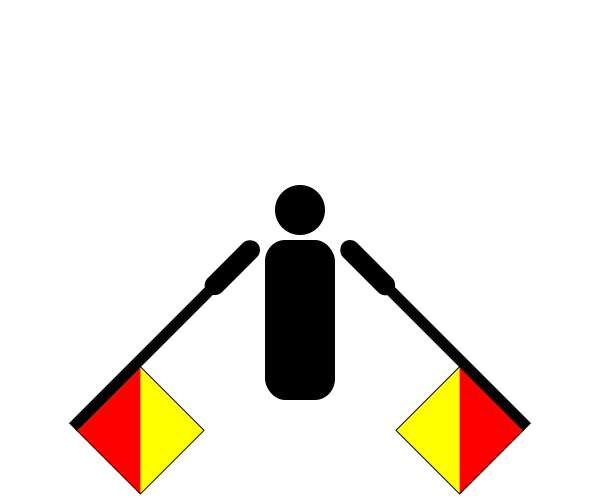
There are approximately 222 people named Going in the UK. That makes it one of Britain's least common surnames. Only around three in a million people in Britain are named Going.
Surname type: Location or geographical feature
Origin: English
Region of origin: British Isles
Country of origin: England
Religion of origin: Christian
Language of origin: English
