GOFORTH
Goforth is an English surname that can be traced back to the Old English phrase gān forþ, meaning “to go forth”. The name is essentially a locational surname, traditionally bestowed upon individuals who resided near a road or path that led out of a settlement, indicating that they were situated in a place from which they would proceed or depart.
The literal translation of the surname is “go forward”, a phrase that carried connotations of progress, pioneering, and trailblazing during the Middle Ages. Such surnames were commonly created when a person was noted for travel or for being physically inclined to move forward in society.
In the northern counties of Yorkshire and Lincolnshire the name Goforth appears as an almost exclusive variant of the more familiar surnames Gifford and Giffard. These surnames are of Old French origin, introduced into England after the Norman Conquest of 1066. The original French word giffard translates as “chubby‑cheeked”, and the surname is recorded in the Domesday Book of 1086 in a Latinised form “Gifardus”; a member of the family named Walter Gifhard appears in this record. Over time, the spellings evolved into forms such as Giffard, Gifford, Jefferd, Jefford, Gof‑f‑ord, Gof‑f‑orth and Gayforth, the latter two arising from a mistaken association with the Old English ford.
Historical church registers document the surname in the early modern period. The marriage of William Goforth and Agnes Smithson was recorded in Howden, Yorkshire, on 24 April 1581, while the union of Richard Goforth and Alice Johnson appeared in Spalding, Lincolnshire, on 24 January 1635. The earliest recorded spelling of the family surname is Richard Gofforth, christened at Howden on 4 April 1550 during the reign of King Edward VI, known as “The Boy King” (1547‑1553).
The earliest documented reference to the name in the medieval fiscal records is found in the County of Kent, where a Robert Goforth appears in the Pipe Rolls of 1198. Subsequent occurrences include variations such as Goffart, Gotfert and Gofforth. Although the surname is most commonly associated with England, its presence has expanded throughout the United States, particularly in the states of North Carolina, Tennessee and Texas, thanks to migration and settlement patterns.
The multiplicity of spelling variants – examples being Gofforth, Gofoarth, Gofroth, Goffroth, Goferth and Goafarth – reflects regional accents, the translation of phonetics into orthography and occasional clerical errors over many centuries. These variations do not indicate a distinct lineage but rather the natural evolution of a name carried across families and localities.
In summary, the surname Goforth embodies a heritage of movement and geographical significance, with roots in Old English and Old French etymology. Its historical documentation, ranging from the Domesday Book to contemporary church registers, demonstrates a durable presence that has survived linguistic changes and geographical dispersal.
Typical given names associated with the Goforth surname
Male
- Alexander
- Anthony
- Barrie
- Christoper
- Christopher
- Graham
- James
- Joseph
- Martin
- Philip
- Richard
- Robert
- Steven
Female
- Andrea
- Celia
- Chantel
- Claire
- Gemma
- Helen
- Janet
- Joan
- Julie
- Kathleen
- Louise
- Lucy
- Victoria
Similar and related surnames
Related and similar names are generated algorithmically based on the spelling, and may not necessarily share an etymology.
How to communicate the surname Goforth in...
Braille
⠛⠕⠋⠕⠗⠞⠓
Morse
--.---..-.---.-.-....
Semaphore

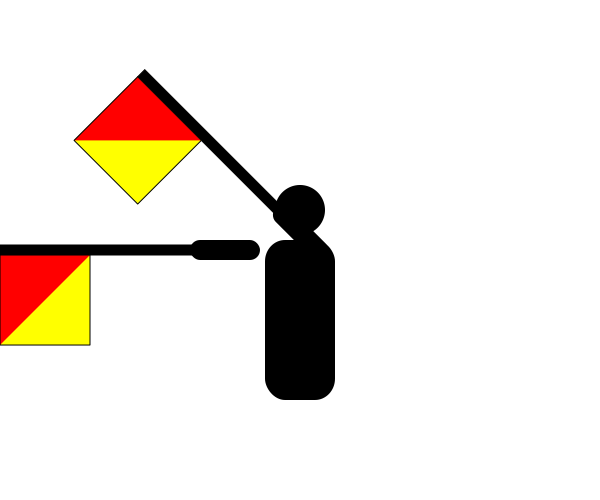
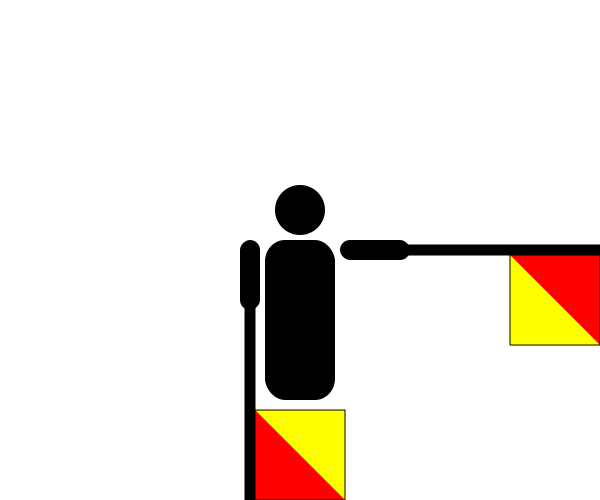
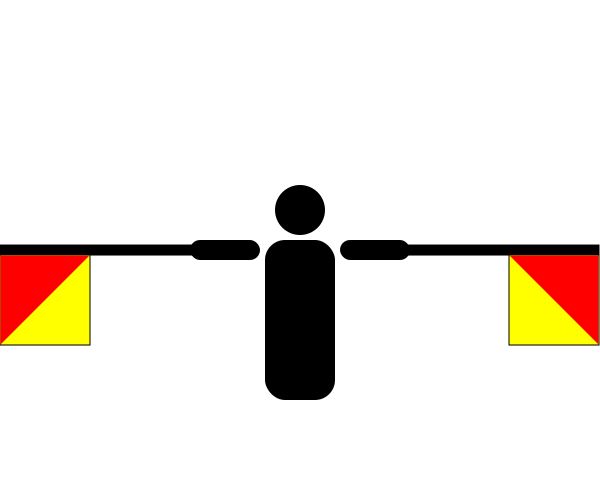
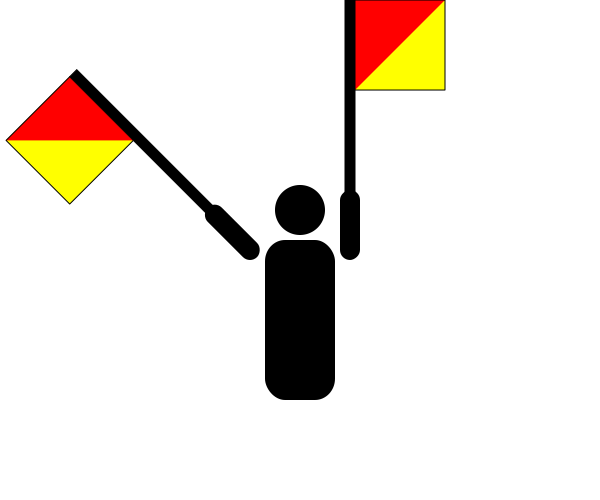

There are approximately 230 people named Goforth in the UK. That makes it one of Britain's least common surnames. Only around four in a million people in Britain are named Goforth.
Surname type: Location or geographical feature
Origin: English
Region of origin: British Isles
Country of origin: England
Religion of origin: Christian
Language of origin: English
