GODING
The surname Goding is of English provenance and is most commonly associated with the British Isles, particularly the county of England. It is a patronymic name formed from a personal name and an identifying suffix, which together convey the notion of lineage.
The personal element of the name derives from the Old English given name Goda. The suffix -ing, a conventional patronymic marker in medieval English, denotes “son of”. Consequently, the combined meaning of the surname is son of Goda.
Scholars recognise that the root personal name Goda was itself likely adopted from the Old Norse name Góði, a word meaning “good” or “godly”. This linguistic borrowing reflects the close cultural contacts between the Anglo‑Saxons and the Norse peoples during the early medieval period.
Documentary evidence of the name appears in the Domesday Book of 1086 in the form of the personal name Godwine (a compound of god “good” and wine “friend” or “protector”). The first confirmed use of the surname Goding is recorded in the latter half of the twelfth century, with entries such as Walter Godwin in the 1177 Pipe Rolls of Norfolk, dated to the reign of King Henry XI.
Over the centuries the name has been spelt in several variants, including Godwyn (listed in Cambridgeshire in 1239) and Goudwyne (noted in Sussex in 1327). Modern civil registers have also documented spellings such as Goding, Godin, and occasionally Goin.
In terms of geographical concentration, the surname is relatively uncommon across England but shows a notable concentration in the East Anglia region, where many genealogical records from the High Middle Ages place bearers of the name.
One historically significant bearer associated with the Goding lineage is Harold, second son of Godwin, who succeeded his father as Earl of Wessex in 1053 and later became King of England in 1066. His tenure, though brief, is recorded in contemporary chronicles and underlines the stature of the family connected to the name.
It is important to distinguish the English Goding from the Germanic surname Göding, which originates in Middle High German and is associated with medieval noble families in German‑speaking Europe. While the spelling is similar, the Germanic form has different etymological roots, relating to terms such as gôde “region” or gastaldus “court official”. The presence of both names in modern Europe is coincidental rather than indicative of a single shared origin.
In conclusion, the surname Goding reflects a lineage rooted in early Anglo‑Saxon naming practices, influenced by Norse linguistic elements and preserved through medieval documentation. Its rarity and concentration in East Anglia make it a distinctive marker of English heritage, with a clear lineage distinct from similarly spelled Germanic surnames.
Typical given names associated with the Goding surname
Male
- Andrew
- Christopher
- Dylan
- Farren
- George
- Mark
- Michael
- Montague
- Paul
- Peter
- Richard
Female
- Alison
- Beryl
- Dawn
- Deborah
- Holly
- Joyce
- Karen
- Keeley
- Kerry
- Lisa
- Margaret
- Patricia
- Susan
- Vera
Similar and related surnames
- Catanack
- Cattanack
- Cattanco
- Catting
- Coating
- Codding
- Coding
- Cotting
- Cowding
- Cudding
- Cuting
- Cutteng
- Cutting
- Gadding
- Gadong
- Gating
- Gatting
- Gauding
- Gdaniec
- Goading
- Godden
- Goddin
- Godding
- Goddings
- Goddington
- Goddins
- Godi
- Godin
- Godina
- Godines
- Godinez
- Godino
- Godins
- Godling
- Godon
- Godwin
- Godwing
- Godyn
- Godzina
- Goeting
- Goodding
- Goodenaugh
- Goodenough
- Gooding
- Goodinge
- Goodings
- Goodinough
- Goodnough
- Gotting
- Gouding
- Gouting
- Gudding
- Kadango
- Kading
- Kaeding
- Katanga
- Katanic
- Katanka
- Kating
- Katnik
- Katongo
- Katunga
- Keating
- Keatting
- Keding
- Keeding
- Keeting
- Keting
- Ketting
- Kiding
- Kieting
- Kiting
- Kotenko
- Kotting
- Kudenga
- Kutnick
- Kutnik
Related and similar names are generated algorithmically based on the spelling, and may not necessarily share an etymology.
How to communicate the surname Goding in...
Braille
⠛⠕⠙⠊⠝⠛
Morse
--.----....-.--.
Semaphore

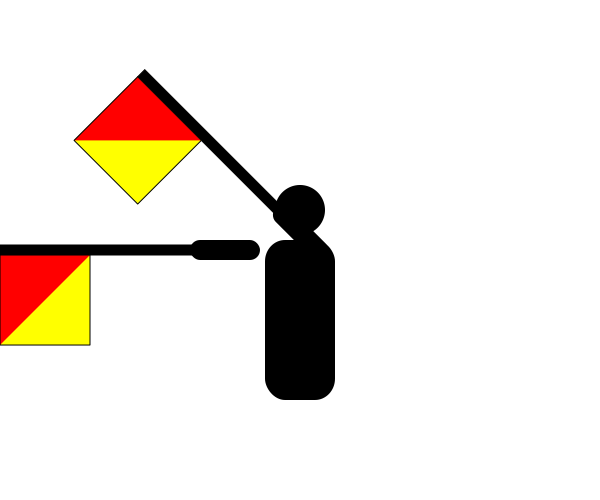

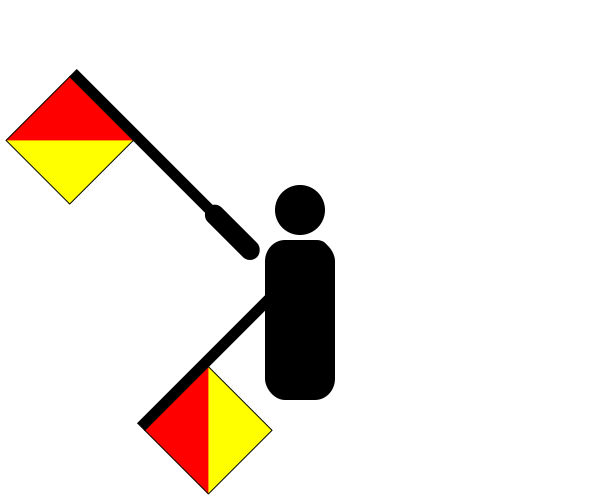
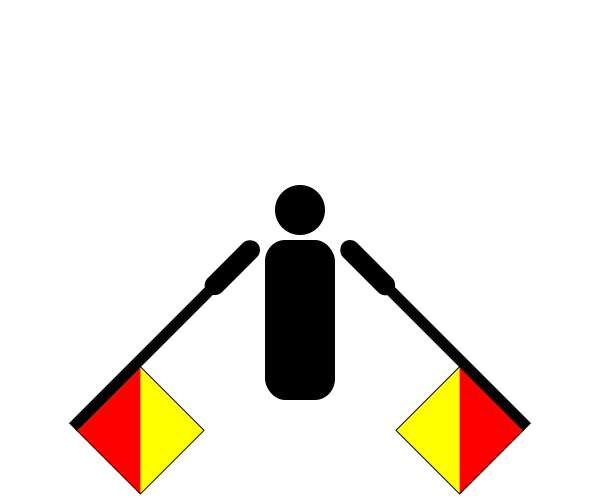
There are approximately 192 people named Goding in the UK. That makes it one of Britain's least common surnames. Only around three in a million people in Britain are named Goding.
Surname type: Location or geographical feature
Origin: English
Region of origin: British Isles
Country of origin: England
Religion of origin: Christian
Language of origin: English
