GODARD
Godard is a surname that traces its roots to both French and Germanic linguistic traditions. The name derives from the personal name Godehard, itself composed of the elements god – meaning “good” or “deity” – and hard – meaning “brave”, “hardy” or “strong”. Consequently, the surname is commonly interpreted as “good and strong” or “brave and noble”.
The introduction of the name into Britain is linked to the Norman Conquest of 1066. Norman settlers brought the personal name Golhard – a variant spelling reflective of regional pronunciation – into the English realm. The name quickly found use across Europe, with recorded forms appearing on contemporary documents such as the Curia Rolls of Hampshire, where a Robert God(d)ard is dated to 1208 during the reign of King John.
Early English records of the surname appear in the mid‑thirteenth century. In 1160–66 a Godardus de Clakesbi is listed in Lincolnshire, and by 1221 individuals such as Wlfrich Godard of Norfolk and Symon Godhard of Cambridgeshire are documented. These attestations illustrate the surname’s early establishment in the English countryside.
Variants of the name are widespread. In France the forms Godart and Goudard are common, while Godar appears in several regional dialects. German records include Gotthard, Godehard and Goddert, and Dutch sources list Goedhard and Goedhart. The surname also surfaces in Holland and in countless other European languages, often adapting to local orthographic conventions.
The distribution of the surname remains strongest in northern France, particularly in the regions of Picardie and Lorraine. It is also found in other French‑speaking territories such as Belgium and Canada, and has a notable presence within the United States, especially in the Midwestern states and parts of New England where French‑Canadian migration has historically been considerable.
Prominent individuals bearing the surname include the 17th‑century engraver John Goddard (fl. 1645–1571), whose work – notably the engraving “Seven Deadly Sins” – is preserved in the British Museum. In modern times, the name has been carried by figures such as the celebrated French filmmaker Jean‑Luc Godard, whose contributions to cinema have repositioned the surname within contemporary cultural consciousness.
The heraldic traditions associated with the Godard family include a coat of arms described as “azure on a fess between three hawks' heads erased gold, five lozenges conjoined in fess green”. This emblem has been preserved in various genealogical registries and serves as a visual reminder of the family’s historical identity.
In sum, the Godard surname encapsulates a rich tapestry of linguistic heritage, historical migration, and cultural significance that persists across centuries and geographies. Its evolution from a Germanic personal name to a widespread family name reflects broader patterns of medieval societal development and the enduring power of nomenclature.
Typical given names associated with the Godard surname
Male
- Andrew
- Christian
- Florent
- Laurent
- Lee
- Michael
- Paul
- Philip
- Simon
- Thomas
Female
- Carol
- Catherine
- Claire
- Emma
- June
- Kendra
- Leigh
- Rosemary
- Sophie
- Stephanie
Similar and related surnames
Related and similar names are generated algorithmically based on the spelling, and may not necessarily share an etymology.
How to communicate the surname Godard in...
Braille
⠛⠕⠙⠁⠗⠙
Morse
--.----...-.-.-..
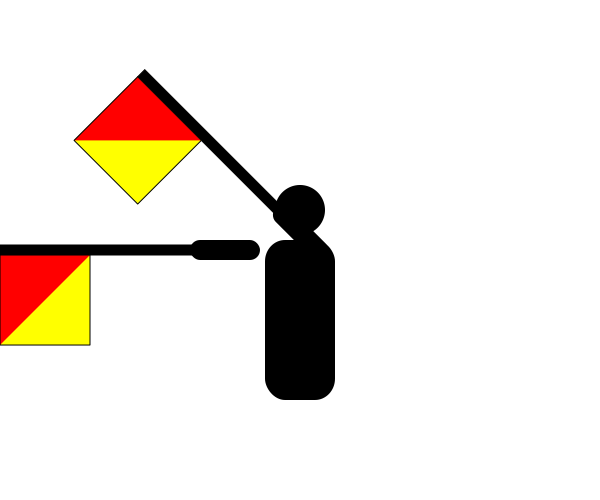
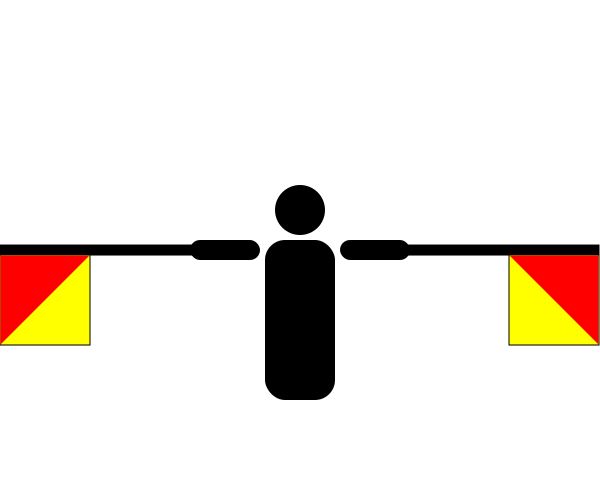
Semaphore



There are approximately 106 people named Godard in the UK. That makes it one of Britain's least common surnames. Only around two in a million people in Britain are named Godard.
