GLOWACKI
The surname Glowacki is of Polish origin and is historically linked to the word głowa, meaning head. It is most often considered a patronymic surname, traditionally used to identify the descendants of an ancestor named Glowacki. The original bearer of the name may have been viewed as a person of importance within their community, or may have been a nickname for an individual with a distinguishing head shape or size.
Recorded variations of the surname are numerous and include Glowach, Glowacha, Glowacz, Glowacki, Glowinski in Poland, Gloyas in Hungary, and the Czech Hlavac and Hlavecek. These forms all derive from the ancient pre‑7th century Slavonic word glowa, translating to head. In medieval practice, such nicknames were often given in reference to a learned person or one who made particular use of his intellect; alternatively, the name may have carried a jocular connotation, reflecting the humour of the period. The evolution from personal nickname to hereditary surname was common in the 14th‑to‑16th century, a time when most European surnames were firmly established.
One recorded instance of the surname appears in the Napoleonic era: Michel Glowacki of Koscielawies, Bydgoszcz, Poland, in 1792; another is Marcin Glowacka of Broniewo, Poland, in 1797. These early records are valuable because they demonstrate the continuation of the name into the modern period despite the scarcity of surviving registers before the eighteenth century.
There are also toponymic theories concerning the surname. One suggests that Glowacki originates from Glowacz, itself derived from the Germanic Glow, meaning range or ridge. Under this interpretation the name would point to an ancestor who lived in a hilly area characterised by such ridges, or who may have been a pilgrim travelling from a nearby Polish settlement. The toponymic interpretation therefore highlights an environmental association in addition to a personal one.
In contemporary times the surname is relatively uncommon but still recognisable. The United Kingdom, Poland, Belarus, Ukraine, and Germany house the largest populations of people bearing the name. In the United States, the Census Bureau records more than eleven thousand individuals with the surname Glowacki. Outside of Europe and the United States, the name is rare, with only a few families identified in Canada, Australia, New Zealand, and Brazil.
Historical records also document close links between the name and certain noble families. Variants such as Glovicz appear in Prussian and Polish documents from the thirteenth and fifteenth centuries. In the sixteenth century the Glovacz family is recorded as Royal Prussian Court Physicians, while the Glovicz name appears within Knight families of Polish and Prussian nobility. The most common contemporary spelling, Glowacki, began to dominate in Poland during the late nineteenth century, superseding earlier forms such as Glovicz and Gloviczki. A German variant, Glowatz, is still used in parts of Germany, and the surname Gazowski—a blend of Glovicz and Gorski, meaning “forest” or “woodland” in Polish—also appears in eighteenth‑century Lithuanian records.
Although the origins of the surname are firmly situated within the Polish linguistic and cultural milieu, the multiplicity of its spellings and the historical movement of its bearers attest to a wider European presence. Modern bearers of the name continue to carry a link to a past in which individuals were identified by a nickname pertaining to their head or leadership, a nickname that evolved into a distinguished family name that has persisted across continental borders and centuries.
Typical given names associated with the Glowacki surname
Male
- Adam
- Bartosz
- Dominik
- Edward
- Krzysztof
- Marcin
- Michal
- Pawel
- Rafal
- Robert
- Tomasz
Female
- Deborah
- Ewa
- Jan
- Jodi
- Katarzyna
- Kristi
- Margaret
- Maria
- Marian
- Teresa
Similar and related surnames
Related and similar names are generated algorithmically based on the spelling, and may not necessarily share an etymology.
How to communicate the surname Glowacki in...
Braille
⠛⠇⠕⠺⠁⠉⠅⠊
Morse
--..-..---.--.--.-.-.-..
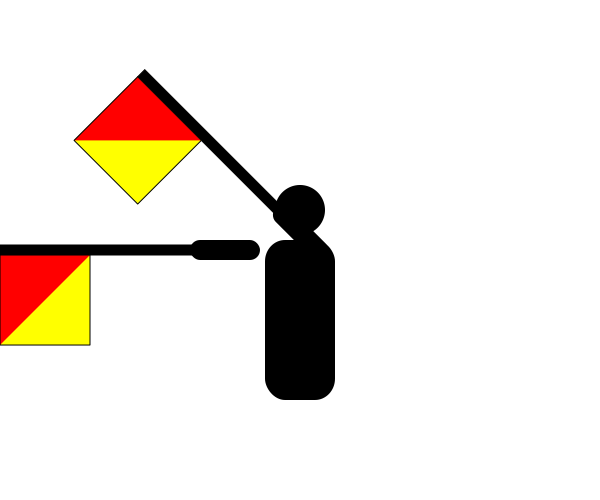
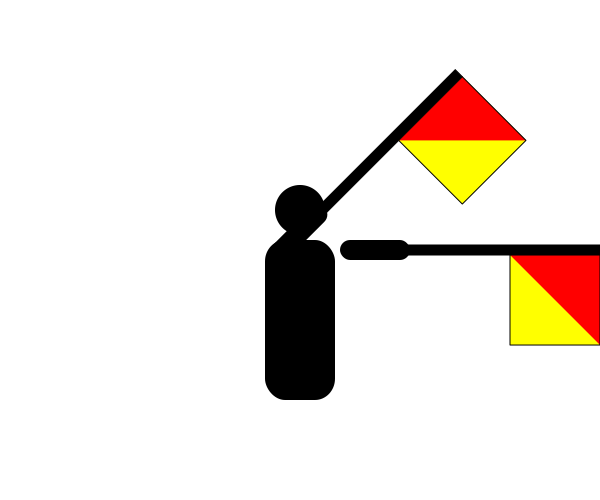
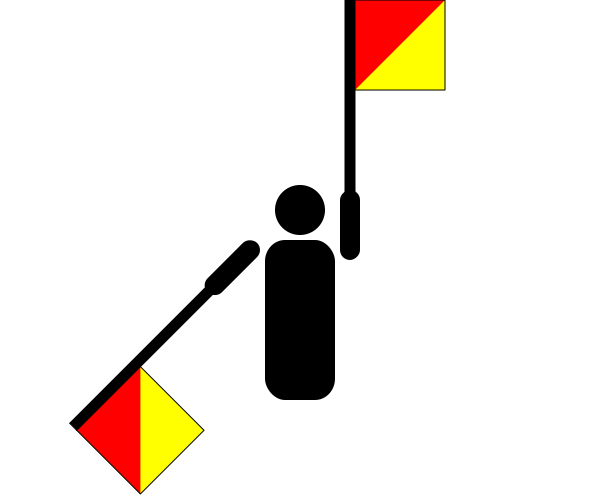
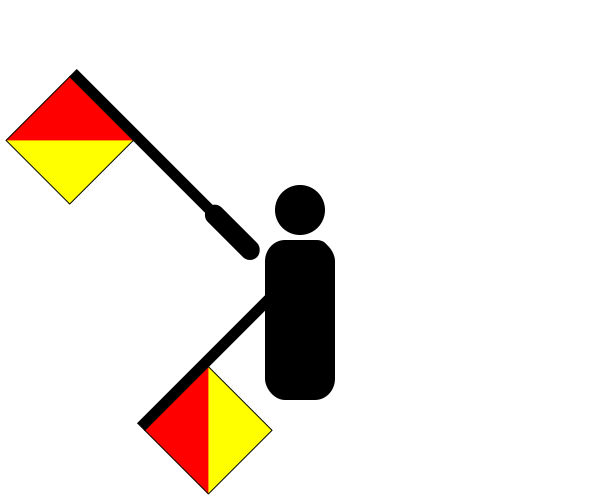
Semaphore




There are approximately 261 people named Glowacki in the UK. That makes it one of Britain's least common surnames. Only around four in a million people in Britain are named Glowacki.
