GLASSER
Glasser is a surname of Germanic origin, originally denoting a person engaged in the trade of glass‑making or glazing. The name derives from the German word glas, the Middle High German equivalent of the English word for the transparent substance, and was historically applied to artisans who manufactured or fitted windows, mirrors and other glass objects.
The occupational character of the name is reflected in its earliest recorded forms in England, where it appeared as a metonymic designator for a glazier or glass blower. The West Midland counties of Shropshire, Worcestershire and Warwickshire contain the most significant early instances. Examples include Thomas le Glasyer of Cornwall in 1297 and Robert le Glasiere of Essex in 1327, records which illustrate the use of the agent suffix -er to mark a profession. In the 1379 Poll Tax returns for Yorkshire, a Walterus Glassenwryght and a Robertus de Spalding, glasenwryght, are noted as glass makers.
Several spellings of the surname have been documented in historical registers. These include Glase, Glass, Glace, Glaze and Glaize. In Scottish records, the name appears as Glass from the sixteenth century, with the variant possibly deriving from the Gaelic word glas meaning grey, green or blue. A notable instance is the grant of lands to Alexander Glass in 1506.
The heraldry associated with the Glasser name features a silver shield bearing a fleur‑de‑lis between three mullets within a red bordure; the crest is described as a mermaid holding a mirror and a comb, depicted in proper colours. The earliest documented spelling in Shropshire is that of Ricardus Glase, who married Margeriam Higgons in 1540 at Pontesbury, a wedding carried out during the reign of King Henry the Eighth.
In continental Europe and Eastern Europe, Glasser also appears among Ashkenazi Jewish families, particularly in Poland, Hungary and the Czech Republic. The surname is frequently encountered in Jewish archives and on tombstones, dating back to the mid‑fourteenth century when it was first recorded in Prague. Here the name is thought to have been derived from the Yiddish word glass, a term denoting an object that is shiny or polished, and was originally assigned to a blacksmith or other artisan whose products were considered of high quality.
Throughout the nineteenth and early twentieth centuries, many bearers of the name emigrated from German and Eastern‑European regions to the United States, Canada and Australia, often establishing new glass‑working or metal‑based enterprises. In the United States, the surname is comparatively common, especially in New York, Pennsylvania and California, reflecting the success of descendants who set up trade businesses in their new homeland.
The surname Glasser persists in contemporary usage across several countries, including Germany, Austria, Switzerland and the former Austrian‑Hungarian Empire, as well as in the United Kingdom where several lineages remain in the West Midland counties. Its enduring presence in historical documents and heraldic records underscores the lasting impact of those skilled in the craft of working with glass.
Typical given names associated with the Glasser surname
Male
- Carl
- Daniel
- David
- Harry
- Joseph
Female
- Azzi
- Danielle
- Jacqueline
- Julia
- Julie
Similar and related surnames
Related and similar names are generated algorithmically based on the spelling, and may not necessarily share an etymology.
How to communicate the surname Glasser in...
Braille
⠛⠇⠁⠎⠎⠑⠗
Morse
--..-...-........-.
Semaphore


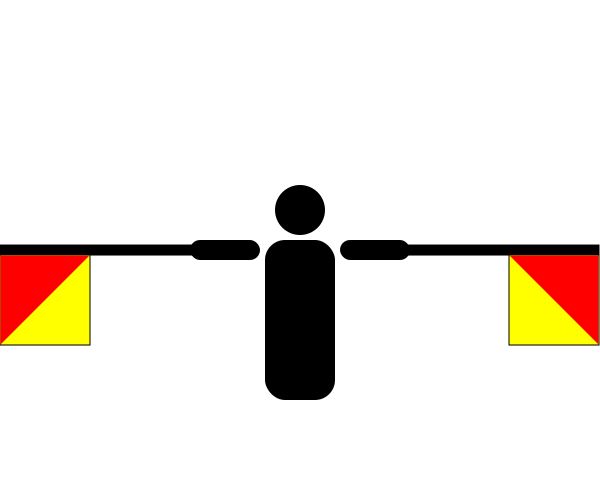
There are approximately 83 people named Glasser in the UK. That makes it one of Britain's least common surnames. Only around one in a million people in Britain are named Glasser.
Origin: English
Region of origin: British Isles
Country of origin: England
Religion of origin: Christian
Language of origin: English
