GLANVILLE
Glanville is a surname of both English and French heritage, traditionally situated within the British Isles and particularly England. Its origins are firmly rooted in the linguistic and historical developments of the Norman conquest and subsequent Anglo‑Norman settlement.
The etymology of Glanville derives from the Old French noun gland, meaning ‘acorn’, combined with the Old English feld, meaning ‘field’. Consequently, the surname is interpreted as “one who lives near or works in a field of acorns”, representing a locational surname associated with a specific farm or estate that historically featured abundant acorn trees.
Earlier forms of the surname include de Glanville, Glanvill and Glanfield. It entered England in 1066 alongside the followers of Duke William of Normandy, the conqueror of England. The family name was originally linked to a place called Glanville in Calvados, Normandy, and the derivation is from the French word glan (acorn or a copse of young oaks) combined with ville, meaning a large house or settlement.
The first recorded instance of the surname in English documents appears in the Domesday Book of 1086, where a man named Robert de Granuill is noted as having been granted lands in Suffolk. This early entry confirms the presence of the family in the English realm shortly after the Norman invasion and illustrates the assimilation of Norman place‑based surnames into English society.
Subsequent medieval records provide further evidence of the surname’s prominence. In 1127, the Pipe Rolls of Norfolk list William de Glanvile, while Ranulf de Glanville, who died in 1190, is recorded as having served as the Sheriff of Yorkshire from 1163 to 1170 and later as the Chief Justice of England until his death. Ranulf’s final act was to die at Acre in the Holy Land whilst accompanying King Richard I of England, the lord once called “Lionheart”, on a Crusade.
A notable later bearer of the name is Sir John Glanville (1542–1600). He is credited with becoming the first attorney to be appointed as a judge of the common pleas in 1598, marking a significant advancement for the legal profession and highlighting the enduring influence of the Glanville family within English jurisprudence.
Throughout its history, the Glanville surname has connoted a lineage that has integrated early Norman influence with established English customs. Its meaning, rooted in a pastoral landscape of acorn fields, and its early appearance in legal and administrative records, underscore the surname’s longevity and historical significance within the United Kingdom.
Typical given names associated with the Glanville surname
Male
- Andrew
- David
- James
- John
- Mark
- Michael
- Paul
- Peter
- Richard
- Robert
- Shaun
Female
- Christine
- Elizabeth
- Emma
- Helen
- Jacqueline
- Jennifer
- Margaret
- Patricia
- Sarah
- Susan
Similar and related surnames
Related and similar names are generated algorithmically based on the spelling, and may not necessarily share an etymology.
How to communicate the surname Glanville in...
Braille
⠛⠇⠁⠝⠧⠊⠇⠇⠑
Morse
--..-...--....-...-...-...
Semaphore


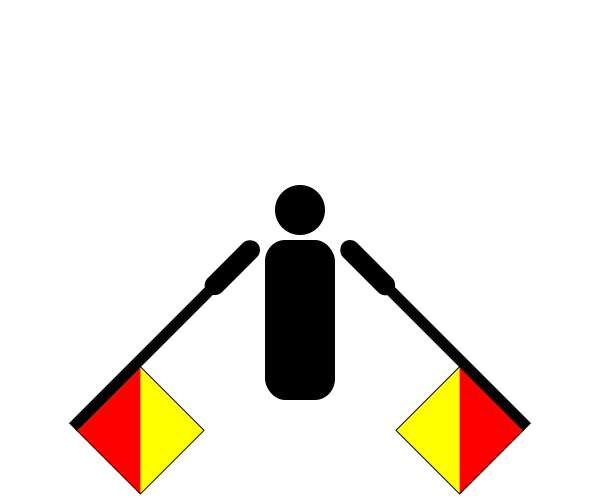
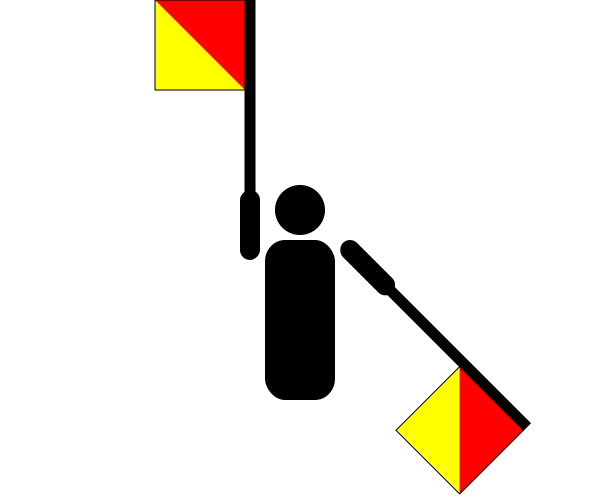
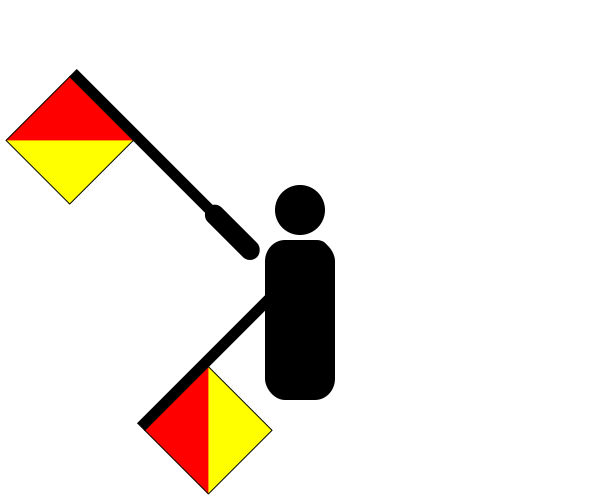

There are approximately 2,708 people named Glanville in the UK. That makes it roughly the 3,295th most common surname in Britain. Around 42 in a million people in Britain are named Glanville.
Origin: English
Region of origin: British Isles
Country of origin: England
Religion of origin: Christian
Language of origin: English

Famous people named Glanville
- Susannah Glanville-Hearson - Actress
- Brian Glanville - Writer
- Ranulph Glanville - Cyberneticist (1946 to 2014)
- Philippa Glanville -
- Stephen Glanville - Egyptologist (1900 to 1956)
- Mark Glanville - Singer and writer
- Harold Glanville - Politician (1854 to 1930)
Names and descriptions courtesy of Wikipedia, and may contain errors. This is not intended to be an exhaustive list of every famous person with this name.