GERMAN
German is a surname of widespread usage that enjoys a long and varied history. It is found across the United Kingdom, continental Europe, North America and beyond, and it appears in its original or derivative forms in many languages.
The earliest documented meaning of the word derives from the Latin noun germanus, which translates as “brother” or “relative.” In the Middle Ages it was employed as a personal name, a term of affection or respect that signified a close kinship or friendship. Over time this personal appellation became fixed as a hereditary surname.
A parallel line of origin arises from the French name Germain, which originally meant “German.” The French form arose in the Norman linguistic milieu and was later adopted by English speakers. The two etymologies – Latin and French – produced essentially the same spelling in English, though they entered the country through different routes.
Several nationalistic and locational sources contribute to the surname’s diversity. One common explanation is that it denoted a “man from Germany.” This interpretation is consistent with medieval practice, whereby newcomers were identified by the name of their place of origin. Another significant source refers to the Norman town of Saint‑Germain, from which settlers were known to have fled after the 1066 invasion. In this context the name signifies a person’s geographic provenance rather than a familial bond.
Still another suggested derivation links the name to the German words geri, meaning “spear,” and man, meaning “man.” This etymology would describe a warrior or mercenary skilled in spear combat – a profession historically employed by various European monarchs. While this hypothesis is less widely accepted, it underscores the name’s potential occupational dimension.
The surname has survived in a variety of spellings, each shaped by local dialects and orthographic practices. Known forms include German, Germann, Germain, Germing, Jerman, Jarman, Jarmain, and Jermyn in England and Ireland; Gherman in Hungary; Germani in Italy; Germano and De Germano in Spanish‑speaking contexts; and Germain in France. The first recorded instance in English law occurs in the 1279 “Hundred Rolls” of Oxfordshire, where a William Jermain is mentioned.
In European demographic statistics the surname is particularly common in the German‑speaking heartland. It is listed among the top two surnames in Austria, occupies one of the top ten in Germany, and ranks sixth in Switzerland. In neighbouring Central and Eastern European countries its presence is also pronounced, especially in Slovakia and the Czech Republic.
Across the Atlantic the name has maintained a high frequency. According to the United States Census it ranks among the top fifty surnames, a status that reflects the substantial German diaspora that settled in North America from the late seventeenth century onward. Canada likewise records a considerable frequency, with the surname found in the provinces of Ontario, Manitoba, Alberta and Saskatchewan. The name also appears in other English‑speaking lands where German settlers historically resided.
Modern spelling variants manifest the surname’s geographic breadth. In addition to the above examples, one encounters forms such as Germane, Germant, Germaine, Germainus, and Germin. Many of these derivatives share the same linguistic root yet have adapted to local phonological and orthographic conventions.
Throughout its history the surname German has come to signify more than mere taxonomical identification; it serves as a reminder of an individual’s ancestral ties, of migration patterns across continental borders, and of the shared cultural narratives that arise from these connections. It remains a testament to the way in which language and lineage intertwine over the centuries.
Typical given names associated with the German surname
Male
- Andrew
- David
- John
- Michael
- Paul
- Peter
- Richard
- Robert
- Stephen
- Steven
Female
- Alison
- Angela
- Anne
- Elizabeth
- Helen
- Jacqueline
- Janet
- Karen
- Lisa
- Margaret
- Mary
- Rachel
- Sarah
Similar and related surnames
- Gearman
- Gehrman
- Gehrmann
- Geirman
- Geran
- Germa
- Germain
- Germaine
- Germains
- Germana
- Germanacos
- Germane
- Germanes
- Germaney
- Germani
- Germanis
- Germaniuk
- Germann
- Germano
- Germanos
- Germanou
- Germanov
- Germans
- Germanus
- Germany
- Germay
- Germen
- Germeney
- Germin
- Germon
- Germyn
- Gierman
- Girma
- Girman
- Greman
- Gyerman
- Jarmain
- Jarmaine
- Jarman
- Jarmann
- Jarmans
- Jarmin
- Jermain
- Jermaine
- Jerman
- Jermanis
- Jermann
- Jermany
- Jermin
- Jermyn
- Jorman
- Jurmaine
- Jurman
- Jurmann
Related and similar names are generated algorithmically based on the spelling, and may not necessarily share an etymology.
How to communicate the surname German in...
Braille
⠛⠑⠗⠍⠁⠝
Morse
--...-.--.--.
Semaphore


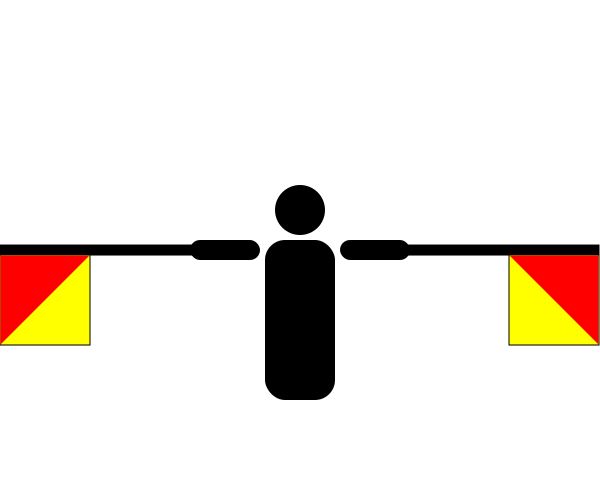
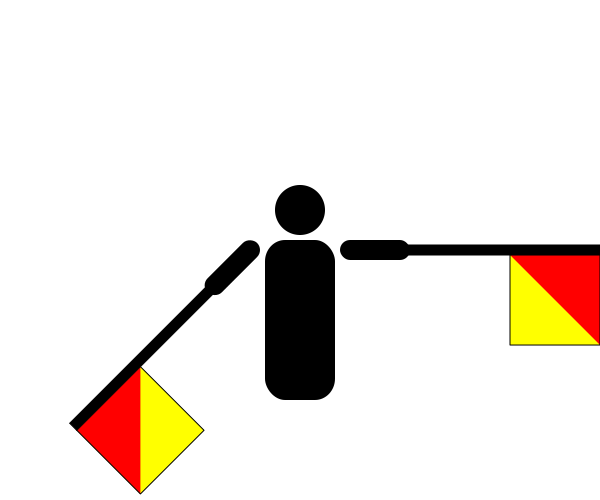

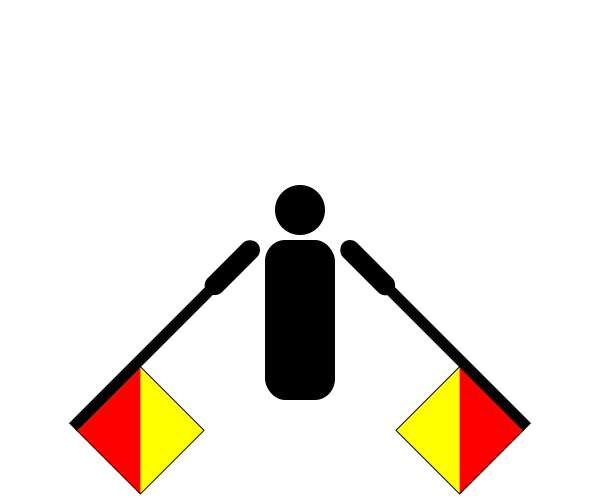
There are approximately 1,822 people named German in the UK. That makes it roughly the 4,543rd most common surname in Britain. Around 28 in a million people in Britain are named German.
Surname type: Location or geographical feature
Origin: English
Region of origin: British Isles
Country of origin: England
Religion of origin: Christian
Language of origin: English

Famous people named German
- Lauren German - American actress
- Antonio German - Grenadian football player
- Edward German - Musician and composer (1862 to 1936)
- Veronica German - Politician
- Mike German, Baron German - Politician
- Harry German - Cricketer (1865 to 1945)
- Arthur German - Cricketer (1905 to 1968)
Names and descriptions courtesy of Wikipedia, and may contain errors. This is not intended to be an exhaustive list of every famous person with this name.