GENTILE
Gentile is an Italian surname with a root that can be traced back to the Latin word gentilis, meaning of the same clan or family. The term was originally employed as a descriptor for individuals who were not of noble birth or who did not belong to the aristocracy. Over time, the surname came into widespread use across Italy, particularly in the south, and it has since been carried abroad by emigrants to countries such as Argentina, the United States and Brazil.
The earliest documented appearance of the name appears in the Pipe Rolls of Hampshire, dated 1202, where it is recorded as Osbert le Gentil. This early record shows that the name was already in use during the reign of King John (1199‑1216). In England it evolved into forms such as Gentile, Gentil, or Gentyl and is mentioned in the Hundred Rolls of Wiltshire of 1273 and in the 1379 Poll Tax Returns Records of Yorkshire. A later example is the christening of Mathewe Gentyle on 11 December 1603 at St. Helen's, Bishopgate, London. The name also appears in the 18th‑century marriage record of Robert Gentile and Frances Pope dated 9 June 1767 in Maidstone, Kent.
The surname was at times connected to descriptors of character and social standing. In Medieval England and Old French, the word gentil conveyed the sense of courteous or well‑born, and it was originally given as a nickname to someone of noble conduct. Hence, bearers of the name were sometimes perceived as genteel or refined, traits that may have further reinforced the surname’s prestige in the centuries that followed.
Variants of the surname are numerous and reflect regional linguistic differences within Italy. Common variants include Genti, Gentili, Gentilini, Gentilucci, Gentilomo and Gentilcore. In Lombardy and Veneto the forms Gentilini or Gentilomo are more frequent, whereas central Italy favours Gentili or ‹Gentilucci›. These variations arose through dialectal pronunciation shifts and the natural process of surname evolution over several centuries.
While the original meaning of gentile in Latin could also denote a person who was not Jewish – thereby referring to a Christian or a gentile in the biblical sense – the surname in contemporary use principally signifies nobility, courtesy or a distinguished lineage. The name is held by individuals of diverse faiths and social backgrounds, reflecting its long history and geographical spread. In the modern era it remains one of the more common surnames within the Italian diaspora, especially in communities with Italian heritage in North America and South America.
In summary, the surname Gentile originated from a Latin adjective signifying belonging to a clan, later acquiring connotations of nobility and courtesy. Its early appearance in legal documents illustrates its established use by the early twelfth century, and its many variants across Italian dialects attest to its widespread adoption. Today, the name continues to be borne by a broad spectrum of people, a testament to its enduring legacy throughout history and geography.
Typical given names associated with the Gentile surname
Male
- Anthony
- Antonio
- Christopher
- Giovanni
- Giuseppe
- Kenneth
- Luciano
- Matthew
- Michael
- Paul
- Simon
Female
- Angela
- Carol
- Irene
- Jacqueline
- Joanna
- Joy
- Karen
- Maria
- Michelle
- Nicola
- Sofia
- Sonia
- Valentina
Similar and related surnames
Related and similar names are generated algorithmically based on the spelling, and may not necessarily share an etymology.
How to communicate the surname Gentile in...
Braille
⠛⠑⠝⠞⠊⠇⠑
Morse
--..-.-...-...
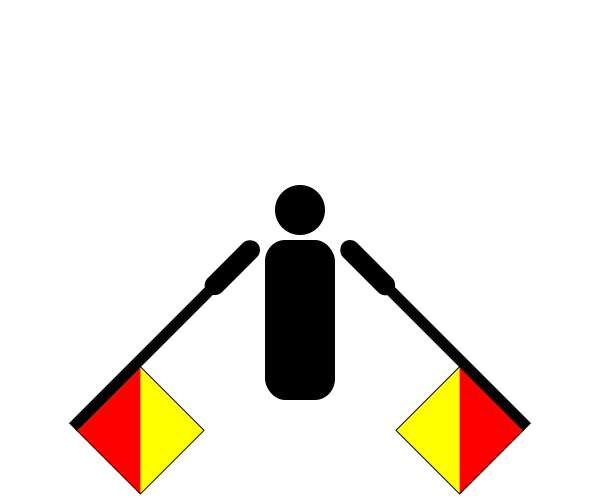
Semaphore





There are approximately 319 people named Gentile in the UK. That makes it one of Britain's least common surnames. Only around five in a million people in Britain are named Gentile.
Region of origin: Europe
Country of origin: Italy
Language of origin: Italian

Famous people named Gentile
- Chris Gentile - Football player
Names and descriptions courtesy of Wikipedia, and may contain errors. This is not intended to be an exhaustive list of every famous person with this name.