GARTH
Garth is a surname that emerged in the British Isles, with its roots firmly planted in the English tradition and a supplementary element drawn from Old Norse influence.
The core etymology of the name is traced back to the Old Norse word garðr, which denotes an enclosure or a garden. As a surname, Garth therefore conveys the notion of a person dwelling in or associated with a fenced or cultivated space.
As a topographical identifier, the surname was originally given to individuals who lived adjacent to or worked within such an enclosure—be it a paddock, orchard or a fenced piece of land. In the medieval period, natural and man‑made features were the first source of distinguishing surnames, as neighbourhoods gravitated towards small communities. The element of enclosure or garth was frequently employed; consequently the name is regarded as an early and geographically practical form of identification.
Historical records provide some of the earliest evidence of the family name. In 1297, a man known as John del Garth is mentioned in the Early Medieval Records of Yorkshire during the reign of King Edward the First. This precedes later references, including Mariota del Garth of Cumberland in 1332 and Willelmus del Garth of Yorkshire in 1379. A further example is the christening of William Garth, a small child, at St. Crux in 1564, followed by the marriage of Thomas Garth to Ellynor Dickison at St. Andrew’s in 1572. These records attest to the spread and usage of the name within the broader region.
A notable bearer of the surname in the early modern era was Sir Samuel Garth, who lived from 1661 to 1719. Garth served as a physician in ordinary to King George the First and as physician‑general to the army. His service included a Latin oration over the body of John Dryden in 1700, with Garth delivering the speech upon Dryden’s lying body in the College of Physicians.
For those who bear the name, the family Coat of Arms is a gold shield, featuring two lions passant in pale between three black crosses crosslet fitchee. The shield is precise yet evocative of the role that the name has played across the country.
The surname is not confined solely to the English tradition; rather, it also reflects the topographic influences of the Norse settlers in Northern England and Southern Scotland. In addition to its roots in an enclosure, Garth was initially regarded as a locational name for those coming from places named Garth or Garth in either England or Scotland. Garth remains a surname with a distinctly topographical origin, signifying an enclosed or protected space tied closely to place. It is in that sense that the name persists to the present day, serving as an enduring reminder of a historical link between land, community and identity.
Typical given names associated with the Garth surname
Male
- Andrew
- Anthony
- David
- James
- John
- Michael
- Paul
- Peter
- Richard
- Robert
- William
Female
- Eleanor
- Elizabeth
- Emma
- Fiona
- Jennifer
- Joanna
- Lily
- Margaret
- Patricia
- Priscilla
- Rachel
- Sarah
- Sheila
- Susan
Similar and related surnames
Related and similar names are generated algorithmically based on the spelling, and may not necessarily share an etymology.
How to communicate the surname Garth in...
Braille
⠛⠁⠗⠞⠓
Morse
--..-.-.-....
Semaphore


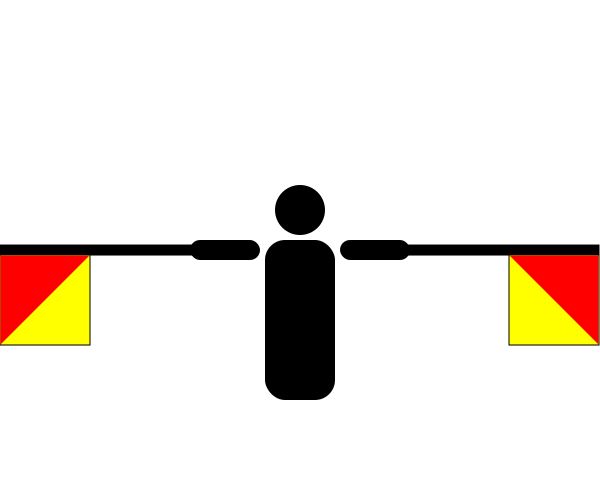
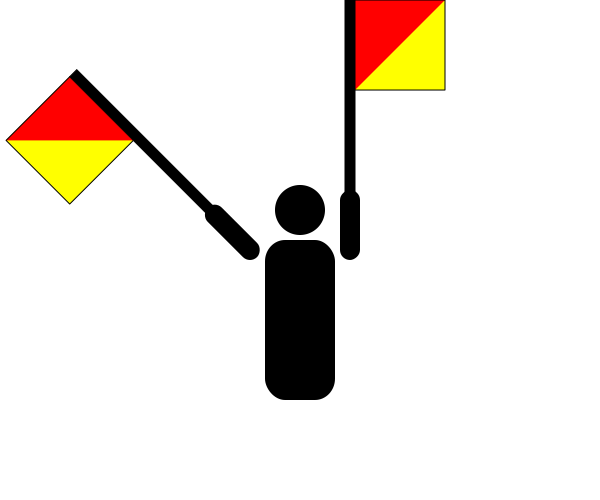

There are approximately 950 people named Garth in the UK. That makes it roughly the 7,659th most common surname in Britain. Around 15 in a million people in Britain are named Garth.
Surname type: Location or geographical feature
Origin: English
Region of origin: British Isles
Country of origin: England
Religion of origin: Christian
Language of origin: English