GAMBRELL
Gambrell is a surname that finds its origins in both English and French linguistic traditions. It is commonly associated with the British Isles, particularly England, and has a notable presence in the United States, especially within the southern states.
The derivation of Gambrell can be traced to the Old French word gambrelle, which literally means a crooked stick or a bent leg. Historical usage suggests that the surname began as a descriptive nickname for an individual who had a crooked or bowed leg. Over time, this descriptive term evolved into a hereditary family name and was transmitted through successive generations.
Parallel linguistic traditions record an Old Norse origin for the name. The personal byname Gamall – the Old Danish and Old Swedish Gamal – means “the old one.” In the Middle Ages, it was common for surnames to arise from such nicknames, reflecting personal characteristics or social standing. The name appears in medieval documentary sources such as the Domesday Book of 1086, the 1158 Pipe Rolls of Yorkshire, and the 1296 Ministers Accounts of the Earldom of Cornwall. In Scotland the name is recorded in 1377 and 1444, while in England a 1202 witness named Simon Gamel is listed in the Assize Court Rolls of Lincolnshire.
An occupational hypothesis also exists. In the Middle Ages a similar term, gambrel, was used to describe a hooked stick employed by butchers to hang carcasses. The occupation of butcher, or more generally a maker of spinning spindles or tools, could have produced a surname. In French, the term gambier meant “maker of legs” and could also have referred to a craftsman involved in cloth‑making. The consistency of these occupational references underscores the likelihood that the surname originated from a trade or profession.
Multiple spelling variants have emerged over the centuries because of linguistic shifts, regional pronunciation differences and clerical transcription practices. The persistent forms include Gambell, Gamble, Gammell, Gammill, Gemmell and Gemmill. In contemporary usage Gambrell remains a distinct variant.
Church registers record the surname in various forms throughout the early modern period. For example, the marriage of Janet Gemmell to Johone Findlay in 1607 at Canongate, Midlothian, and the subsequent 1678 pairing of Christian Gemmell with James Robertson at Edinburgh, demonstrate the name’s persistence within Scottish society. In London a 1721 marriage between James Gemmell and Elizabeth Simon took place at St. Botolph's, Bishopsgate.
Modern demographic analysis indicates that the surname Gambrell is most densely populated in the United States. The spread to the southern states is attributed, in part, to the migration of French Huguenots during the 17th century, many of whom settled in South Carolina where the Huguenot community was strong. The surname can also be located in the United Kingdom, Australia and other regions of the world as a result of subsequent migration.
In summary, the surname Gambrell encapsulates a complex blend of linguistic and cultural histories. Its roots in Old French and Old Norse, its possible occupational associations, and its varied documented spellings all contribute to a genealogical line that spans from medieval England and Scotland to modern international diasporas.
Typical given names associated with the Gambrell surname
Male
- Andrew
- Anthony
- Christopher
- David
- Ian
- James
- John
- Michael
- Paul
- Peter
- Stefan
- Stephen
- Thomas
Female
- Beryl
- Caroline
- Catherine
- Diane
- Elizabeth
- Jennifer
- Laura
- Lynda
- Marjorie
- Mary
- Nicola
- Rebecca
- Samantha
Similar and related surnames
Related and similar names are generated algorithmically based on the spelling, and may not necessarily share an etymology.
How to communicate the surname Gambrell in...
Braille
⠛⠁⠍⠃⠗⠑⠇⠇
Morse
--..----....-...-...-..
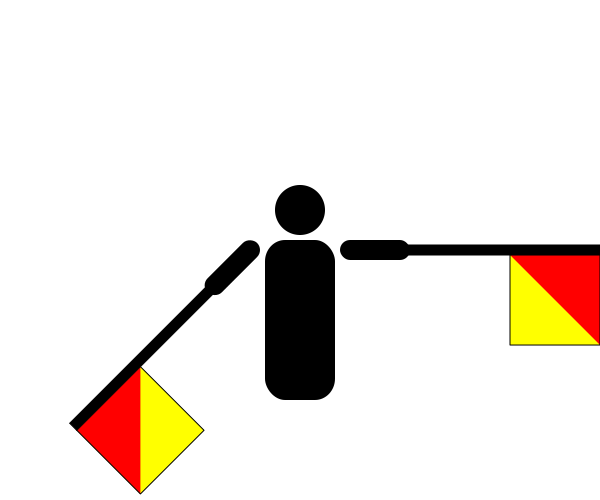
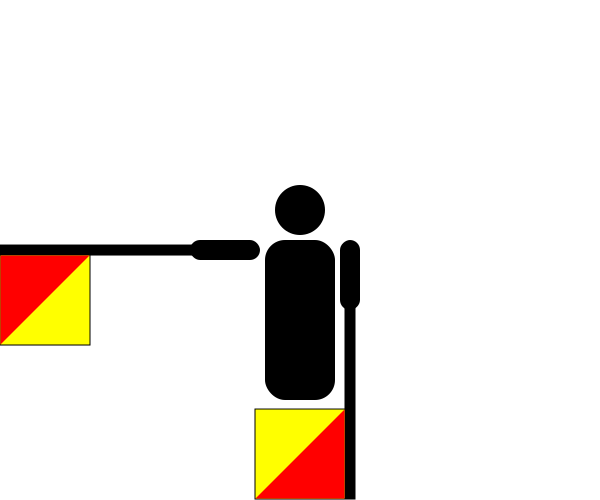
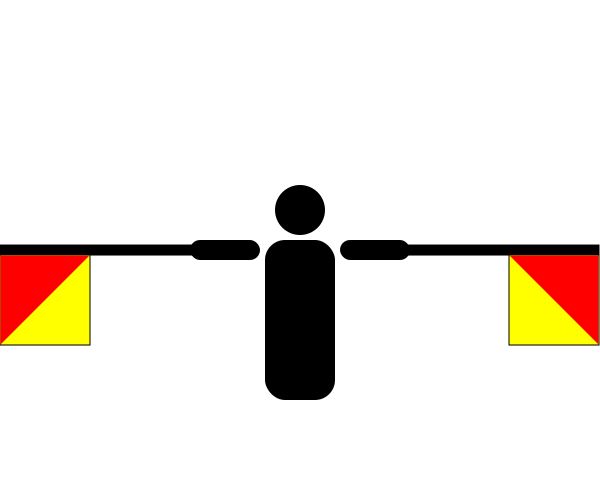
Semaphore




There are approximately 193 people named Gambrell in the UK. That makes it one of Britain's least common surnames. Only around three in a million people in Britain are named Gambrell.
Surname type: Location or geographical feature
Origin: English
Region of origin: British Isles
Country of origin: England
Religion of origin: Christian
Language of origin: English
