GAIR
Gair is a surname of Gaelic and Scottish provenance, an enduring testament to the linguistic heritage of the British Isles. The name appears to have arisen as a descriptive nickname, drawn from the Gaelic word gearr, meaning “short” or “small.” Over time, such personal descriptors have conformed to the pattern of hereditary surnames found throughout Scotland and the wider Celtic world.
Early instances of the name occur in medieval English records where it is spelled Gare or Gair. The first recorded form, John de la Gare, is dated to 1181 within the Pipe Rolls of County Kent, under the reign of King Henry XI, who built much of the country’s church infrastructure. By the sixteenth century, variations such as Henry Garr (Stepnly, 1570), Margaret Garre (All Saints, Newcastle‑upon‑Tyne, 1643), and John Garr (Edlingham, Northumberland, 1668) illustrate the fluid orthography that accompanied the name’s passage from a nickname into a fixed family marker.
Topographical theories regarding the English occurrences also appear in the literature. The name may denote a dweller by a fish trap, known as a gar, which was a small pike, or by a hill fort or earthwork. These usages echo the Olde English pre‑seventh‑century practice of deriving surnames from the landscape that an individual inhabited or harboured.
In Ireland, the surname appears with a different linguistic foundation. Derived from the Gaelic giar, meaning “rough” or “fierce,” the O Gairs were a noted brehon family in Munster in the medieval period. Their involvement in regional politics and military campaigns, most often in support of local chieftains, reflects the martial reputation attached to the name. Irish spelling variants include Gear, Gare, Geare, Gier, and the surname has migrated to other parts of Ireland, particularly Dublin and County Cork.
Further etymological enquiry links Gair to the Irish surname Geary, itself derived from O Gadhra, a patronymic meaning “descendant of Gadhra.” Gadhra stems from a word signifying “well‑born,” so that Gair may convey a sense of pedigree or noble birth. Additional variants that surface in English‑speaking records are Gaire, Gearry, Girr, Gaer, Gear, Geer, Keary, Keery and Gayer; these reflect both regional accents and transcriptional shifts over centuries.
The distribution of Gair remains concentrated in Scotland, especially in the Lowlands (Perthshire, Angus, Argyll, Fife) and the north‑east and far north. Occasional families can also be found in England, Wales, and Ireland, though the surname is considerably rarer there. In diaspora communities, Gair occurs in Canada, the United States, Australia, New Zealand, and South Africa. According to the 2000 United States Census, approximately 14 000 individuals bear the surname, with a greater concentration in the eastern states, parts of the Midwest, and the South. In Australia, estimates place around a thousand bearers primarily in New South Wales and Victoria, while in New Zealand the surname is mainly situated on the North Island, again numbering roughly a thousand.
Despite its relative scarcity in the contemporary era, the Gair surname remains a potent symbol of cultural and historical continuity, linking present‑day bearers to a lineage that spans Gaelic, English, and Irish traditions. Its endurance across regions and centuries underscores the resilience of family identities formed in the early medieval period and perpetuated through migration, colonisation, and the global dispersion of the British and Irish peoples.
Typical given names associated with the Gair surname
Male
- Andrew
- Anthony
- Christopher
- David
- James
- John
- Paul
- Peter
- Robert
- Stephen
- William
Female
- Anne
- Catherine
- Elizabeth
- Helen
- Judith
- Lisa
- Margaret
- Mary
- Michelle
- Nancy
- Paula
- Sharon
- Susan
Similar and related surnames
- Agir
- Caira
- Carre
- Core
- Corr
- Correa
- Correia
- Corrie
- Cree
- Curr
- Gaer
- Gaere
- Gahir
- Gahr
- Gai
- Gaia
- Gaier
- Gaire
- Gairey
- Gairn
- Gairns
- Gairus
- Gairy
- Gar
- Gara
- Garai
- Garay
- Gard
- Gare
- Gareh
- Gares
- Garey
- Garg
- Gargh
- Gari
- Garia
- Garie
- Garis
- Garn
- Garo
- Garow
- Garr
- Garra
- Garre
- Garrie
- Garro
- Garrs
- Garry
- Gars
- Garwe
- Gary
- Garz
- Gau
- Gaur
- Gaura
- Gaure
- Gauri
- Gaurie
- Gaw
- Gayre
- Ghair
- Ghare
- Ghari
- Gharu
- Ghauri
- Gheer
- Ghere
- Ghir
- Ghiro
- Ghor
- Goar
- Goare
- Goor
- Gor
- Gora
- Gore
- Goree
- Gorr
- Gour
- Guar
- Guare
- Guarro
- Guary
- Guer
- Guier
- Guir
- Guira
- Guire
- Guiry
- Gur
- Gure
- Gurr
- Guure
- Kaura
- Kear
- Keer
- Kerai
- Kerr
- Kour
- Quarrie
Related and similar names are generated algorithmically based on the spelling, and may not necessarily share an etymology.
How to communicate the surname Gair in...
Braille
⠛⠁⠊⠗
Morse
--..-...-.
Semaphore


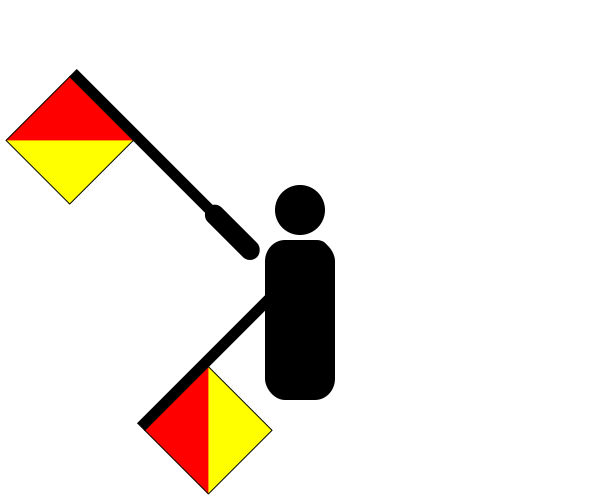
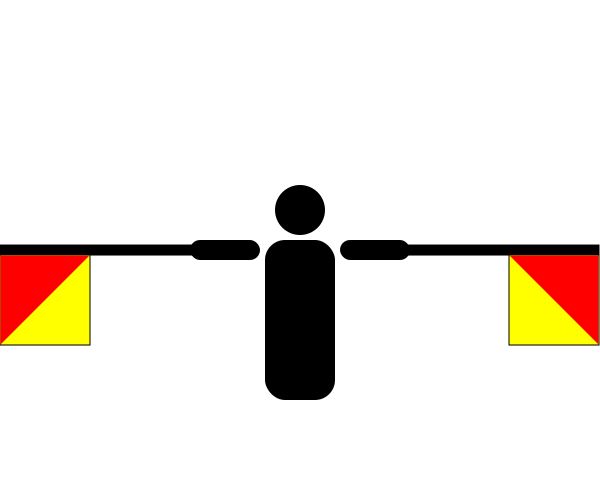
There are approximately 1,590 people named Gair in the UK. That makes it roughly the 5,105th most common surname in Britain. Around 24 in a million people in Britain are named Gair.
Origin: Celtic
Region of origin: British Isles
Country of origin: Scotland
Religion of origin: Christian
Language of origin: Gaelic
