FULL
Full is an English surname of antiquated origin, documented with a multiplicity of spellings such as Fulle, Fullard, Fullerd, Fullager and Fullman. It is almost certainly derived from pre‑7th century terms that were used both as a personal name and as a component of place names.
One line of derivation links the name to the Old English word ful, which was employed in personal and place names such as Fulwood. The element may mean either “marshy” or “muddy” wood, reflecting a topographical feature. Another proposed source is the occupational surname Fuller, from the Old English fullere, meaning a person engaged in the tread‑drying of cloth. A third possibility regards Full as a nickname, either describing a man full of energy and enthusiasm or, alternatively, as a derogatory variant of Foul used to indicate uncleanliness or moral corruption.
In parish registers of London the spelling variations appear frequently: a record of a Frisewith Full who married Edward Banister in St Nicholas Acons (May 1581), a christening witness named Thomas Fullman at St Margarets Westminster (June 1680), and a John Fullager found as a witness in St Mary Magdalene (October 1702). The form Fullard or Fullerd may derive from a personal name that combined Full with the suffix ‑hard, signifying a “hard man.”
Geographically the surname remains most common within the United Kingdom, particularly in Lancashire, Yorkshire and Derbyshire. In the United States it is most frequently encountered in North Carolina, Mississippi, Kansas and Missouri, whereas it is comparatively rare in Canada, generally appearing in Ontario and British Columbia. Occasional instances exist in Germany, Sweden and other European countries, usually as an Anglicised form of local surnames.
Occupationally, bearers of the name Full have historically engaged in roles such as miller, hayward, wagon driver and, during the Industrial Revolution, factory labourer or coal‑miner. These activities reflect the surname’s association with working‑class communities, particularly in the North of England.
Variant spellings extend across many languages: in French the name appears as Foul and Foulon; in German it is rendered as Foul or Fouly; and in Spanish it may be found as Foula. Scottish variants include MacFall, MacFeeal and McFaul, while Irish forms such as O’Fuail and MacFoley are occasionally Anglicised to Full. These diverse orthographic variations attest to the surname’s dissemination across the British Isles and its adaptation to local linguistic norms.
Although the surname Full may bear different connotations depending upon its etymological source, it remains a name rooted in the English linguistic and cultural heritage. Its persistence across centuries and across a mosaic of English‑speaking societies illustrates the enduring nature of surnames derived from descriptive, occupational or topographical origins.
Typical given names associated with the Full surname
Male
- Adrian
- Darren
- David
- James
- Matthew
- Michael
- Nicholas
- Nik
- Peter
- Roger
- Tristram
- Wayne
Female
- Jean
- Joanne
- Judith
- Karen
- Katherine
- Kathryn
- Louise
- Rebecca
- Sarah
- Susan
Similar and related surnames
Related and similar names are generated algorithmically based on the spelling, and may not necessarily share an etymology.
How to communicate the surname Full in...
Braille
⠋⠥⠇⠇
Morse
..-...-.-...-..
Semaphore
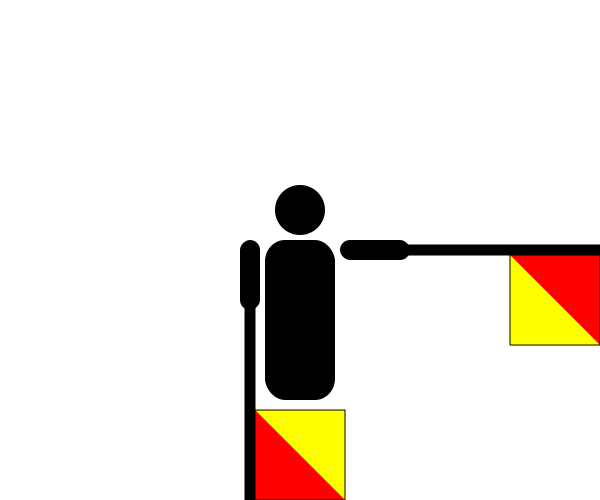


There are approximately 228 people named Full in the UK. That makes it one of Britain's least common surnames. Only around four in a million people in Britain are named Full.
