FOLKS
The surname Folks is of English origin and is derived from the Middle English word folk, meaning “people” or “community”. In medieval usage it was often employed as a nickname for an individual who was well known or held a prominent position within a local group, thereby associating the bearer with the wider community.
Historical records show that the name also has roots in the Old German personal name Fulco or Folco, translating as “people”. This personal name was in use in England before the Norman Conquest and was reintroduced after 1066 through Norman influence, appearing in Old French as Fulco and Foughes. The Domesday Book of 1086 contains the entries Folco and Fulco, and subsequent medieval documents record intermediary forms such as Fuke (1166), Fulk (1177), Fouke (125), and Folkes (1279). The earliest documented use of the surname is recorded in the Feet of Fines for Somersetshire in 1198, where an individual named Peter Fulch is listed during the reign of King Richard I (1189‑1199).
Throughout the Middle Ages the name evolved into a hereditary surname. Variants recorded in parish registers and court documents include Folk, Folke, Folkes, Foulk and Foulkes, as well as Fulk and Fuke. In the south of England a phonological shift replaced the initial f with a v, giving rise to forms such as Voak, Vokes, Volk and Volkes. Other documented variations include Fewkes, Foakes, Fooks, Foukx, and Fowke. The surname has also appeared in continental forms such as Fuchs, the German word for “fox”, which share phonetic similarities and may indicate a continental equivalent in some dialects.
A notable marital record preserved at St. Botolph's, Bishopsgate, London, shows that on 20 January 1594 Henry Foulkes married Agnes Hall, illustrating the continued use of the surname into the early modern period.
Contemporary distribution data from the genealogical database Forebears indicates that the surname Folks is most prevalent in the United States, with the highest density in South Carolina. Worldwide it ranks 13,949th in frequency and is found in English-speaking countries such as the United Kingdom, Canada, and Australia. The variant spelling Folkes follows a similar distribution pattern, particularly in England and the United States.
The presence of multiple spellings reflects the historical practice of scribes recording names phonetically and the influence of regional pronunciation on orthography. Migration, particularly between England and the Americas, also contributed to the spread and diversification of the surname.
The etymological connection to the concept of people or community, as well as the historical association with leadership roles—whether as a clan chief, local elder, or representative of a group—provides a meaningful insight into the sociocultural identity of bearers of the surname Folks. Although the name is not common, its persistence through centuries attests to its rootedness in community heritage and social leadership within English history.
Typical given names associated with the Folks surname
Male
- Andrew
- David
- Julian
- Ronald
- Stephen
Female
- Jeanine
- Julie
- Margaret
Similar and related surnames
Related and similar names are generated algorithmically based on the spelling, and may not necessarily share an etymology.
How to communicate the surname Folks in...
Braille
⠋⠕⠇⠅⠎
Morse
..-.---.-..-.-...
Semaphore
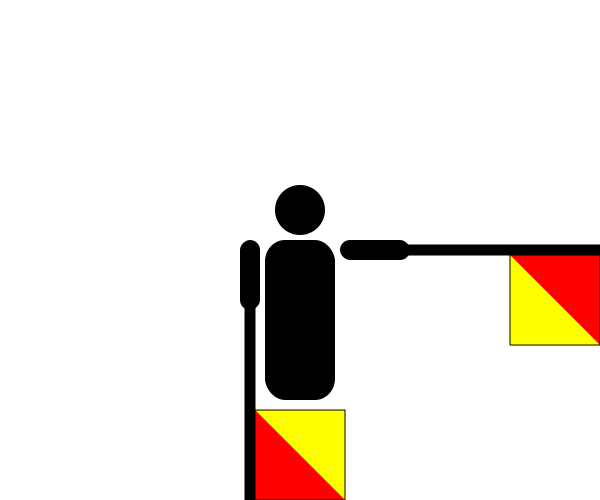
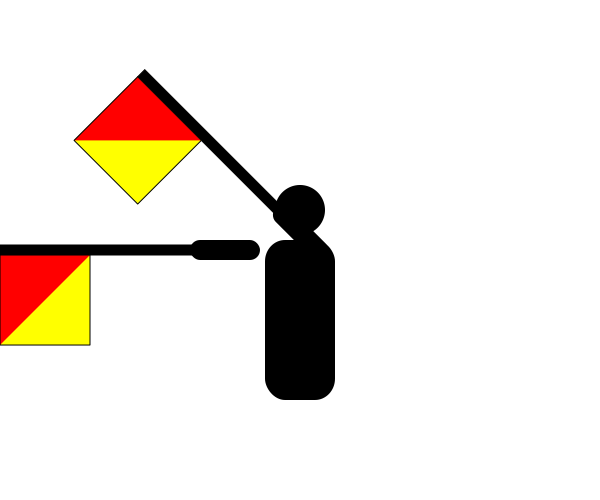

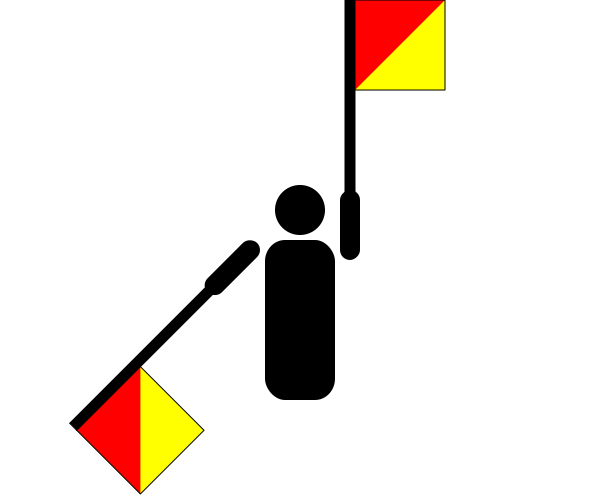

There are approximately 70 people named Folks in the UK. That makes it one of Britain's least common surnames. Only around one in a million people in Britain are named Folks.
