FLUCK
The surname Fluck is of German origin and derives from the Middle High German term vlucke, which translates to “luck” or “fortune.” It is identified as a nickname surname, historically bestowed upon an individual who was regarded as fortunate or prosperous, or alternately employed in an ironic sense upon a person believed to possess a stroke of good luck.
A dialectal variant of the Old Norse byname Floki is also recorded. This personal name originally denoted an outspoken or enterprising person and, in later usage, was interpreted as indicating an entrepreneur. Contemporary variants of the surname include Flook and Flux, though the earliest documented spelling appears in London records of the eighteenth century.
Notable early occurrences of the name are found in parish registers at St. Clement Danes, Westminster, London, where an infant named Elizabeth Fluck was christened in 1729, and in All Hallows, London Wall, in 1656, recording the marriage of Rose Fluck to Francis Wooton. The first unequivocal marriage record involving a Fluck is that of James Fluck, who married Elenor Browneing at St. Mary, Marylebone, London, in 1684, during the reign of King Charles II.
Other scholarship associates the surname with the German verb fluchen, meaning to swear or blaspheme. From this perspective, the name may be conceptualised as a topographic surname deriving from a place characterised by a fortified hill or tower—known as a flusher—where individuals who swore or blasphemed are said to have lived. Historical evidence suggests a possible connection with the Lower Barony Lands in the Bavarian district of Unter‑der‑Fluch, although surviving records from that period are scarce.
Over the centuries, individuals bearing the surname have migrated beyond German borders. In the United Kingdom, Fluck is infrequently encountered, yet concentration remains in the North West, particularly in Manchester and Liverpool. In the United States, the surname is most prevalent in the Midwest—chiefly Ohio, Michigan, and Wisconsin—indicating a probable provenance from Rhineland‑Palatinates, Hessia, or northern Bavaria. Significant populations also exist in South Africa, Canada, and Australia, reflecting nineteenth‑century immigration patterns.
The spelling of the surname has varied considerably. Documented variants include Fluks, Flucks, Flugge, Flukeshofer, and Flucke; further variations such as Fluke and Fluker may have evolved from the same root. These orthographic differences are typical of surnames with deep historical roots, especially when transferred between languages and alphabets.
In some German contexts the term Fluck is also recognised as the name of an educational game, traditionally played with wooden pieces shaped to represent different objects. Although the game was reportedly invented in the sixteenth century, its continued popularity today demonstrates the cultural resilience of the name beyond its purely onomastic function.
Typical given names associated with the Fluck surname
Male
- Anthony
- Martin
- Michael
- Nicholas
- Peter
- Philip
- Richard
- Robert
- Steven
- Timothy
Female
- Barbara
- Dionne
- Elizabeth
- Hannah
- Jane
- June
- Margaret
- Pamela
- Rose
- Sally
- Sarah
- Susan
- Sylvia
- Victoria
Similar and related surnames
Related and similar names are generated algorithmically based on the spelling, and may not necessarily share an etymology.
How to communicate the surname Fluck in...
Braille
⠋⠇⠥⠉⠅
Morse
..-..-....--.-.-.-
Semaphore
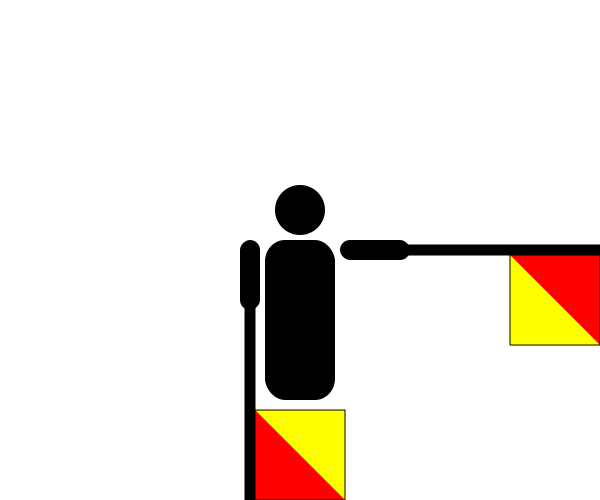


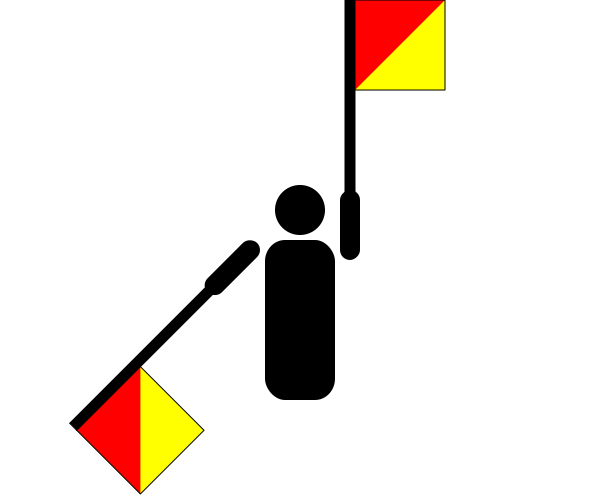
There are approximately 207 people named Fluck in the UK. That makes it one of Britain's least common surnames. Only around three in a million people in Britain are named Fluck.
Origin: English
Region of origin: British Isles
Country of origin: England
Religion of origin: Christian
Language of origin: English
