FLEMMING
The surname Flemming is a patronymic and locative surname that emerged in the British Isles. It is recorded as having English, Norse and Scottish roots and has historically signified a person who originated from the region of Flanders, now part of Belgium, the Netherlands and western France.
Its earliest linguistic form derives from the Old Norse personal name Flaemingr. The name was adopted into Anglo‑Saxon speech as Flem(m)ing and entered the kingdom of England following the Norman Conquest. The Norman French word Flamanc, meaning “the Fleming” or “a man from Flanders”, was introduced to England in 1066 and subsequently adapted into the English and Scottish vernacular as Flemming.
During the Middle Ages a large number of people from Flanders migrated to England and Scotland. Many of them were drawn by the flood‑prone low-lying lands of their homeland and by opportunities in the burgeoning textile industry. They established cloth manufactories in East Anglia and Yorkshire, where the export of English wool had been prohibited. The surname was consequently used as a simple identifier for those who had crossed the sea from the Low Countries.
The earliest surviving record of the name is found in the Yorkshire Assizes of 1219, where a man named William Le Flamanc is mentioned. This document, dated during the reign of King Henry I, confirms the use of the spelling with the prefix “Le”, a French article meaning “the”. The usage of “Le Flamanc” suggests that the name functioned as a descriptive epithet in its early days.
Throughout the centuries the spelling of the surname has varied. Common variants include Flemminge, Flemyng and the more familiar Fleming. Other forms such as Flaming and Flemmock appear in regional registers, reflecting local pronunciation and orthographic conventions.
Several individuals of note have carried the surname. Alexander Fleming (1824 – 1875) was a medical writer whose 1845 treatise, Physiological and Medicinal Properties of Aconitum Napellus, was influential in the development of a tincture that bears his name. Margaret Fleming (1803 – 1811), known by the affectionate nickname “Pet Marjoie”, was a child prodigy who interacted with Sir Walter Scott and composed verses on Mary Queen of Scots. These examples illustrate the presence of the name across diverse social spheres in the nineteenth century.
In contemporary times the surname is established in many English‑speaking countries, including the United Kingdom, Canada, the United States and Australia, a result of the long‑standing patterns of diaspora. The name no longer serves its original function as a geographic marker; instead it functions as a historical and familial identifier that connects bearers with a shared ancestral lineage linked to Flanders.
Typical given names associated with the Flemming surname
Male
- Andrew
- Anthony
- David
- Ian
- James
- John
- Michael
- Paul
- Peter
- Robert
- Thomas
Female
- Jane
- Janet
- Jean
- Jennifer
- Laura
- Margaret
- Mary
- Myrtle
- Nicola
- Patricia
- Rebecca
- Renee
- Sarah
- Susan
Similar and related surnames
Related and similar names are generated algorithmically based on the spelling, and may not necessarily share an etymology.
How to communicate the surname Flemming in...
Braille
⠋⠇⠑⠍⠍⠊⠝⠛
Morse
..-..-...----..-.--.
Semaphore
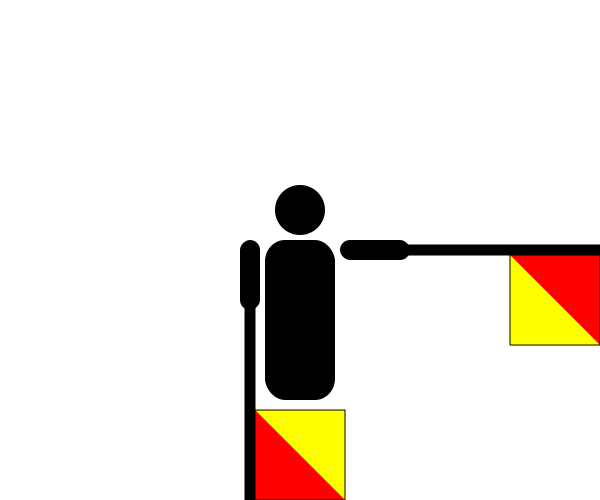


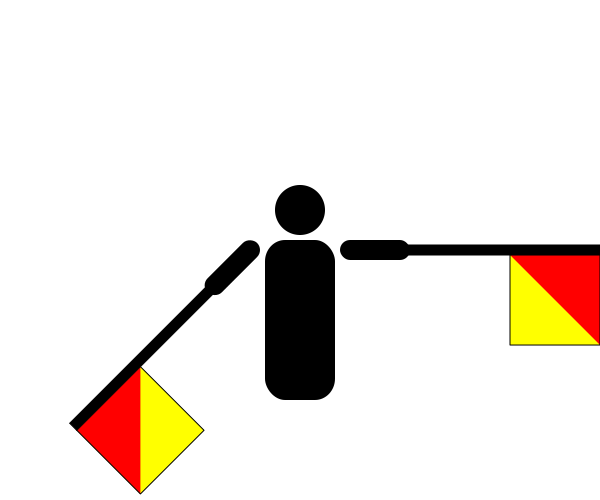
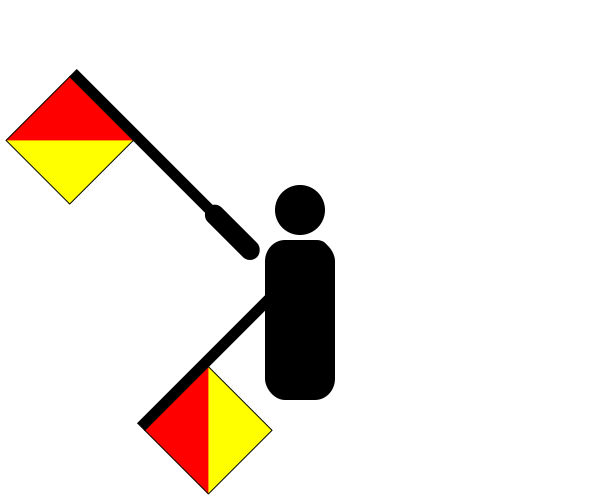
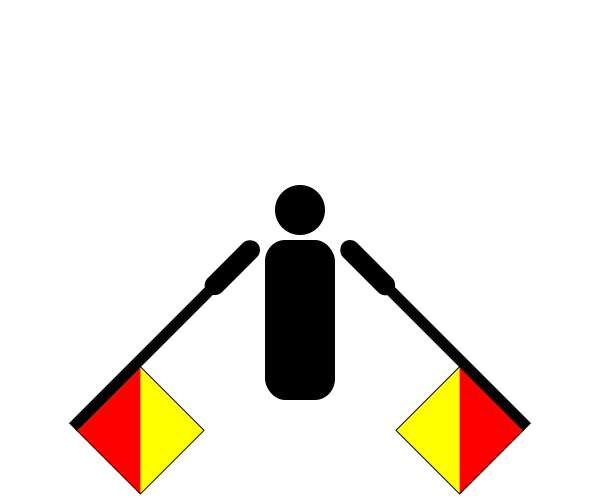

There are approximately 1,021 people named Flemming in the UK. That makes it roughly the 7,255th most common surname in Britain. Around 16 in a million people in Britain are named Flemming.
Surname type: Location or geographical feature
Origin: English
Region of origin: British Isles
Country of origin: England
Religion of origin: Christian
Language of origin: English

Famous people named Flemming
- Lucian Flemming - Anguillan football player
Names and descriptions courtesy of Wikipedia, and may contain errors. This is not intended to be an exhaustive list of every famous person with this name.