FLEISCHMANN
Fleischmann is a surname of German origin, traditionally classified as an occupational name that signifies a butcher or a man involved in the meat trade. The lexical root of the name is the Middle High German word fleischmann, literally translating to “meat man” or “butcher.” This derivation is corroborated by the Old English pre‑7th Century word floesc, which denotes flesh or meat, and by the High German term fleisc.
Historical documentation places the earliest recorded spelling of the family name in 1534, when an individual named Hanns Fleyschman entered into marriage with Dorothea Nuesslin in Neur\u00e4nberg. The name appears again in 1555 on the registers of Coburg, Sachsen‑Coburg‑Gotha, where Catharina Fleischman was married to Wolfgang Espacher, and in 1752 in London, at St. George’s, Mayfair, with the union of Daniel Felix Fleischmann and Maria Clotton. These entries illustrate the surname’s presence across German territories and in England during the early modern period.
As an occupational designation, members of the Fleischmann family were commonly associated with guilds that regulated the standards of butchery and meat commerce. The guild system, prevalent in medieval Germany, upheld stringent requirements for masters of the craft; the Fleischmanns would have been expected to adhere to these norms. Moreover, the name could also serve as a topographic identifier for individuals residing near a meat market or on farms where cattle were raised for slaughter, further reflecting the importance of the animal‑meat industry in that era.
In contemporary times, the surname has a substantial presence in German‑speaking countries such as Germany, Austria, and Switzerland. Diasporic migration has spread the name to North America, where it is most frequent in the United States—particularly in the eastern states of Virginia, North Carolina, and up‑state New York—and Canada, especially Ontario and Montreal. Australia, New Zealand, and parts of South America also contain identifiable clusters of families bearing the name, reflecting patterns of emigration from Europe during the 19th and 20th centuries.
Numerous orthographic variants exist, including Fleischman, Fleschman, Fleschmann, Flesherman, and Fleischius, among others. These variants arise from regional pronunciation differences and the adaptation of German phonology to English orthographic conventions. In French‑speaking contexts the name may appear as Fleschman, while in Polish it is rendered Flejszman. The American brand Fleischmann’s Yeast is a commercial appropriation of the name, illustrating its cultural penetration beyond purely genealogical boundaries.
Throughout its history, the Fleischmann surname has been associated with qualities such as strength, unity, and resilience—traits valued by families tied to the demanding profession of butchery. The name continues to be a point of pride for many descendants, who regard it as a link to an ancestral occupation that played a vital role in early European societies and remains a symbol of heritage in the modern era.
Similar and related surnames
Related and similar names are generated algorithmically based on the spelling, and may not necessarily share an etymology.
How to communicate the surname Fleischmann in...
Braille
⠋⠇⠑⠊⠎⠉⠓⠍⠁⠝⠝
Morse
..-..-........-.-.....--.--.-.
Semaphore
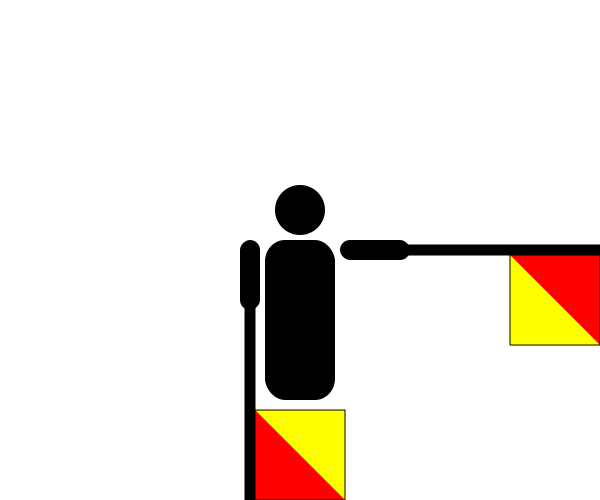


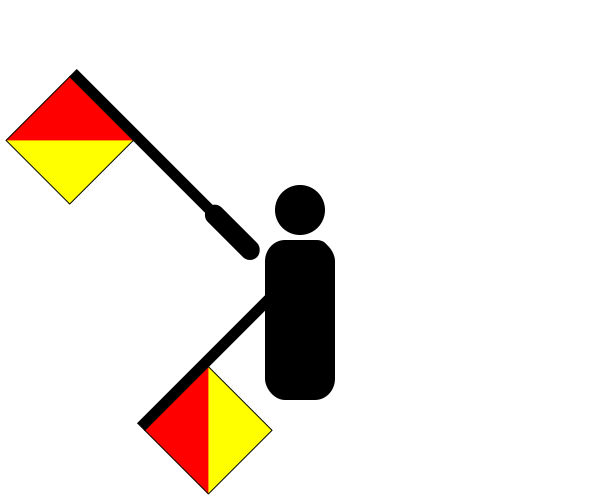


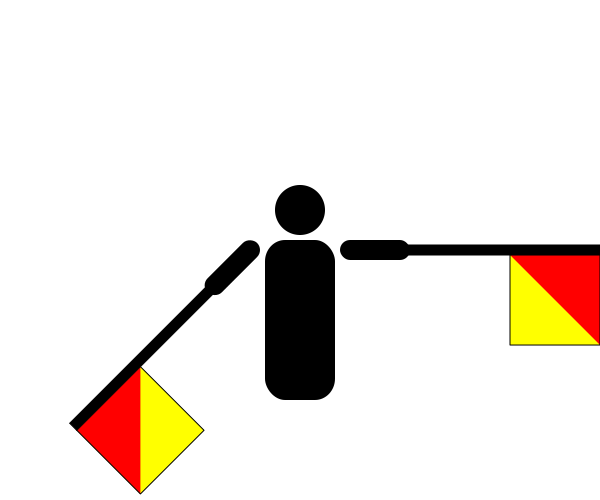

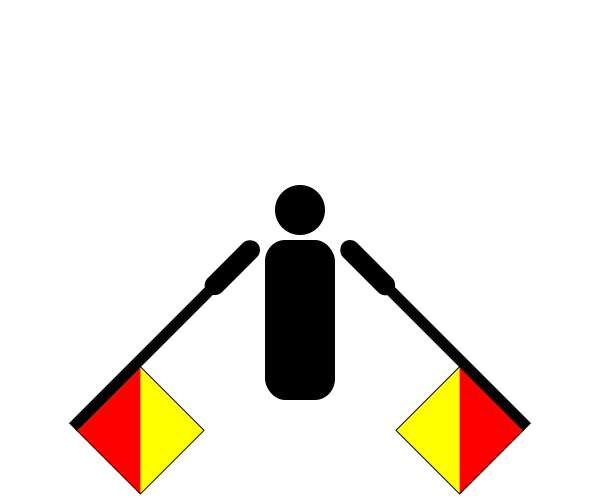
There are approximately 56 people named Fleischmann in the UK. That makes it one of Britain's least common surnames. Only around one in a million people in Britain are named Fleischmann.

Famous people named Fleischmann
- Erin Marie Moran-Fleischmann - American actress (1960 to 2017)
- Martin Fleischmann - Chemist (1927 to 2012)
Names and descriptions courtesy of Wikipedia, and may contain errors. This is not intended to be an exhaustive list of every famous person with this name.