FLEISCHER
Fleischer is a surname that originates from German-speaking regions of Europe.
The name is occupational in nature and is a direct translation of the word fleisch – meaning meat – in Middle High German. It was therefore given to individuals who practised the art of slaughtering and selling meat, that is, butchers.
This occupational naming convention was common in medieval Germany, where surnames frequently reflected the bearer’s trade, in the same fashion as Smith or Taylor.
Recorded versions of the name include Fleis, Fliesch, Fleischer, Fleischmann, Vle, Vlee, Van der Vlies, Van de Vlies, Vlies, Vlse, and other forms. These variations arise from differing regional pronunciations and from adaptations in non‑German speaking countries.
In addition to a butcher origin, the surname can also derive from the Dutch word vlie meaning fleece, thereby referring to a sheep farmer, or it may have a locational basis linked to a place called Vlieland in The Netherlands, a site whose name is thought to mean either free lands or sheep lands.
Early evidence of the surname appears in continental records: for instance, Heinrich Fleyse is found in the charters of Cleeburg, in the state of Hesse, in the year 1357, and Michael Fleischer of Zittau, Germany, is recorded in 1380.
Within England the name appears as early as the mid‑sixteenth century, reflected in the record of Nicholas Vlse, whose daughter Elizabeth was christened at St Dunstans in East Stepney on 1 October 1647. This early English use suggests that the original bearers may have been Protestant Huguenot refugees.
Later examples include Cornelius Van Der Vlies of Rotterdam on 31 October 1690, and Arij Van de Vlies of Vlaardingen, South Holland on 30 September 1714.
In modern times the surname is common throughout Germany and Austria, and is frequently encountered in other European countries that host sizeable German‑speaking communities. It is also present in the United States, a legacy of German immigration.
Among Ashkenazic Jewish communities the name is often seen, sometimes as Fleischman or Fleishman. In Anglicised contexts it may appear as Fleischer‑Smith, Fleischerman, or simply Fisher.
The rich variety of spelling forms and geographic spread of the surname are a testament to the historical migration of individuals and families whose professional identity as butchers or sheep farmers became a marker of lineage.
Typical given names associated with the Fleischer surname
Male
- Benjamin
- Carl
- Daniel
- Derek
- Frank
- Freddy
- Jason
- Joseph
- Paul
- Stephen
- Yeshaya
Female
- Clarissa
- Helena
- Inger
- Janet
- Jessica
- Karen
- Nina
- Nora
- Sarah
- Ulrike
- Vanessa
Similar and related surnames
Related and similar names are generated algorithmically based on the spelling, and may not necessarily share an etymology.
How to communicate the surname Fleischer in...
Braille
⠋⠇⠑⠊⠎⠉⠓⠑⠗
Morse
..-..-........-.-.......-.
Semaphore
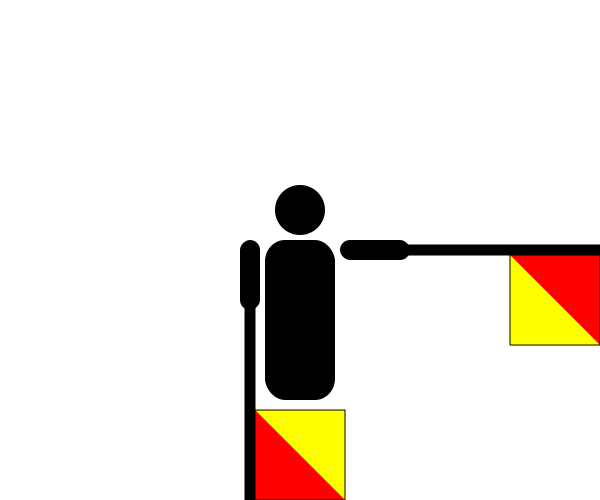


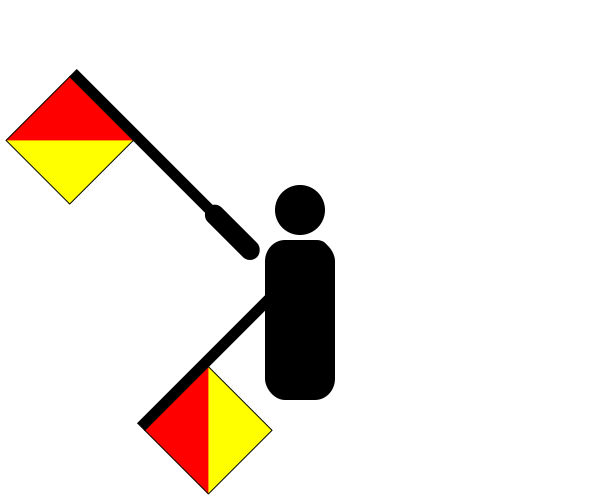


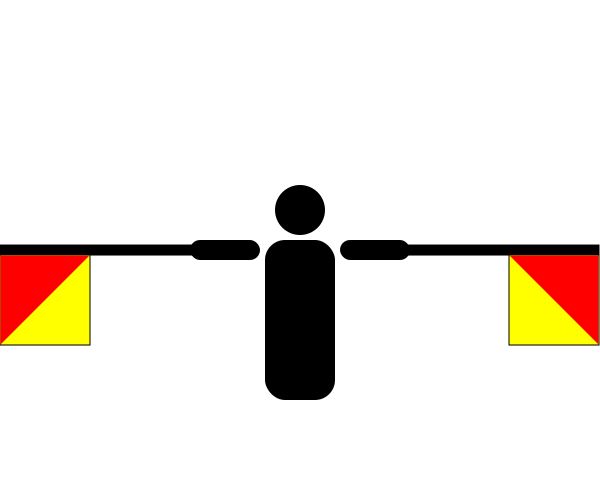
There are approximately 151 people named Fleischer in the UK. That makes it one of Britain's least common surnames. Only around two in a million people in Britain are named Fleischer.
Region of origin: Europe
Country of origin: Poland
Language of origin: Polish
