FLANNERY
Flannery is a surname of Gaelic origin, found primarily within the British Isles, and particularly in Ireland. The name is associated with the Irish linguistic tradition and traces its roots to the Celtic cultural sphere. Within Christian communities of Ireland, the surname has been borne by a number of notable figures and families.
The etymology of the name is linked to the Gaelic patronymic Ó Flannabhra, meaning “descendant of Flannabhra.” In this construction, flann denotes a red or ruddy hue, while abhra means eyebrow. Consequently, the surname may be interpreted as “descendant of the red‑eyebrowed” or “descendant of the ruddy‑eyebrowed.” This origin reflects the common practice in Gaelic naming of using descriptive nicknames as the basis for family names.
Historical records show the surname appearing in two principal forms: O'Flannery and Flannery. It originally functioned as a nickname derived from the words flann (red) and abrha (eyebrow). The earliest chieftain referred to by this name is believed to have possessed prominent red eyebrows, and there is evidence that the clan may have connections with early Norse settlers in Ireland. Dublin, which served as the capital of the Irish Viking kingdom in the tenth century, was a focal point of Viking activity, and it is plausible that the O'Flannery clan originated from these settlers before integrating into Irish society.
From the fourteenth century onwards, the surname has been associated mainly with County Mayo on the west coast and with the barony of Connelloe in County Limerick. In the eighteenth century, a sept of the family relocated eastward to County Tipperary. The surname also appears in the context of the Great Famine, when Martin Flannery emigrated from Ireland aboard the ship “Miracle of Liverpool” on 14 July 1846, bound for New York. Other prominent bearers include the Reverend William Flannery (1830–1902), a noted author born in Tipperary who spent his career in Canada, and Thomas Flannery (1840–1916), a pioneer in the Gaelic Revival of the late nineteenth century. The earliest documented holder of the name was John O'Flannery, who served as bishop of Derry between 1401 and 1415.
In contemporary times, the surname remains recognised within Ireland and outside its borders. Immigration during the nineteenth and twentieth centuries has dispersed members of the family to the United Kingdom, North America, and other parts of the world, where they continue to be identified by the same traditional spelling. The persistence of the name across centuries and geographies attests to its deep roots within Gaelic culture and its enduring status within the Irish diaspora.
Typical given names associated with the Flannery surname
Male
- Christopher
- David
- James
- John
- Mark
- Michael
- Patrick
- Paul
- Peter
- Thomas
Female
- Alison
- Catherine
- Christine
- Elizabeth
- Helen
- Karen
- Katherine
- Margaret
- Mary
- Michelle
- Sarah
- Susan
- Tina
Similar and related surnames
Related and similar names are generated algorithmically based on the spelling, and may not necessarily share an etymology.
How to communicate the surname Flannery in...
Braille
⠋⠇⠁⠝⠝⠑⠗⠽
Morse
..-..-...--.-...-.-.--
Semaphore



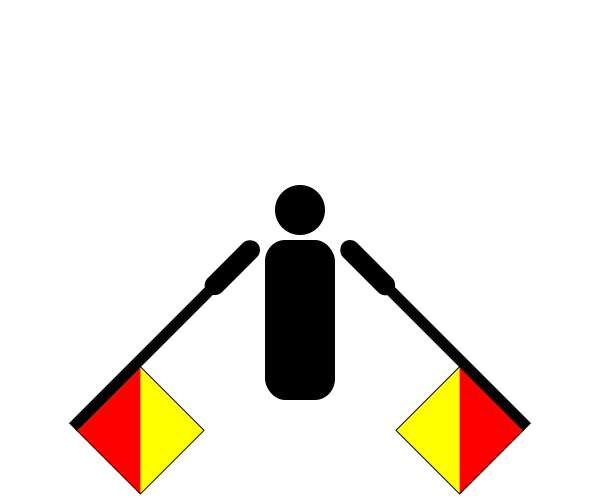

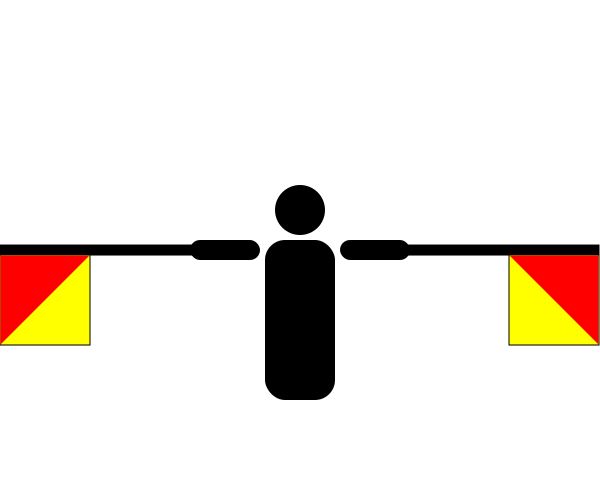
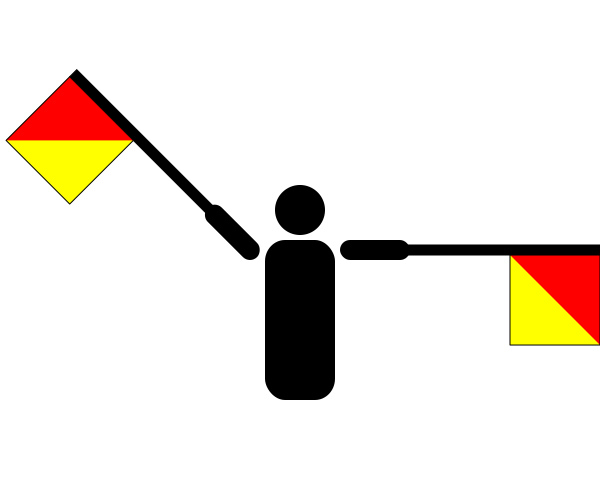
There are approximately 2,456 people named Flannery in the UK. That makes it roughly the 3,560th most common surname in Britain. Around 38 in a million people in Britain are named Flannery.
Origin: Celtic
Region of origin: British Isles
Country of origin: Ireland
Religion of origin: Christian
Language of origin: Gaelic

Famous people named Flannery
- Kate Flannery - American actress
- Peter Flannery - Playwright
- Martin Flannery - Politician (1918 to 2006)
- Paddy Flannery - Scottish football player
- Niall Flannery -
- James Fortescue Flannery - Politician (1851 to 1943)
Names and descriptions courtesy of Wikipedia, and may contain errors. This is not intended to be an exhaustive list of every famous person with this name.