FITCHETT
Fitchett is a surname of English origin that has been recorded in the British Isles since the twelfth century. A diminutive form of Fitch, the name developed from the Old English word fiche, meaning a pike or a sharp point, and was originally used as a nickname for a person who possessed a pointed or sharp character, or who resembled a pike in appearance.
Over time the nickname evolved into a hereditary surname, and early instances of the name appear in the contemporary records of the period. The earliest documented use of the name is in the 1176 Pipe Rolls of Dorset, where a witness named Hugh Fichet is recorded. Subsequent entries show the name again in the 1183 Pipe Rolls of Northumberland with a witness called Robert Fichet, in the Assise Rolls of Somerset as Hugh Fiche, and in the 1297 Subsidy Rolls of Yorkshire as Roger Fiche. These entries provide the foundation for the modern spelling Fitchett.
The surname is also linked to the Old French word fiche, meaning stake, derived from the Latin figere. In France it was a metonymic occupational name for a workman who used an iron‑pointed implement. The occupational origin of the name gave rise to a genuine link between the workman and the iron point, and the profession of a metal worker later became hereditary. Although other theories have been offered that the name came from a nickname for a polecat called fitch, recent historical scholarship suggests that the fitch form was not used until the sixteenth century, short of contemporary evidence that the surname Fitchett was found as a byname or as a fitchet in the 12th century.
In early modern England a byname could often be adopted by a person who held the campaign for metal–working with a frontier expression. The fitchet was likely seen as a sign of a workman in England who might have carried a sharp pointed implement that was either a stake or a plough‑point. Many of the earliest Edmunds hailed from the small villages in the country, and the earliest recorded Hodgheman or local outsider that led to the name was likely a Fitchett.
A marriage of the Fitchett surname is recorded in London in which Lawrence Fitchett and Katerine Lisence were wed on the nineteenth of June, 1632, at St. Mary on the Hill. The coat of arms awarded to a family under the name Fitchett consists of a black shield, with a gold lion rampant, overall a bend ermine. The crest, or side, depicts a lion rampant erminois, ducally crowned in gold. This heraldry was granted to a member of the family whose belongings and deeds highlight their continuing presence in the region.
In summary, the Fitchett surname reflects early usage as a diminutive of Fitch and derives from a descriptive or occupational root that highlights a characteristic, tool or occupation of the original bearer. The land records and genealogical registers of the medieval period provide a clear line of evidence that the name persists in the present day as a widely recognised surname across the country, revealing a long family history that started in the medieval English countryside.
Typical given names associated with the Fitchett surname
Male
- Alan
- Andrew
- Barry
- David
- James
- John
- Mark
- Matthew
- Michael
- Paul
- Peter
- Stephen
Female
- Christine
- Claire
- Dorothy
- Julie
- Karen
- Lisa
- Louise
- Margaret
- Nicola
- Rebecca
- Sarah
- Sheila
- Valerie
Similar and related surnames
Related and similar names are generated algorithmically based on the spelling, and may not necessarily share an etymology.
How to communicate the surname Fitchett in...
Braille
⠋⠊⠞⠉⠓⠑⠞⠞
Morse
..-...--.-......--
Semaphore
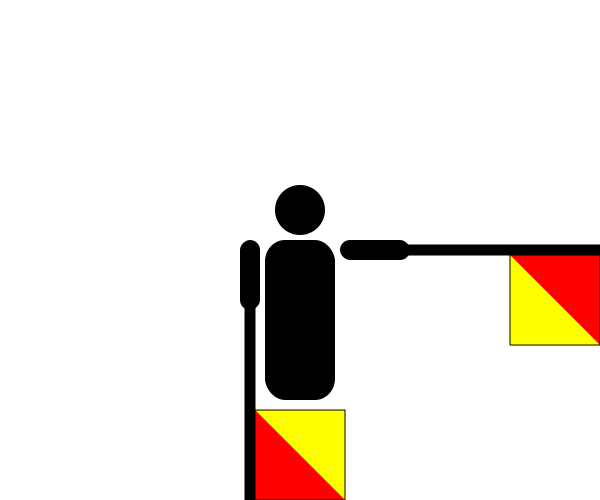
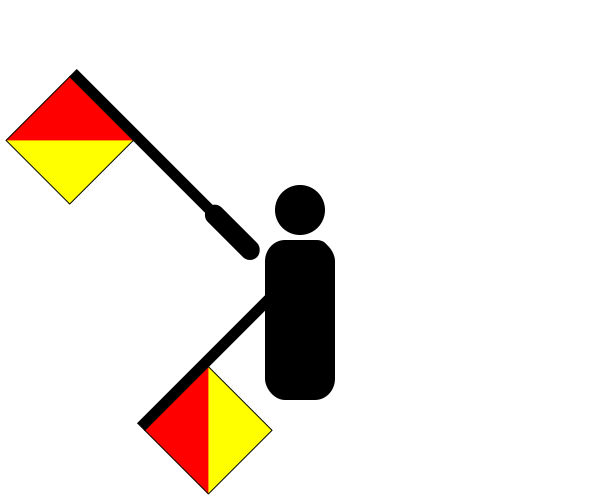
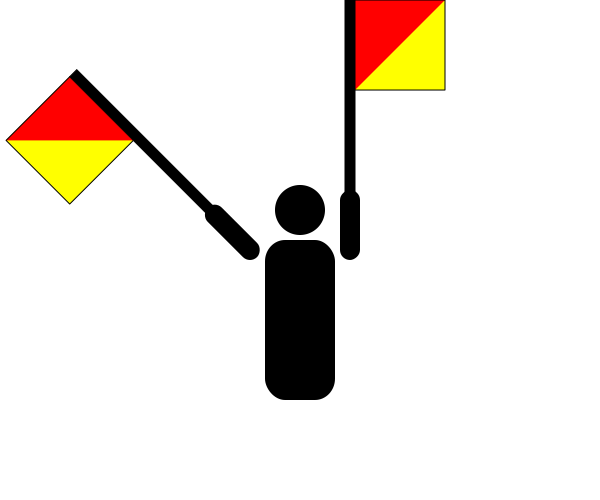


There are approximately 1,493 people named Fitchett in the UK. That makes it roughly the 5,366th most common surname in Britain. Around 23 in a million people in Britain are named Fitchett.
Surname type: Diminutive
Origin: English
Region of origin: British Isles
Country of origin: England
Religion of origin: Christian
Language of origin: English