FINN
Finn is a surname of Irish origin which is rooted in the Gaelic linguistic tradition of the British Isles. The name is derived from the ancient Gaelic word Fionn, meaning fair or white, and is closely associated with Irish religious history and the wider Celtic cultural milieu.
In Irish folklore, the name is most famously linked with the legendary hero Fionn mac Cumhaill, often anglicised as Finn McCool. The mythological figure embodies ideals of strength, wisdom and fairness, and the surname often conveys a sense of national heritage and a symbolic connection to these enduring values.
The surname Finn is an anglicised form of the Old Gaelic name O'Finn. In that context the prefix O denotes grandson or male descendant of and is combined with the personal name Finn, again stemming from fionn and signifying fair haired. This structure marks a lineage and a link to forebears who bore the same personal characteristics.
There were three principal O'Finn septs in Ireland. One was based in County Sligo, where its chiefs exercised control over the lands of Calry on the shore of Laigh Gill, a location that contributed the origin of the place name Coolavin (in Irish Cuil O'bhFinn), meaning the refuge place of the O'Finns. A second sept held church lands in Kilcolgan, County Galway, while a third was situated in the ancient territory of Oriel (now County Armagh and County Monaghan) and spelt their name as MacFhinn or Maginn. Petty's 1659 census records the name Finn as widespread in County Cork.
Recorded examples include Francis Finn, a witness at the church of St. Peter and St. Kevin in Dublin on 26 April 1691, Susannah Finn who married Joseph Watson in Dublin on 20 August 1799, and Michael Finn of Kilworth, County Cork on 5 October 1864. The earliest attested spelling is that of O'Finn, Bishop of Munster, recorded in the Annals of Inis Faithleann in 1020 during the reign of Malachy I, High King of Ireland (1014-1122).
Today the surname Finn remains a marker of Irish identity. Its etymological roots in fionn continue to signify characteristics of fairness and brightness, while its historical connections to notable clans and to the mythic tradition of Fionn mac Cumhaill provide avenues for cultural pride and genealogical research within the Anglo‑Irish and broader Celtic context.
Typical given names associated with the Finn surname
Male
- Andrew
- Anthony
- Daniel
- David
- James
- John
- Michael
- Patrick
- Paul
- Thomas
Female
- Alison
- Catherine
- Claire
- Elizabeth
- Helen
- Jacqueline
- Joanne
- Margaret
- Mary
- Maureen
- Patricia
- Sarah
- Susan
Similar and related surnames
- Fin
- Finney
- Finnie
- Fynn
- Fine
- Fina
- Fini
- Fines
- Finey
- Fing
- Fink
- Finna
- Finnah
- Finie
- Finne
- Finni
- Finno
- Finnay
- Finnes
- Finnis
- Finns
- Finny
- Fino
- Fins
- Fyne
- Fynne
- Phinn
- Vin
- Vinn
- Vinne
- Figna
- Finah
- Finc
- Find
- Finneis
- Finnies
- Finnih
- Fint
- Flin
- Flinn
- Flint
- Flyn
- Flynn
- Flynne
- Lynn
- Phin
- Vine
- Vinnes
- Vinni
- Foan
- Van
- Vann
- Vian
Related and similar names are generated algorithmically based on the spelling, and may not necessarily share an etymology.
How to communicate the surname Finn in...
Braille
⠋⠊⠝⠝
Morse
..-...-.-.
Semaphore
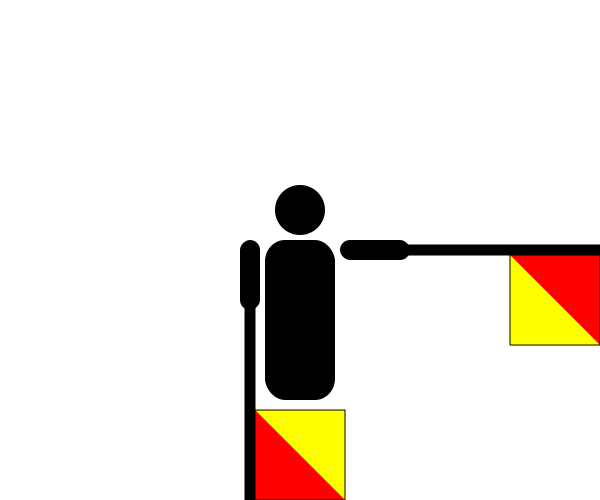
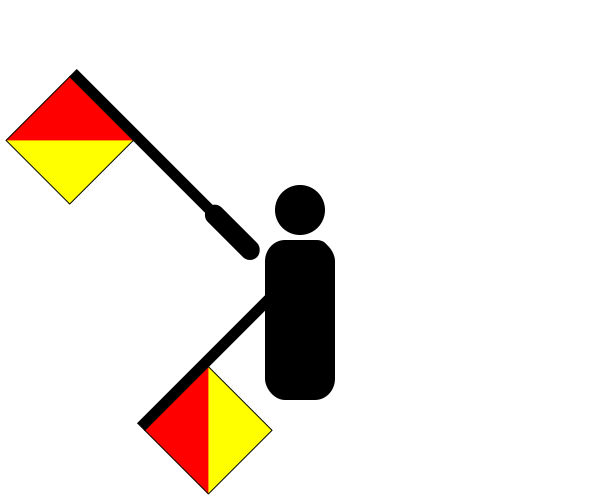
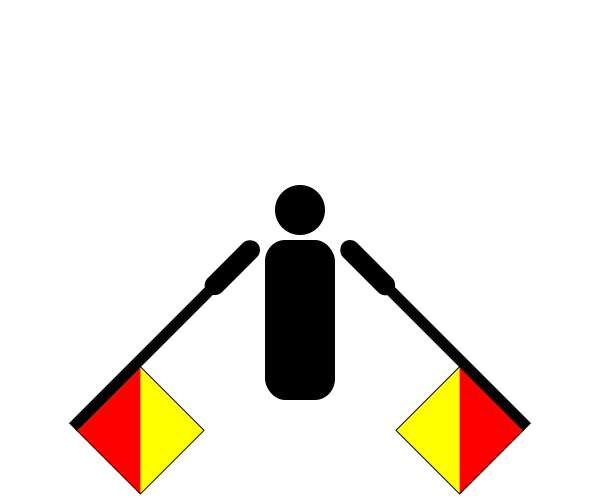
There are approximately 9,271 people named Finn in the UK. That makes it roughly the 1,018th most common surname in Britain. Around 142 in a million people in Britain are named Finn.
Origin: Celtic
Region of origin: British Isles
Country of origin: Ireland
Religion of origin: Christian
Language of origin: Gaelic

Famous people named Finn
- Mickey Finn - Musician (1947 to 2003)
- Steven Finn - Cricket player of England
- Neil Finn - Football player
- Simon Finn - Musician
- Kyle Finn - Irish football player
- Liam Finn - Rugby league player
- Micky Finn - Football player
- James Henry Finn - Recipient of the Victoria Cross (1893 to 1917)
- Ronald Finn - Medical researcher (1930 to 2004)
- Harry Finn - Army general (1852 to 1924)
Names and descriptions courtesy of Wikipedia, and may contain errors. This is not intended to be an exhaustive list of every famous person with this name.