FINCHAM
The surname Fincham is of strictly English origin, belonging to the cohort of locational surnames that emerged in the early Middle Ages. It is derived from two Old English elements. The first element, fenn, denotes a marsh or fen, describing the flood‑prone landscape that would have surrounded the original settlement. The second element, ham, signifies a homestead or village. Consequently, the surname originally identified individuals who resided in or near a marshy village, providing a practical geographical reference for medieval communities.
Historical evidence places the earliest recording of the place name Fincham in the Domesday Book of 1086, where it appears as P(h)incham. By 1095, documents from the Abbey of Bury St. Edmunds refer to the settlement as Fincham in the English-speaking part of Norfolk. The placename itself is likely to mean a homestead frequented by finches; this interpretation is derived from the pre‑7th‑century Old English word finc for finch, combined with ham. The use of the bird in the toponym may reflect either a notable presence of finches in the area or a symbolic association associated with the locale.
Locational surnames such as Fincham typically originated when a local landowner or lord adopted the name of the village to which he belonged, or when an inhabitant migrated elsewhere and was identified by reference to his birthplace. The earliest recorded spelling of the family name is that of Nigellus de Fincham, dated to circa 1100, found in the Records of the County of Norfolk during the reign of King William I, the First (commonly known as Rufus). This demonstrates a continuity of the name from the early 12th century onward.
Parochial registers subsequently document members of the Fincham family in the Elizabethan and early Stuart eras. Examples include the christening of Agnes Fincham on 18 December 1569 at Stow Bardolph, Norfolk; the marriage of William Fincham and Alice Foster in Wimbotsham, Norfolk, in 1592; and the marriage of Simeon Fincham and Mary Anthony on 25 September 1626 at Allhallows, Honey Lane, London. These entries record the persistence of the surname throughout the region and its appearance in judicial and ecclesiastical records.
The household has also preserved a heraldic achievement. The coat of arms is rendered on a silver field bearing three black bars and an ermine bend. The crest consists of a gold hind's head erased; the hinde's mouth holds a branch of green holly, which is fructed in red. The heraldic description associates the emblem with the family's historical identity and its roots within the English countryside.
Typical given names associated with the Fincham surname
Male
- Andrew
- Anthony
- David
- James
- John
- Mark
- Michael
- Paul
- Peter
- Robert
- Stephen
Female
- Christine
- Elizabeth
- Emma
- Helen
- Jacqueline
- Jane
- Margaret
- Nicola
- Patricia
- Rebecca
- Sarah
- Susan
Similar and related surnames
Related and similar names are generated algorithmically based on the spelling, and may not necessarily share an etymology.
How to communicate the surname Fincham in...
Braille
⠋⠊⠝⠉⠓⠁⠍
Morse
..-...-.-.-......---
Semaphore
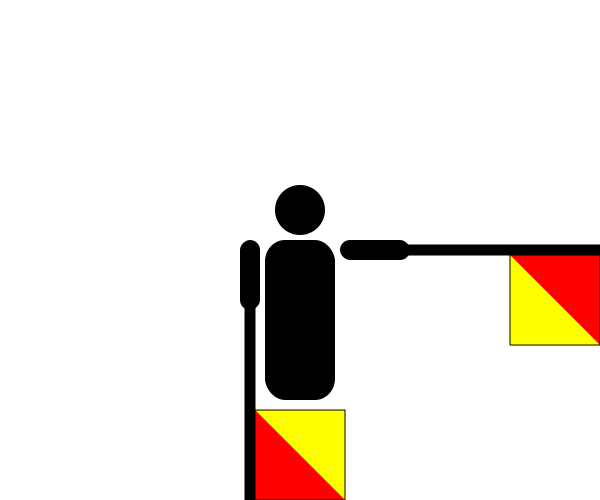
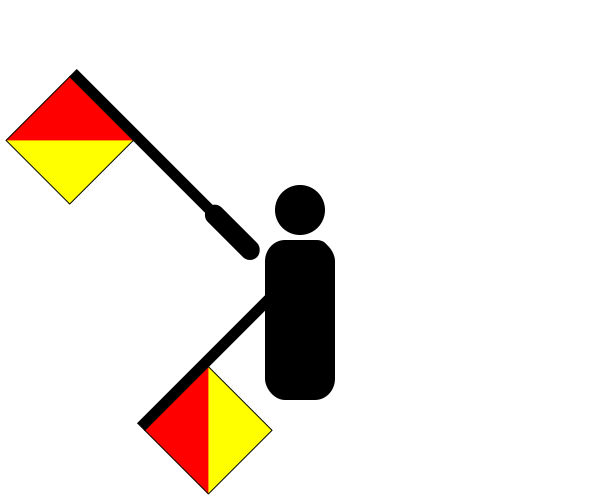
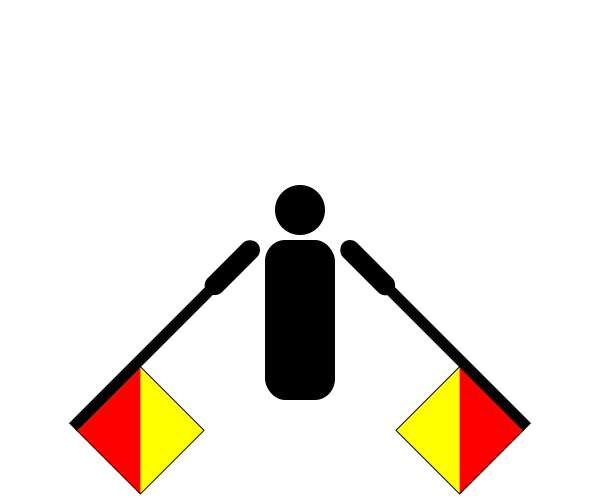


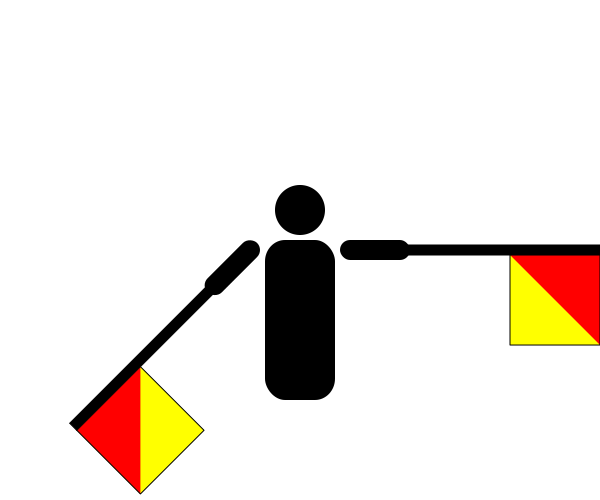
There are approximately 1,835 people named Fincham in the UK. That makes it roughly the 4,513th most common surname in Britain. Around 28 in a million people in Britain are named Fincham.
Surname type: Location or geographical feature
Origin: English
Region of origin: British Isles
Country of origin: England
Religion of origin: Christian
Language of origin: English

Famous people named Fincham
- Peter Fincham - Television executive
Names and descriptions courtesy of Wikipedia, and may contain errors. This is not intended to be an exhaustive list of every famous person with this name.