FEW
Few is a surname of English origin, derived from the Old English word feaw, meaning “few” or “small in number.” It is widely regarded as having arisen as a nickname for an individual of small stature, limited possessions or, in some cases, as a reference to the youngest member of a family.
The earliest documented use of the name appears in the parish registers of the 16th century and is connected with the spelling Fewe, an earlier form of the modern surname. The first recorded instance that is directly regarded as a hereditary surname is that of Thomas Phehewe, christened on 7 July 1582 at St Mary Magdalene, Bermondsey, London, during the reign of Elizabeth I.
Several 16th and 17th‑century documents show the name being recorded in its various spellings: Anne Phehew, daughter of Robert Phehew, christened 27 September 1584; Dorothie Pehew, probable sister of Anne, christened 26 October 1589; Joane Fewe, who married Alexander Willes in 1603 at St Dunstans in Stepney; Ana Few, daughter of Edmond Few, christened 9 October 1653 at St Botolphs Without, London; and Robert Phugh, son of Richard Phugh, christened 30 March 1685 at St Martins in the Field, Westminster. These records are interpreted as evidence that the modern form of the name evolved from a dialectal form of the Welsh patronymic Ap Hugh (the son of Hugh), which was frequently written as Phugh in contemporary records.
There has been some suggestion that the name originally developed as a short form of the surname Fewster, which itself may derive from the pre‑10th‑century French word fustier, meaning a “saddle‑tree maker.” However, the linguistic and documentary evidence supporting this origin is considered unlikely. Other conjectural associations link the name to the Norman French word fustier or the French surname Fuster, and to the Welsh surname Vaughan, but these connections are not regarded as definitive.
In 1612 a coat of arms was granted to the family, described in heraldic terms as a blue field with a silver lion rampant, its claws and tongue in red. These arms were intended to serve as a visual signifier of the family’s identity within the heraldic tradition of early modern England.
In contemporary times the surname Few remains relatively uncommon, with fewer than 10,000 bearers worldwide. The majority of those who carry the name are located in English‑speaking countries, particularly the United States, where it ranks as a popular surname in the state of Georgia. It is also found in England and Australia, though in markedly smaller numbers.
Thus, the surname Few has a well‑documented history rooted in medieval England, with variations that reflect linguistic shifts and regional influences. Its current distribution and heraldic associations underscore its continuing presence within the tapestry of English surnames.
Typical given names associated with the Few surname
Male
- Alan
- Anthony
- Christopher
- David
- Ian
- James
- John
- Jonathan
- Michael
- Richard
- Robert
- Simon
Female
- Amanda
- Helen
- Janet
- Jennifer
- Kathleen
- Kaye
- Marie
- Mary
- Nicola
- Patricia
- Rachel
- Rebecca
- Sarah
- Susan
Similar and related surnames
Related and similar names are generated algorithmically based on the spelling, and may not necessarily share an etymology.
How to communicate the surname Few in...
Braille
⠋⠑⠺
Morse
..-...--
Semaphore
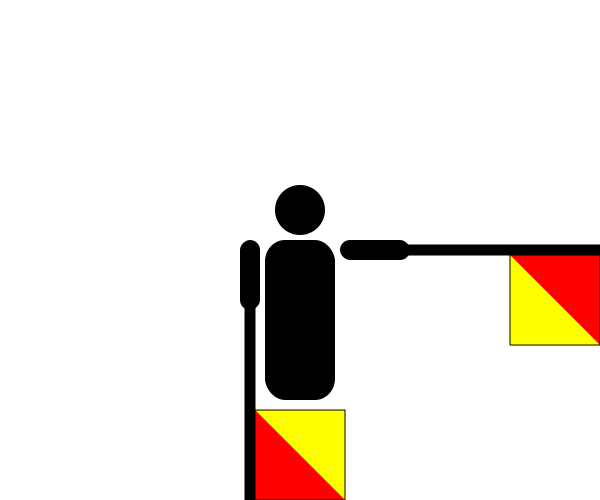

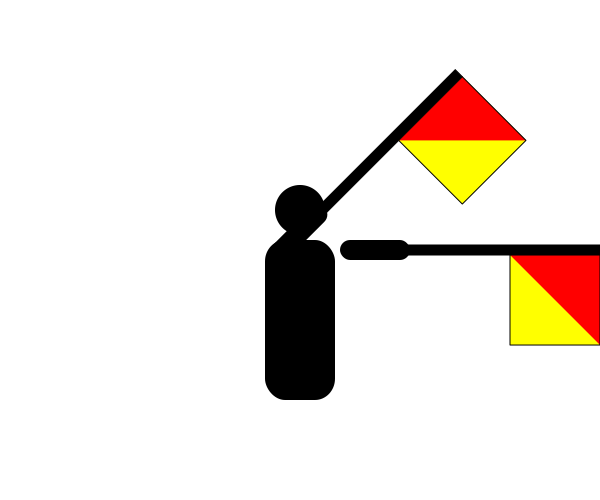
There are approximately 1,302 people named Few in the UK. That makes it roughly the 6,012th most common surname in Britain. Around 20 in a million people in Britain are named Few.
Origin: English
Region of origin: British Isles
Country of origin: England
Religion of origin: Christian
Language of origin: English

Famous people named Few
- Rosaline Few -
Names and descriptions courtesy of Wikipedia, and may contain errors. This is not intended to be an exhaustive list of every famous person with this name.