FERNANDO
The surname Fernando is a family name that can be found throughout Europe, particularly in Portugal and Spain. It is a Christian surname of Iberian origin, and its etymology is rooted in Germanic linguistic elements that migrated through the Visigothic conquest of the Iberian Peninsula in the sixteenth century. The name is derived from the given name Ferdinand, itself composed of the Germanic elements frithu, meaning peace, and nantha, meaning brave or daring. Consequently, the surname can be understood to signify a person who is both courageous and peaceful, or someone who is brave in pursuit of peace.
Historical records indicate that the name appears in a variety of spellings, including Ferdinand, Fernandez, Fernando, Ferrandiz, Hernan, Hernando and Hernandez. These variations reflect the diverse linguistic environments in which the surname evolved. The earliest known instance of the family name was that of Barabonado Vera Fernandez, dated 1 July 1525, born in Granada during the reign of King Charles I of Spain. Other early documentation, such as the christening of Caranjon Fernandez on 6 December 1534 at Nuestra Senora la Antigua in Valladolid, and the christening of David Hernandez on 18 March 1745 at St. Anne's Soho in Westminster, London, demonstrate the name’s spread across European Christian societies.
The surname gained prominence largely because of King Ferdinand I of Castile and León (1198-1252), who led the reconquest of Spanish territories from Moorish rule. His reign contributed to the popularisation of the name across the Iberian Peninsula and beyond, and his subsequent canonisation further cemented the name’s association with piety and royal legitimacy. In ecclesiastical registers, the name appears in contexts ranging from baptisms to marriage alliances, reflecting its integration into the social fabric of medieval and early modern Europe.
The most commonly associated heraldic symbol for the Fernando family is a red shield charged with two gold battle axes endorsed, and in base a gold crescent. This coat of arms, described by the blazon tradition, visually represents martial readiness and a hopeful aspiration towards peace, echoing the name’s Germanic roots. The use of this emblem in family crests and seals has helped to preserve the identity of disparate branches of the Fernando lineage across centuries and borders.
In sum, the surname Fernando encapsulates a rich confluence of Germanic bravery and Iberian peace, transmitted through centuries of migration, conquest, and royal patronage. Its endurance in Portuguese and Spanish communities, and its occasional appearance in British records, underline the enduring influence of early medieval cultural exchanges on today’s European onomastic heritage. The formal, noble craftsmanship of its heraldry and historical documentation continues to affirm the name’s significance within the broader tapestry of European ancestry.
Typical given names associated with the Fernando surname
Male
- Andrew
- Anthony
- Anton
- Cedric
- John
- Joseph
- Kurukulasuriya
- Lawrence
- Mark
- Michael
- Rohan
- Warnakulasuriya
Female
- Anne
- Antoinette
- Christine
- Judith
- Manel
- Maria
- Mary
- Samantha
- Sandra
- Sarah
- Susan
Similar and related surnames
- Farnaind
- Farnan
- Ferdinando
- Ferenando
- Ferlando
- Fernado
- Fernan
- Fernanades
- Fernand
- Fernande
- Fernandel
- Fernander
- Fernanders
- Fernandery
- Fernandes
- Fernandess
- Fernandex
- Fernandey
- Fernandez
- Fernandis
- Fernandiz
- Fernandz
- Fernant
- Fernendes
- Fernendez
- Fernent
- Ferniand
- Ferrando
- Firnan
- Forenan
- Fornan
- Furnandiz
- Vernan
Related and similar names are generated algorithmically based on the spelling, and may not necessarily share an etymology.
How to communicate the surname Fernando in...
Braille
⠋⠑⠗⠝⠁⠝⠙⠕
Morse
..-...-.-..--.-..---
Semaphore


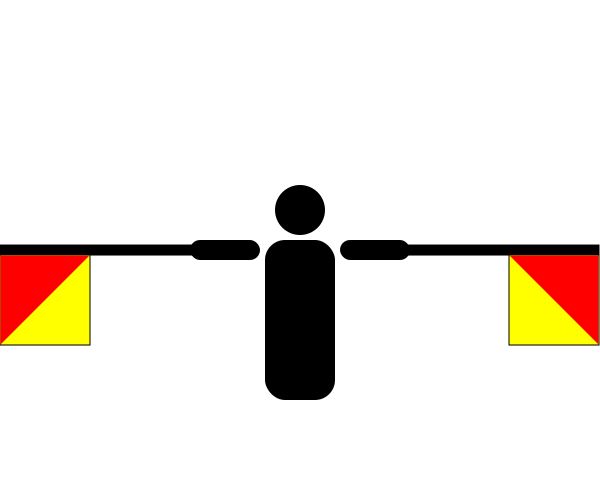
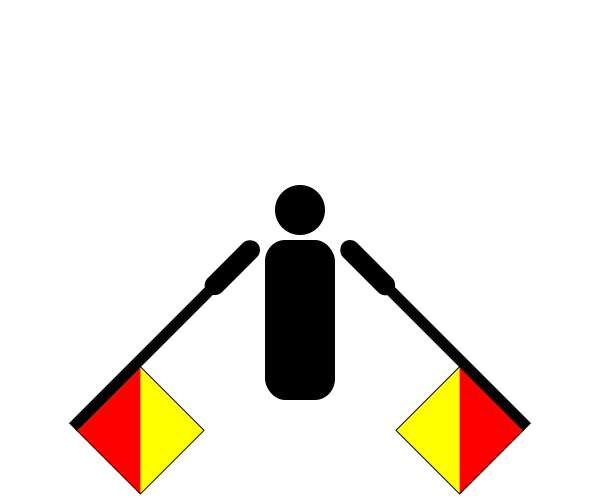


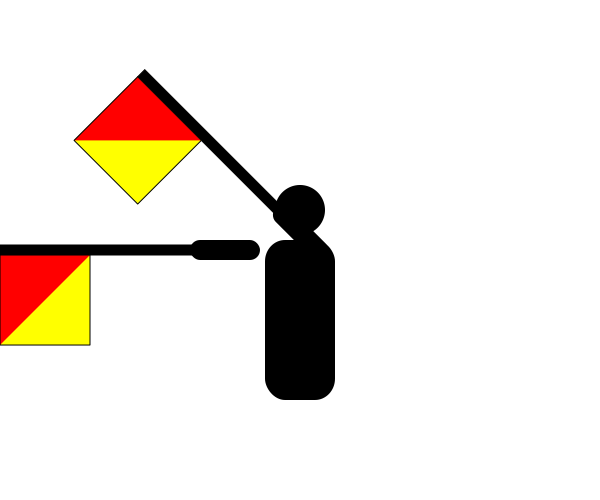
There are approximately 3,117 people named Fernando in the UK. That makes it roughly the 2,893rd most common surname in Britain. Around 48 in a million people in Britain are named Fernando.
Origin: Iberian
Region of origin: Europe
Country of origin: Portugal
Religion of origin: Christian
Language of origin: Portuguese
