FERBER
Ferber is a surname of Germanic origin that entered the English lexicon in the late seventeenth century. It is traditionally regarded as an occupational name, originally applied to individuals who performed the craft of dyeing, a trade of significant importance in medieval and early modern Europe.
The etymology of the name can be traced to the Middle High German word vërber, meaning “dyer.” Derivation from the German farber—an agent noun form of varwe, “colour” – is also documented. These linguistic roots establish the surname as a descriptor of the wearer’s trade rather than a geographical or patronymic label.
Historical records show that the surname arrived in England during the late 1600s. The earliest documented instance is the christening of John Ferber at St. Dunstan’s, Stepney, on 28 June 1672. Subsequent entries in parish registers show the name in use within English communities for several decades thereafter.
Throughout its history the spelling of Ferber has varied. Documented variants include Farber, Fever, Faerber, and Ferver. In German church registers, the name appears in forms such as Johann Sebastian Ferber (born 25 November 1608, Landauin, Pfalz Stadt) and Johan Matthias Ferber (married 2 July 1658, Sankt Lambertus, Duesseldorf Stadt). These variations illustrate the fluidity of orthographic practices in the pre‑modern period.
Coat‑of‑arms bear a distinctive red shield bearing a gold cross pomel. In heraldic symbolism, red (“gules”) denotes military fortitude and magnanimity, while gold (“or”) signifies generosity and elevation of mind. The cross represents Christian faith and the love of God for sinful men, reflecting the religious commitments of families who adopted the surname.
Other sources record an alternative occupational derivation for the surname, linking it to mining. According to these accounts, the German word Fürber is interpreted as “miner,” suggesting that bearers of the name may have been involved in iron extraction. While this interpretation presents a divergent occupational origin, the primary evidence for Ferber remains tied to dyeing.
In contemporary demography, the surname persists worldwide. In the United States, concentrations are greatest in metropolitan New York, in particular Brooklyn and Long Island; Pennsylvania, Ohio, and Michigan also record significant numbers. In Canada, Ontario and Quebec exhibit the highest prevalence, especially in Toronto, Montreal, and Ottawa. European distribution remains strong in German‑speaking regions such as Germany, Austria and Switzerland, and the surname is also noted in Poland, the Czech Republic and other Central and Eastern European countries. Australia and New Zealand contain notable populations, particularly in New South Wales and Victoria.
The surname’s reach among Ashkenazi Jewish communities is also documented, reflecting migration and settlement patterns that have broadened its geographic distribution. Variants such as Feurbar, Furby, and Ferbee often appear as Anglicised or Americanised forms of the name, further demonstrating its adaptability across linguistic contexts.
Similar and related surnames
Related and similar names are generated algorithmically based on the spelling, and may not necessarily share an etymology.
How to communicate the surname Ferber in...
Braille
⠋⠑⠗⠃⠑⠗
Morse
..-...-.-.....-.
Semaphore
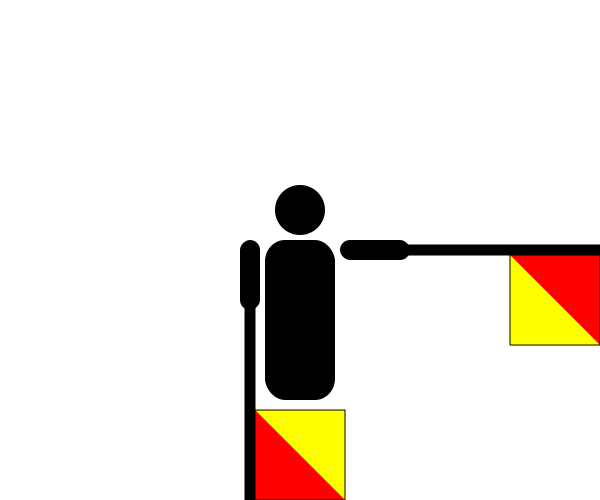

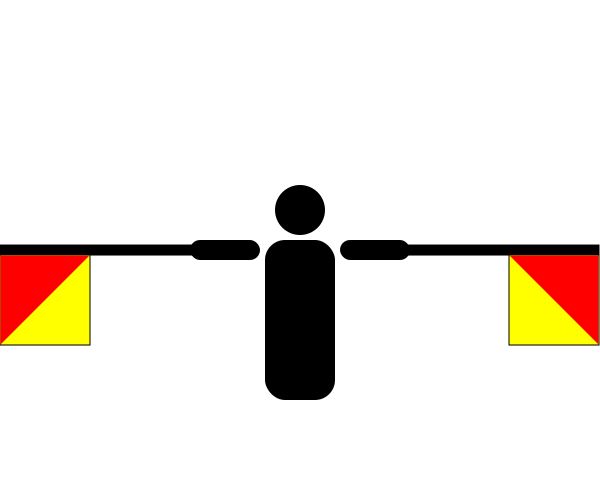
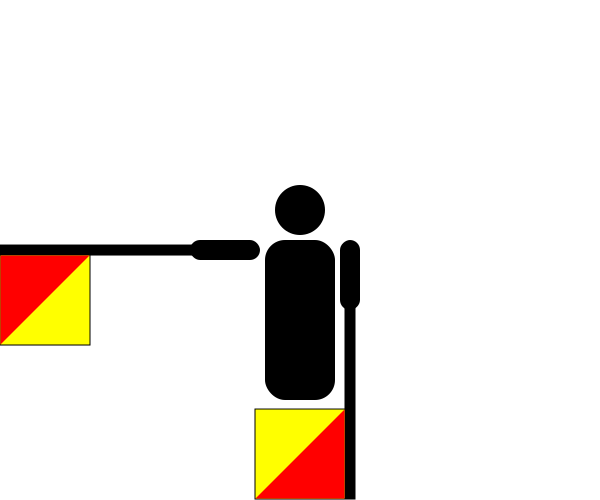
There are approximately 146 people named Ferber in the UK. That makes it one of Britain's least common surnames. Only around two in a million people in Britain are named Ferber.
Origin: English
Region of origin: British Isles
Country of origin: England
Religion of origin: Christian
Language of origin: English