FELDMANN
Feldmann is a surname of Germanic origin, derived from the combination of feld meaning "field" and mann meaning "man". In literal translation the name signifies a person associated with fields, typically in an agricultural capacity such as a farmer or a labourer.
Historically, the surname was occupational in nature. During the medieval period it would have been bestowed upon individuals whose livelihoods involved working, cultivating or otherwise tending to open country. As was common with many surnames of that era, the designation persisted through generations and came to be recognised as a hereditary family name.
Early documentary evidence of the name appears in England and Germany. The earliest recorded instance is believed to be that of Robert de Felde, dated 1185, listed in the registers of the Knights Templars for the county of Gloucestershire during the reign of King Henry II. In 1188 the Pipe Rolls of Bedfordshire, England, include an entry for Hugo de la Felde. The German record follows shortly after, with Petrus im dem Velde mentioned in 1216 in Mengen, Germany. Later references include Franz van de Velde, Bishop of Herzogbusch, in 1576, and Margarett Feilde, whose marriage was recorded in the church of St. Martin Orgar, London, in 1586.
Variations in spelling are numerous, reflecting regional dialects, phonetic interpretations, and the evolution of language over time. Common forms include Feldmann, Feldman, Feldmon, Feldmen and Feltman. The double‑n variant is more frequent in German-speaking areas, whereas the single‑n form is found in other regions. Other related surnames, such as Field, Fields, Van der Veld and Felder, share a similar agricultural connotation.
The distribution of the surname has expanded from its German homeland to various parts of the world. In Germany it remains relatively uncommon, ranking around the two hundredth position among popular surnames, yet it is recognisable as a typical representative of German occupational names. Significant populations also exist in the United States, Israel, Canada, Brazil and other European countries, a spread attributable to centuries of migration and settlement.
Within Jewish Ashkenazi communities the name Feldmann or its variants appear as well. In this context the surname does not necessarily denote a connection to farming; rather it may have been adopted when surnames were compulsory, reflecting a broader pattern of occupational and geographical naming within those communities.
The surname Feldmann thus encapsulates a lineage rooted in the agrarian life of medieval Europe, illustrating how a simple descriptor of occupation became a lasting family identifier across continents and centuries.
Similar and related surnames
Related and similar names are generated algorithmically based on the spelling, and may not necessarily share an etymology.
How to communicate the surname Feldmann in...
Braille
⠋⠑⠇⠙⠍⠁⠝⠝
Morse
..-...-..-..--.--.-.
Semaphore
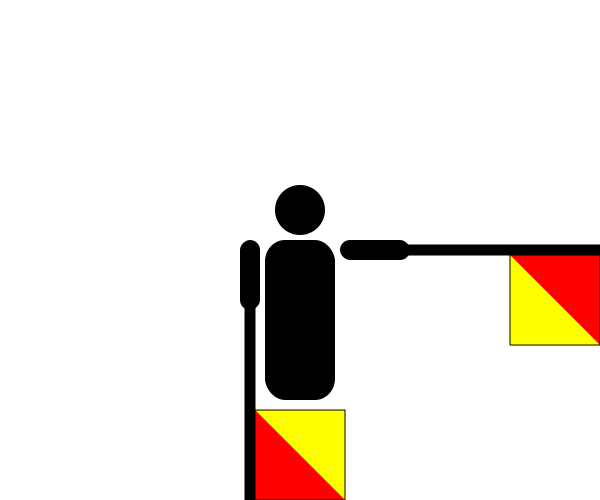


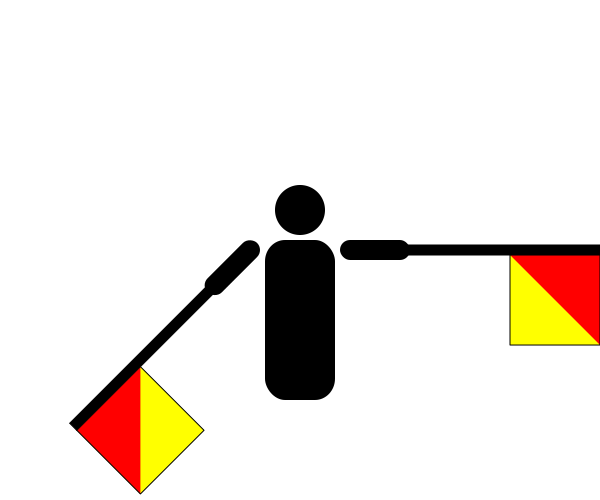

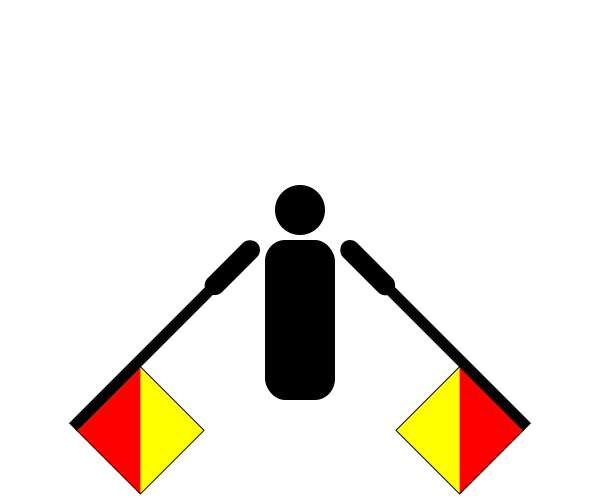
There are approximately 60 people named Feldmann in the UK. That makes it one of Britain's least common surnames. Only around one in a million people in Britain are named Feldmann.
